

Table of Contents
ToggleCENTRE TIGHTENS NORMS FOR FOREIGN CONTRIBUTIONS
TOPIC: (GS2) POLITY: THE HINDU
The Union Home Ministry has amended the Foreign Contribution Regulation Act (FCRA) Rules, 2010.
Highlights of Amendments
- Specified Categories & Activities: NGOs must register under five categories: social, economic, educational, cultural, and religious.
- For the first time, separate activity lists are notified for each category. Example: Educational category includes 22 activities but bars political awareness programmes.
- Religious category permits 16 activities like discourses, meditation retreats, burial ground maintenance (excluding proselytisation).
- Mandatory Disclosures: NGOs must declare Geographical scope of programmes. Websites, social media accounts, and publications (books, magazines, articles).
- Separate fees for each State/UT and category, replacing earlier singlefee system.
Expanded Definition of Key Functionary
- Includes trustees, partners, governing body members, HUF Karta, and anyone controlling the organisation.
- Associations with foreign nationals (except Persons of Indian Origin) as key functionaries are ordinarily ineligible unless specially permitted.
Penalties & Compliance
- Minimum fine: ₹1 lakh for violations.
- Misuse of funds or use in unapproved areas → penalty of 30% of misused amount or ₹1 lakh (whichever higher).
- Other violations: excess administrative spending, speculative investments, unauthorised receipts.
Rationale & Broader Context
- Aim: Uniformity in FCRA forms (FC) and avoidance of duplication.
- Builds on earlier amendments (2020) that capped administrative expenses at 20% and barred subgranting.
- Reflects global trend: many countries (e.g., USA’s Foreign Agents Registration Act) regulate foreign funding to prevent undue influence.
- Balances sovereignty, communal harmony, and transparency with NGO autonomy.
Why These Changes Were Needed
- Scale of Foreign Funding & Misuse Risks: 16,000 NGOs registered under FCRA collectively receive ₹22,000 crore annually in foreign contributions.
- Registration Gaps: Earlier rules lacked clarity on management of assets created from foreign contributions after cancellation or surrender of registration.
- Transparency & Accountability Deficit: Lack of uniform disclosure norms led to duplication and weak monitoring.
- Inconsistent Penalties: Previous framework had overlapping investigations and inconsistent penalties for violations. Penalties were often inadequate compared to the scale of misuse.
Impact of Amended FCRA Rules on NGOs
- Greater Scrutiny & Accountability: Over 16,000 NGOs registered under FCRA collectively receive around ₹22,000 crore annually in foreign contributions (MHA data, 2025).
- Strict Alignment with Categories & Geography: NGOs must operate only within five permitted categories: social, economic, educational, cultural, and religious.
- Reduced Flexibility but Enhanced Transparency: NGOs must declare key functionaries, now expanded to include trustees, partners, and governing body members.
- Shift Towards Domestic Funding Sources: With tighter foreign inflows, NGOs are encouraged to tap CSR funds, local donors, and government schemes. India’s CSR spending crossed ₹25,000 crore in FY 2025 (MCA data), offering a significant domestic pool.
Conclusion
The new FCRA norms mark a shift towards tighter regulation and transparency, reinforcing India’s sovereignty while reshaping the operational landscape for NGOs.
RECONNECT PUBLIC HEALTH WITH PEOPLE’S NEEDS
TOPIC: (GS2) POLITY: THE HINDU
Recently, concerns have been raised that Ayushman Bharat Health & Wellness Centres and the Digital Health Mission are not adequately addressing people’s real health needs.
Ayushman Bharat Initiative
Launch & Objective
- Introduced in 2018 by the Government of India.
- Aim: Provide comprehensive healthcare services (preventive, promotive, curative, rehabilitative, palliative) and financial protection against high medical costs.
- Designed to reduce OutofPocket Expenditure (OOPE), which still accounts for ~48% of total health spending in India.
Two Major Components
- Health & Wellness Centres (HWCs)
- Transform existing SubCentres, PHCs, CHCs into HWCs.
- Provide primary care services: maternal & child health, NCD screening, essential drugs, diagnostics, and health promotion.
- Target: 1.5 lakh HWCs across India.
- Pradhan Mantri Jan Arogya Yojana (PMJAY)
- World’s largest governmentfunded health insurance scheme.
- Coverage: ₹5 lakh per family per year for secondary and tertiary care.
- Beneficiaries: ~50 crore people (based on SECC 2011 data, NFSA lists, and vulnerable groups).
- Cashless treatment at empanelled hospitals nationwide.
Recent Expansions & Achievements
- In 2024, coverage extended to all senior citizens aged 70+, irrespective of income. As of 2026, PMJAY is operational in all 28 states and 8 UTs.
- States like Odisha (2025), Delhi (2025), West Bengal (2026) joined recently, expanding reach to millions more families.
- PM Modi highlighted savings of ₹2.25 lakh crore in medical expenses for poor and middleclass families through Ayushman Cards and Jan Aushadhi Kendras.
Digital Integration – ABHA Card
- Under the Ayushman Bharat Digital Mission (ABDM), citizens receive a unique 14digit Ayushman Bharat Health Account (ABHA) number.
- Enables digital health records, linking lab reports, prescriptions, and hospital visits.
- Strengthens India’s move towards a digital health ecosystem.
Challenges in India’s Public Health Policy
- Universal Health Coverage vs Reality: Despite PMJAY covering 50 crore beneficiaries, hospitalisation rates remain lower than 2014 levels (NSO survey).
- India’s OutofPocket Expenditure (OOPE) is still 48% of total health spending (NHA 2023), among the highest globally.
- Ayushman Bharat Health & Wellness Centres (2018): Unlike measurable indicators (e.g., Maternal Mortality Ratio – 97 per 100,000 live births in 2020, Immunisation coverage ~76% NFHS5), wellness lacks clear metrics.
- Grassroots institutions like SCs, PHCs, CHCs renamed as “Wellness Centres,” creating ambiguity in mandate. Shifted focus from population health outcomes to individual wellbeing, which is subjective and hard to measure.
- Digital Health Mission (ABDHM): Introduced ABHA card and digital health records. budget ~₹300 crore annually. Focuses on data generation (registries of facilities, professionals, insurance).
- India spends only 2.1% of GDP on health (202425 budget), far below WHO’s recommended 5%. Example: Doctorpopulation ratio ~1:1,500, worse than WHO norm of 1:1,000.
Broader Dimensions
- Equity: Policies must address social determinants (poverty, caste, gender).
- Global Lessons: Countries like Thailand achieved UHC by strengthening primary care institutions, not just insurance.
- Fiscal Priority: India’s health budget allocation remains below 1.5% of total expenditure, limiting systemic reforms.
Strong Conclusion
India’s public health must reconnect with people’s felt needs by strengthening grassroots institutions and focusing on measurable population outcomes, not just wellness narratives or digital records.
FROM INVENTION TO GLOBAL SCALE
TOPIC: (GS3) SCIENCE AND TECHNOLOGY: THE HINDU
Recently, industry leaders highlighted that India must move beyond invention and focus on scaling innovations globally in sectors like semiconductors, AI, quantum computing, and space.
India’s Technology Journey
- Early Vision but Limited Scale: India set up Semiconductor Complex Limited (SCL) in 1976, anticipating the digital age.
- Unlike Taiwan’s TSMC and South Korea’s Samsung, India failed to scale due to limited capital, inconsistent policy, and inwardfocused public sector strategy.
- Electronics Corporation of India Ltd (ECIL) (1967) built indigenous computers and control systems during technology embargoes. Focus stayed on strategic needs, not global commercial markets.
- The Simputer (1998) anticipated smartphone features but lacked venture capital, supply chains, and consumer markets. Apple later scaled the iPhone into a $3 trillion ecosystem, showing the importance of global scalability.
Pharma & Computing
- India’s pharmaceutical industry became the “pharmacy of the world,” producing 60% of global vaccines.
- PARAM supercomputers (1990s) showcased indigenous computing strength.
- These examples highlight how scale and ecosystem building can convert innovation into global leadership.
Digital Platforms
- Aadhaar enabled identity verification for over 1.3 billion citizens.
- UPI transformed financial inclusion, processing 16,416 crore transactions in FY 202324.
- These platforms prove that designing for scale can reshape governance and create globally admired models.
Current Opportunities for India’s Tech Leadership
Artificial Intelligence (AI)
- India has strong capabilities in software engineering and digital infrastructure. The challenge is to build globally scalable AI products.
- India can democratise AI like UPI, which processed 16,416 crore transactions in FY 202324, transforming financial inclusion.
Quantum Computing
- India should focus on reducing costs of quantum infrastructure and developing practical applications in healthcare, materials science, climate modelling, and drug discovery.
- Under the National Quantum Mission (2023), India aims to build 50–1000 qubit systems by 2031, positioning itself as a global player in nextgen computing.
Space Technologies
- Achievements like Chandrayaan3 (2023) and Mangalyaan (2014) highlight India’s ability to combine frugal innovation with worldclass ambition.
- Future opportunities include spacebased data centres, orbital computing, and quantum communication networks.
Scaling Innovation into Global Ecosystems
- Past lessons show invention alone is insufficient; ecosystem building and scale are critical.
- Success stories like India’s pharma industry (60% of global vaccines) and Aadhaar/UPI platforms prove that designing for scale creates global leadership.
- India must replicate this model in AI, quantum, and space technologies to avoid repeating the missed opportunities of SCL and Simputer.
Challenges
- Low R&D Spending: India spends only 0.7% of GDP on R&D (UNESCO, 2024) compared to 2.4% in China and 2.8% in the U.S..
- Semiconductor Ecosystem Gaps: India set up SCL in 1976, but failed to scale due to capital shortages and policy inconsistency. Global leaders like TSMC (Taiwan) and Samsung (South Korea) dominate with >50% global market share, while India’s share remains negligible.
- Weak Venture Capital & Startup Funding: India attracted $9.6 billion VC funding in 2023, far below China’s $40 billion and U.S. $150 billion.
- Digital Divide & Infrastructure Limitations: Despite 1.3 billion Aadhaar enrollments and UPI’s 16,416 crore transactions in FY 202324, rural areas still face internet penetration below 50% (TRAI, 2024).
- Human Capital & Skill Shortages: India produces 1.5 million engineers annually, but only 25% are employable in emerging tech sectors (NASSCOM, 2024).
- Space & Quantum Funding Constraints: ISRO’s annual budget is ~$1.6 billion, far below NASA’s $25 billion or China’s $12 billion.
Conclusion
India’s technological future depends not just on inventing first, but on scaling best — this time, it must do both.
RSS AND THE DEBATE ON LEGAL STATUS
TOPIC: (GS2) POLITY: THE HINDU
Recently, Karnataka Home Minister Priyank Kharge questioned the legal status of the Rashtriya Swayamsevak Sangh (RSS), asking why it operates without formal registration.
What is a Legal Person?
- Defined by jurist John Salmond: a person is any being capable of rights and duties.
- Two types:
- Natural person: living human beings.
- Artificial/Juridical person: entities created by law (e.g., companies, societies, trusts).
- Under Section 9, Companies Act 2013, registered companies can sue and be sued, hold property, and have perpetual succession.
RSS’s Organisational Nature
- RSS describes itself as a voluntary sociocultural body of individuals, not a registered corporate entity.
- Court recognition:
- CIT v RSS (1994, Patna HC): RSS treated as an “association of persons”; donations (gurudakshina) exempted from tax.
- Singhai Lal Chand Jain v RSS (1996, SC): RSS named as a party in eviction proceedings, represented by officebearers.
- Under Section 2(31), Income Tax Act 1961, a “body of individuals” (incorporated or not) is treated as a taxable entity.
Registration Options for Voluntary Associations
- In India, voluntary bodies can register as:
- Society under the Societies Registration Act, 1860.
- Trust under the Indian Trusts Act, 1882.
- Section 8 Company under the Companies Act, 2013.
- Registration provides legal personality, enabling organisations to own property, sue, and be sued.
Donations and FCRA Compliance
- RSS donations often termed gurudakshina, exempted from tax in past rulings.
- Under FCRA 2010, foreign contributions require registration under an existing statute (Society, Trust, Section 8 Company).
- RSS itself is not registered, but affiliated organisations (e.g., ABVP registered in 1949, Bharatiya Mazdoor Sangh, Vidya Bharati) operate as legal entities under relevant laws.
Regulatory Gap Highlighted
- Unregistered bodies like RSS cannot sue or be sued in their own name; they rely on officebearers for representation.
- Raises questions of accountability, transparency, and compliance in funding and governance.
- Debate reflects tension between voluntary sociocultural identity and legal recognition requirements for large organisations.
Broader Dimensions
- Comparative Insight: Many large voluntary organisations globally (e.g., churches, unions) are registered for accountability.
- UPSC Angle: Highlights issues of legal personality, tax law, FCRA compliance, and governance of sociopolitical organisations.
- Policy Question: Should India mandate registration for all mass organisations to ensure transparency in donations and operations?
Conclusion
The RSS debate underscores India’s regulatory gap—large voluntary organisations wielding national influence must balance their sociocultural identity with legal accountability and transparency.
BAN ON TELEGRAM AND EXPANSIVE INTERPRETATION OF IT ACT
TOPIC: (GS2) POLITY: THE HINDU
Recently, the Union government temporarily banned Telegram ahead of the NEET (UG) retest, interpreting the entire platform as “information” under the IT Act, 2000.
Legal Basis of the Ban
- Section 2(1)(v), IT Act defines “information” as data, text, images, sound, codes, software, and databases.
- Government argued that Telegram as a platform is an “aggregation” of these units, thus qualifies as “information”.
- Section 69A, IT Act empowers blocking of public access to “information” via computer resources.
- Court endorsed that blocking power extends to software architecture, codebase, databases, and programmatic ecosystem of an app.
Telegram’s Objection
- Telegram argued that Section 69A allows blocking of specific content only, not entire platforms.
- Ban disproportionately affected 150 million users, including students and educators using Telegram for NEET preparation.
- Relied on Supreme Court’s Anuradha Bhasin case (2020), restrictions on fundamental rights must be proportionate and adopt the least restrictive measure.
Broader Dimensions
- Digital Governance: Raises questions on whether India’s IT Act provisions are being stretched beyond their intended scope.
- Civil Liberties: Highlights tension between national security/exam integrity and freedom of speech & access to digital platforms.
- Global Comparison: Other democracies (e.g., EU) prefer targeted takedowns of unlawful content rather than blanket bans on platforms.
- UPSC Angle: Illustrates how legal interpretation, technology regulation, and fundamental rights intersect in governance.
Conclusion
India’s ban on Telegram shows how expansive legal interpretation can reshape digital freedoms, underscoring the need for proportionate, transparent, and accountable regulation in the digital age.
EL NINO
TOPIC: (GS1) GEOGRAPHY: THE HINDU
Recently, Union Agriculture Minister held a highlevel meeting on the El Niñoinduced weak monsoon, noting rainfall is 43% below normal.
Scale of Vulnerability
- 315 districts assessed as vulnerable to weak monsoon.
- 111 districts (high priority) → irrigation coverage below 25%.
- 76 districts (medium priority) → irrigation coverage between 25–50%.
- 128 districts (low priority) → relatively better irrigation facilities.
- States affected: Madhya Pradesh, Maharashtra (20 districts), Gujarat, Uttar Pradesh, Rajasthan, Karnataka, Bihar, Jharkhand, Telangana, Andhra Pradesh, Odisha.
Risks to Agriculture
- Weak rainfall threatens Kharif crops, especially in rainfed regions.
- Agriculture in these districts is heavily dependent on monsoon rains.
- Delay in sowing and reduced water availability could impact food security and rural incomes.
Government Response
- District Agriculture Contingency Plans (ICAR) prepared → tailored to local climate, cropping patterns, and water resources.
- Measures include:
- Alternative crops suited to low rainfall.
- Crop diversification strategies.
- Optimum use of water resources.
- Additional income opportunities for farmers.
- Water conservation & harvesting under MGNREGA and upcoming VBGRAMG rural programmes to combine employment generation with water storage capacity.
Broader Dimensions
- Climate Change Link: El Niño events are becoming more frequent, intensifying risks for rainfed agriculture.
- Policy Angle: Highlights need for climateresilient farming models like Community Natural Farming (APCNF).
- UPSC Relevance: Connects environment, agriculture, and rural development policies with disaster preparedness.
EL NINO
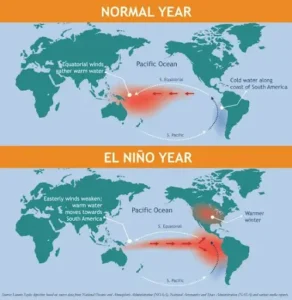
El Niño is part of the El Niño–Southern Oscillation (ENSO) cycle. It occurs when Pacific Ocean waters near South America warm up by more than +0.5°C for several months.
- This warming changes wind patterns (trade winds weaken or reverse) and shifts rainfall across the globe.
How It Forms
- Normally, trade winds push warm water westwards toward Indonesia.
- During El Niño, these winds weaken → warm water flows back east toward South America.
- This disrupts the balance between warm and cool ocean regions, altering weather worldwide.
Global Impacts
- South America & USA → heavy rains, floods.
- India, Southeast Asia, Australia → weak monsoon, droughts, crop losses.
- Marine life → fish die or migrate due to warmer waters; coral reefs suffer bleaching.
Frequency & Duration
- Happens every 2–7 years.
- Lasts about 9–12 months, sometimes longer.
- Strong events (like 1997–98, 2015–16) caused major global disruptions.
Why It Matters for India
- India’s agriculture depends heavily on the southwest monsoon.
- El Niño often leads to belownormal rainfall, affecting Kharif crops like rice, pulses, and oilseeds.
- Example: 2015 El Niño caused one of India’s worst droughts in recent decades.
Conclusion
India must strengthen irrigation, diversify crops, and integrate climateresilient strategies to safeguard farmers against El Niñodriven monsoon shocks.
NIRBHAY CHETNA
TOPIC: (GS2) POLITY: THE HINDU
Recently, the Central Government launched the Nirbhay Chetna Initiative to sensitise 17.5 lakh male elected representatives across Panchayati Raj Institutions.
Initiative
- Nodal Ministry: Ministry of Panchayati Raj.
- Implemented under the Nirbhaya Fund — India’s flagship fund for women’s safety.
- Aims to build awareness, accountability, and leadership among male representatives to promote gender equality and women’s safety.
- Seeks to make Panchayati Raj Institutions more genderresponsive and inclusive in decisionmaking.
Components of Nirbhay Raho
- Nirbhay Chetna: Sensitises male elected representatives on women’s safety and gender equality. Develops a cadre of 28,500 Master Trainers at State, district, and block levels to reach 17.5 lakh men nationwide.
- Nirbhay Netri: Focuses on capacitybuilding and legal awareness among elected women representatives.
- Nirbhay Drishti: Plans CCTV installation at strategic rural points to strengthen technologyenabled safety infrastructure in Panchayats.
Broader Perspective
- Promotes genderinclusive governance aligned with SDG 5 (Gender Equality).
- Encourages communitylevel behavioural change among men — a firstofitskind national effort.
- Supports India’s vision of Viksit Bharat 2047 through safer, equitable rural spaces.
Conclusion
The Nirbhay Chetna Initiative marks a major step toward transforming grassroots governance into a gendersensitive framework, empowering both men and women to ensure safety and equality in rural India.
SARINDA
TOPIC: (GS1) INDIAN ART AND CULTURE: THE HINDU
Recently, the traditional Tripura Sarinda received the Geographical Indication (GI) tag, recognising its cultural and artistic uniqueness.
About Sarinda
- Sarinda is a bowed string instrument carved from a single block of wood with a hollow resonator.
- It is deeply linked to Tripura’s tribal and folk communities, used in rituals, dances, and musical performances.
- Locally known as Sarinda Uakhrap, it symbolises the musical identity of Tripura’s indigenous culture.
Key Features
- Made primarily from bamboo and wood, with an ovalshaped vibrating chamber covered by thin animal skin.
- The top portion is wider and open; the waist is narrow.
- Measures about 65–70 cm in length.
- Equipped with three pegs to fasten strings made of metal, Muga silk thread, or animal gut.
- Played using a bow of horsehair, producing a rustic, resonant tone.
Cultural and Economic Significance
- The GI tag protects traditional artisans and promotes rural livelihoods through cultural tourism.
- Reinforces India’s commitment to preserving intangible heritage under the Geographical Indications of Goods Act 1999.
- Other GItagged items from Tripura include Tripura Queen Pineapple, Risa and Pachra (Rignai), and Matabari Peda.
Conclusion
The Sarinda’s GI recognition celebrates Tripura’s rich folk artistry and ensures that its indigenous musical legacy continues to resonate across generations.