

Table of Contents
ToggleWATER SECURITY AND VIKSIT BHARAT
TOPIC: (GS1) GEOGRAPHY: THE HINDU
Union Jal Shakti Minister highlighted that flagship schemes are transforming India’s water and sanitation landscape, making water security a cornerstone for achieving Viksit Bharat.
What is Water Security?
- The UN defines it as the capacity of a population to safeguard sustainable water supply, protect against water hazards, and preserve ecosystems.
- It also includes protection against waterrelated risks like floods, droughts, and pollution.
Transformation in Water Sector
Jal Jeevan Mission
- World’s largest rural drinking water programme.
- In 2019, only 17% rural households (3.23 crore) had tap water.
- By 2026, 15.8 crore households (81%) have access; target is 100% by 2028.
- Saves 5.5 crore personhours daily, empowering women and reducing waterborne diseases.
Swachh Bharat Mission
- World’s largest rural sanitation movement.
- WHO estimates 3 lakh diarrhoea deaths averted (2014–2019) due to SBMGrameen.
- SBM 2.0 focuses on solid & liquid waste management for sustainable villages.
- Toilets improved dignity, privacy, and safety for rural women.
Water Conservation & River Projects
Groundwater Recharge
- Under Jal Sanchay Jan Bhagidari, 1.55 crore rainwater harvesting structures built till May 2026.
- Reduced number of overexploited groundwater units, showing positive trends.
River Linking & Namami Gange
- Ken–Betwa Project: India’s first major river interlinking, bringing water to Bundelkhand.
- Namami Gange Programme:
- Sewage treatment capacity expanded to 4,260 MLD.
- Biochemical Oxygen Demand reduced from 26 TPD (2017) to 10.75 TPD (2024).
- Effluent discharge reduced from 349 MLD to 265.56 MLD.
- Water quality now meets bathing standards at monitored sites.
Broader Picture
- Population–Resource Imbalance: India has 18% of global population but only 4% of freshwater resources (FAO, 2025). This mismatch creates longterm stress on water security.
- Climate & Urbanisation Pressure: Changing rainfall patterns, rising temperatures, and rapid urban growth are intensifying demand for water in agriculture, industry, and cities.
- Integrated Approach Needed: Drinking water, sanitation, irrigation efficiency, conservation, wastewater reuse, and climate resilience must be treated as one connected ecosystem.
- Global Lesson: Countries like Israel (water recycling) and Singapore (NEWater project) show that community participation + political will can reverse environmental stress.
Road Ahead
- Improve Efficiency: Agriculture consumes nearly 80% of India’s freshwater; microirrigation coverage must expand beyond current 11.7 million hectares (MoA, 2025).
- Promote Recycling: India generates 72,000 MLD of wastewater, but only 30% is treated (CPCB, 2024). Scaling reuse can ease urban water stress.
- Strengthen Governance: Establish National Water Informatics Centre and enforce accountability in schemes like Atal Bhujal Yojana for groundwater management.
- Citizen Participation: Success of Jal Sanchay Jan Bhagidari (1.55 crore recharge structures) shows that local communities are key to sustainable outcomes.
UN MEASURES & GLOBAL PRACTICES
- UN SDG6 (Clean Water & Sanitation): Calls for universal access to safe water by 2030.
- World Bank “Water Forward” Strategy: Aims to improve water security for 400 million people globally by 2030, with India as a key focus .
- Global Techniques:
- Israel: Recycles 85% of wastewater for agriculture.
- Singapore’s NEWater Project: Produces ultraclean water from treated wastewater, meeting 40% of demand.
- China’s Sponge Cities: Urban design absorbs rainwater to reduce flooding and recharge aquifers.
Conclusion
Water security is not just a utility goal but the foundation of a resilient and developed India.
ANDHRA PRADESH’S CASH INCENTIVE FOR MORE CHILDREN
TOPIC: (GS2) POLITY: THE HINDU
On May 16, 2026, Andhra Pradesh CM announced cash incentives of ₹30,000 for the third child and ₹40,000 for the fourth under the State’s new population management policy.
Fertility in Andhra Pradesh
- NFHS6 (202324): State fertility rate is 1.8, below the replacement level of 2.1.
- India’s trajectory: Population decline is not imminent; UN projects India’s population to stabilise and decline only by 2063.
- Global comparison: Japan and South Korea had belowreplacement fertility since the 1980s, but population decline began only around 2010–2020.
Limitations of Cash Incentives
- Hospitalisation Costs: Incentive equals average childbirth cost in rural areas but is inadequate for Csections in private hospitals, where 52% of deliveries occur.
- Monthly Consumption: For a family of five, incentive is about 1.5 times rural MPCE or equal to urban MPCE (NSO Household Consumption Survey, 202324). It covers only one month’s expenses.
- Childcare Burden: Education, healthcare, and housing costs far exceed onetime cash support.
Real Barriers to Larger Families
- UNFPA State of World Population Report 2025:
- Financial limitations are the prime barrier.
- Other concerns include housing shortages, unemployment/job insecurity, and lack of affordable childcare.
- Preference Shift: Majority of Indians prefer 1–2 children; less than 10% want 3 or more.
challenges
- Economic Dimension: Incentives do not address structural issues like rising education and healthcare costs.
- Social Dimension: Women’s empowerment and workforce participation are linked to smaller family size.
- Policy Dimension: Focus should be on child nutrition, maternal health, and social security, not pushing fertility artificially.
- Global Lesson: Countries like France and Singapore offer comprehensive family support (childcare, housing, parental leave) rather than onetime cash.
Way Forward
- Expand Ayushman Bharat, strengthen Jan Aushadhi Kendras, and improve public hospital infrastructure to reduce OOPE further.
- Scale up Anganwadi modernisation under POSHAN 2.0, and integrate affordable housing schemes like PMAYUrban with family welfare policies.
- Expand Skill India Mission for women, enforce equal pay, and incentivise companies to provide workplace childcare.
- Align with SDG3 (Health) and SDG5 (Gender Equality) for sustainable demographic planning.
Conclusion
Cash incentives alone cannot reverse fertility decline; only holistic socioeconomic reforms can ensure balanced population management.
RBI AND ITS GROWING FISCAL ROLE
TOPIC: (GS3) ECONOMY: THE HINDU
The Reserve Bank of India (RBI) approved a record ₹2.87 lakh crore surplus transfer to the Union government for FY26.
What is the Economic Capital Framework (ECF)?
- A framework that guides how the RBI manages its capital, reserves, and risk buffers to maintain financial stability.
- Purpose: Balances RBI’s need for resilience against shocks with the government’s need for surplus transfers.
- Origin: Recommended by the Bimal Jalan Committee (2019); adopted in RBI’s 578th Central Board meeting.
- Revision: First review in 2025, adjusting risk buffers to reflect global and domestic risks.
Key Features
- Contingent Risk Buffer (CRB): Must be maintained between 5.5%–7.5% of RBI’s balance sheet. For FY25, CRB was raised to 7.5%.
- Surplus Distribution Policy (SDP): Ensures smoother, predictable transfers to the government, avoiding abrupt spikes or cuts.
- Risk Provisioning: Covers market risk, credit risk, operational risk, and monetary/financial stability risks.
- Periodic Review: Mandated every 5 years to adapt to evolving macroeconomic conditions.
Related Laws & Institutional Basis
- RBI Act, 1934: Provides the legal foundation for RBI’s capital, reserves, and surplus transfers.
- Article 266 of the Constitution: Surplus transferred to the Consolidated Fund of India.
- Finance Commission Framework: Surplus transfers are nontax revenue, hence not part of divisible pool shared with States.
- Economic Capital Framework (2019): Institutionalised after the Bimal Jalan Committee report to formalise surplus transfer rules.
Why ECF Matters
- For RBI: Ensures adequate capital to maintain monetary and financial stability.
- For Government: Provides a predictable fiscal inflow without new taxes or borrowing.
- For Economy: Protects against external shocks (exchange rate volatility, inflation, global crises).
- Global Comparison: Similar frameworks exist in ECB, US Fed, and Bank of England, but India’s model is unique in linking surplus transfers directly to fiscal planning.
Structural Shift in Surplus Transfers
- Past Levels: Surplus transfers were around ₹30,000–65,000 crore before 2019.
- Economic Capital Framework (2019): Revised rules allowed higher transfers.
- FY26 Record: ₹2.87 lakh crore, larger than annual budgets of several States.
- Balance Sheet Growth: RBI’s assets grew 20.6% in one year to ₹91.97 lakh crore, with gross income rising 26%.
Fiscal Implications
- Government Financing: Surplus transfers provide fiscal space without new taxes or borrowing, easing budgetary pressures. The FY26 transfer of ₹2.87 lakh crore is larger than the annual budgets of several States.
- Nature of Income: Major earnings now come from foreign exchange reserves, gold sales, forex transactions, and securities holdings, reflecting RBI’s growing role in fiscal outcomes.
- Comparison: Unlike advanced economies where central banks relied on quantitative easing (bond purchases), India’s fiscalisation stems from reserve management profits, a unique path in monetaryfiscal interaction.
Federal Blind Spot
- NonTax Revenue: RBI transfers are classified as Union nontax revenue, hence excluded from the divisible pool under Finance Commission devolution.
- States’ Constraints: States face borrowing limits under Article 293 of the Constitution, while expenditure responsibilities in health, education, and infrastructure continue to rise.
- Trend: Alongside cesses, surcharges, and borrowing restrictions, large RBI transfers reinforce fiscal centralisation, reducing States’ fiscal autonomy.
Broader Dimensions
- Economic: Surplus transfers reduce borrowing needs but may weaken incentives for tax reforms and revenue mobilisation.
- Institutional: RBI’s role is shifting from a monetary guardian to a fiscal supporter, raising concerns about central bank independence.
- Federalism: Exclusion of such large transfers from devolution undermines the Finance Commission’s principle of equitable distribution.
- Global Lesson: In democracies, central banks must balance stability and autonomy; excessive fiscalisation risks credibility and investor confidence.
Way Forward
- Transparency: Establish clear rules for surplus transfer mechanisms under the Economic Capital Framework (2019, revised 2025).
- Strengthen Federalism: Revisit devolution formulas to ensure balanced fiscal space for States.
- Institutional Distance: Safeguard RBI’s autonomy by limiting fiscal pressures on monetary policy.
- LongTerm Stability: Align RBI’s role with monetary stability and inflation control, rather than shortterm fiscal needs.
Conclusion
RBI’s rising fiscal role strengthens government finances but challenges central bank independence and India’s federal balance.
HEALTH DATA MUST DRIVE ACTION, NOT JUST HEADLINES
TOPIC: (GS2) POLITY: THE HINDU
Recently released NFHS6, NSO highlight India’s health challenges. However, experts argue that survey findings are celebrated as headlines but rarely translated into timely policy action.
How NFHS Data Can Be Used
- Policy Planning: Provides nationally representative data on fertility, mortality, nutrition, and health to design schemes like POSHAN 2.0 and Ayushman Bharat.
- Monitoring SDGs: Tracks progress on SDG3 (Health) and SDG5 (Gender Equality).
- Targeted Interventions: Identifies lagging states/districts for corrective action in child nutrition, maternal health, and sanitation.
- Budgetary Linkages: Shapes health budgets and resource allocation, e.g., higher spending on primary care and drug procurement.
ActionBased Developments from Previous NFHS Data
- Anaemia Control: NFHS4 showed 58% women anaemic, led to Anaemia Mukt Bharat (2018).
- Maternal Health: NFHS4 data on institutional deliveries (79%), strengthened Janani Suraksha Yojana and LaQshya programme for safe childbirth.
- Nutrition: NFHS5 revealed 35.5% child stunting, prompted reforms in POSHAN Abhiyaan and fortified food distribution.
- Sanitation: NFHS4 data on open defecation supported Swachh Bharat Mission, raising household toilet coverage.
Challenges
Ritualistic Response
- Government highlights achievements, media amplifies numbers, academics await raw data, and industry sees market opportunities.
- Example: NFHS6 findings on obesity and diabetes became business prospects for gyms, apps, and diagnostics rather than triggers for public health reform.
Delay in Data Release
- NFHS6 data collected in 202324, but released in 2026, allowing governments to claim credit for positives and dismiss negatives as “old data”.
- Late release of raw data delays academic analysis by 3–5 years, weakening policy impact.
Missed Opportunities
- Anaemia prevalence remains high, yet responses are limited to reports instead of programmatic correction.
- Outofpocket expenditure continues to burden households, but budgetary allocations remain unchanged.
Way forward
- Rapid Action Notes: Within 30–45 days of survey release, action notes must be prepared linking findings to programmes. NFHS6 shows 67% children under 5 anaemic, demanding urgent POSHAN 2.0 interventions.
- State Review Mechanisms: Conduct working sessions with officials and experts focusing on corrective measures. Outofpocket expenditure still 48% of total health spending (NHA 202223), far above global average (~18%).
- Integrated & Early Data Systems → Combine NFHS, HMIS, and IHIP data; release raw data early for quick analysis. NFHS6 data collected in 202324, released only in 2026, reducing policy relevance.
- Budgetary Linkages: Survey findings must shape health budgets. Stat: India spends 2.1% of GDP on health (Economic Survey 202324) vs WHO’s recommended 5%; NCDs cause 63% of deaths (WHO 2023) yet preventive care gets <20% of budget.
Broader Dimensions
- International Best Practice: Countries like Thailand and Brazil link survey findings directly to budgetary planning.
- Indian Context: Schemes like Ayushman Bharat Digital Mission and IHIP can be leveraged for realtime monitoring.
- Civil Society Role: NGOs and academic institutions can prepare policy briefs within weeks of data release.
Conclusion
Health surveys must act as instruments of accountability and course correction, not just sources of headlines.
INDIA’S INNOVATION IMPERATIVE
TOPIC: (GS3) SCIENCE AND TECHNOLOGY: THE HINDU
At the “Bharat Innovates 2026” event in France highlights how India must push innovation to the global frontier or risk being left behind in global technology competition.
India’s Innovation Potential
- Indian talent pool: Indian professionals already lead global firms (e.g., Sundar Pichai at Google, Satya Nadella at Microsoft).
- Domestic ecosystem: Events like Bharat Innovates 2026 show that incubation of startups in deep tech, AI, defence, and space can yield globally competitive results.
- Middle power collaboration: Partnerships with nations like France strengthen India’s innovation ecosystem.
Challenges in Frontier Innovation
- High capital requirement: Frontier AI and semiconductor research demand tens of billions of dollars, making bruteforce entry difficult.
- Policy uncertainty: Tax unpredictability and rentseeking discourage innovators.
- Talent drain: Many top minds migrate abroad due to lack of quality urban infrastructure and research opportunities.
- Global restrictions: Recent bans on advanced AI models (e.g., Anthropic’s Claude Mythos) for nonAmericans show India’s vulnerability in tech dependence.
Pathways for India
- Stable Capital Environment: Clear tax policies and transparent venture capital rules. Encourage risk capital for exploratory projects.
- Talent Retention: Invest in public goods: clean air, green spaces, reliable transport. Create attractive living conditions for innovators to stay in India.
- Strategic Sectors: Focus on space exploration, defence technology, material sciences where competition is open.
- ISRO’s Chandrayaan3 success shows India can achieve frontier innovation with limited resources.
- Policy Discipline: Treat innovation as a national mission. Link schemes like Startup India, Atal Innovation Mission, and Digital India with frontier research.
Govt initiatives
- IndiaAI Mission: Launched in 2024 with ₹10,300 crore, expanding compute power to 34,000+ GPUs, building indigenous AI models, datasets, and startup support.
- BharatGen Consortium: Led by IIT Bombay, funded with ₹1,058 crore, developing openweight multilingual and multimodal AI models for Indian languages and sectors.
- Sarvam AI: Bengaluru startup valued at $1.5 billion, building large language models (LLMs) and voicenative AI tailored for India’s diverse linguistic needs.
- India–France Innovation Roadmap 2030: Strengthens collaboration in AI, startups, and digital infrastructure, with joint projects and talent exchange (France to host 30,000 Indian students by 2030).
Conclusion
India must innovate to the frontier or risk being sidelined in the global knowledge economy.
NICOBARESE TRIBAL COUNCILS AND DRAFT ELECTION RULES
TOPIC: (GS2) POLITY: THE HINDU
Nicobarese tribal councils from Little & Great Nicobar, Kamorta, and Katchal Islands have formally opposed the draft election rules notified by the Andaman & Nicobar.
Current System in Nicobar
- Consensus-Based Governance: Tribal councils select leaders (Captains, First Captains, Chief Captains) through community consensus and customary practices, not through ballots.
- Kinship & Tradition: Leadership is rooted in clan ties and collective decision-making, seen as closer to participatory democracy than competitive elections.
- Flexibility: Councils meet and decide as per community needs, without fixed electoral cycles.
What the New Draft Rules Propose
- Formal Elections: Introduction of five-yearly elections for village and island tribal councils.
- Constituency Delimitation: Villages to be reorganised into electoral constituencies.
- Electoral Rolls: Preparation of voter lists under the supervision of the Election Commission.
- Structured Hierarchy:
- Villagers elect Captains.
- Direct voting for Chief Captain of each Island Council.
- Vice-Chief Captain chosen by First Captains.
- Women’s Reservation: Mandatory reservation of seats and leadership positions for women.
- Administrative Oversight: A Director of Tribal Council Elections to oversee polls; district administration retains veto powers under the 2009 Regulation.
Tribal Councils’ Concerns
- Risk of Division: Elections may introduce rivalry, factionalism, and conflict in a closeknit tribal society.
- Cultural Autonomy: Councils argue their timetested governance practices have ensured stability for centuries.
- Democratic Values: Claim that consensusbased decisionmaking is more participatory than competitive elections.
- External Interference: Fear that stateimposed rules undermine constitutional protections for Scheduled Tribes under Article 371A/ Sixth Schedulelike safeguards.
Way Forward
- Respect tribal autonomy while ensuring accountability.
- Explore hybrid models: consensus governance with limited electoral oversight.
- Strengthen consultation mechanisms before imposing reforms.
- Align with UN Declaration on the Rights of Indigenous Peoples (UNDRIP) which emphasises selfdetermination.
TRIBAL COUNCILS
Tribal councils are representative bodies of Scheduled Tribes that advise on welfare and protect tribal interests.
Constitutional Basis:
- Article 244: Provides special administration for Scheduled Areas.
- Fifth Schedule: Applies to tribal areas in 9 states; Governor constitutes a Tribes Advisory Council (TAC).
- Sixth Schedule: Applies to Assam, Meghalaya, Mizoram, Tripura; provides Autonomous District Councils (ADCs) with legislative, judicial, and financial powers.
Composition:
- TAC (Fifth Schedule): Consists of not more than 20 members, threefourths must be elected from State Legislative Assembly representatives of Scheduled Tribes.
- ADCs (Sixth Schedule): Members elected directly; some nominated by Governor.
Functions:
- Safeguard tribal customs, traditions, and social practices.
- Advise Governor on matters relating to land alienation, forest rights, and resource management.
- Exercise powers of lawmaking, taxation, and administration of justice in Sixth Schedule areas.
Governor’s Role:
- Governor has special responsibility in Fifth Schedule areas.
- Can modify or annul laws of Parliament/State Legislature in Scheduled Areas.
- Must consult TAC before making regulations affecting tribal welfare.
Conclusion
Imposing elections on Nicobarese councils risks eroding traditional consensus governance; reforms must balance democratic accountability with tribal autonomy.
GRAPES3 TELESCOPE
TOPIC: (GS3) SCIENCE AND TECHNOLOGY: THE HINDU
Recently, scientists from Mumbai, Kochi, and Japan used the GRAPES3 telescope to study how the Earth’s upper atmosphere temperature and the Sun’s magnetic field influence muons (subatomic particles) reaching the planet.
GRAPES3 Telescope
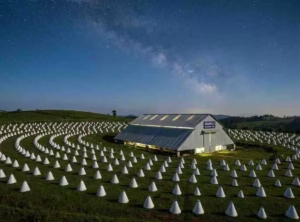
- Full Form: Gamma Ray Astronomy PeV EnergieS phase3.
- Objective: To investigate the origin, acceleration, and propagation of cosmic rays by measuring extensive air showers.
- Phenomena Studied: Solar activity and thunderstorm effects using muon detection.
- Technology: Uses an array of plastic scintillator detectors. Employs a large muon detector based on proportional counters.
- Location: Situated in Ooty, Tamil Nadu.
- Institution: Operated by the Tata Institute of Fundamental Research (TIFR).
Cosmic Rays
- Discovered over 100 years ago; considered the most energetic particles in the universe.
- Earth is constantly bombarded by them uniformly from all directions.
- On entering the atmosphere, they produce particle showers (electrons, photons, muons, protons, neutrons).
- Travel nearly at the speed of light.
- Observed across a wide energy range: 10⁸ to 10²⁰ eV.
- Important for understanding astrophysics, particle physics, and atmospheric science.
Broader Significance
- Enhances India’s role in global cosmic ray research.
- Provides insights into solarterrestrial interactions and climate science.
- Supports international collaboration with Japanese institutions.
- Links to India’s broader scientific missions like ISRO’s space weather studies and neutrino observatories.
Conclusion
GRAPES3 strengthens India’s position in highenergy astrophysics, offering vital clues about cosmic rays and their impact on Earth’s atmosphere.
JOINT CREDITING MECHANISM
TOPIC: (GS3) ENVIRONMENT: THE HINDU
India and Japan have recently adopted the Rules of Implementation for the Joint Crediting Mechanism (JCM) under Article 6.2 of the Paris Agreement, marking a new step in bilateral climate cooperation.
Joint Crediting Mechanism
- Origin: Proposed by Japan in 2013 as a bilateral climate initiative.
- Objective: To promote the spread of lowcarbon technologies and infrastructure through Japanese investment, while supporting sustainable development in partner countries.
- Legal Basis: Implemented under Article 6 of the Paris Agreement; complements existing mechanisms like the Clean Development Mechanism (CDM) and Joint Implementation (JI).
- NDC Contribution: Helps both India and Japan meet their Nationally Determined Contributions (NDCs) by quantifying Japan’s role and sharing credits.
- Global Reach: India is among 31 partner countries participating in JCM.
- Institutional Framework: Operates under the UNFCCC climate governance system.
Focus Areas
- Renewable Energy with Storage: Solar, wind, and hybrid systems.
- Green Fuels: Sustainable aviation fuel, compressed biogas.
- Hydrogen Economy: Green hydrogen and green ammonia projects.
- HardtoAbate Sectors: Steel, cement, and heavy industry decarbonisation.
Broader Significance
- Strengthens India–Japan strategic partnership in climate action.
- Encourages technology transfer and investment flows.
- Supports India’s netzero 2070 target and Japan’s netzero 2050 goal.
- Aligns with SDG13 (Climate Action) and India’s National Hydrogen Mission.
- Provides a model for bilateral carbon market mechanisms under Paris Agreement Article 6.
Conclusion
The Joint Crediting Mechanism deepens India–Japan climate cooperation, combining technology transfer with carbon credit sharing to accelerate lowcarbon growth.