
Table of Contents
ToggleGaganyaan Mission: ISRO's SOLVE Test Explained
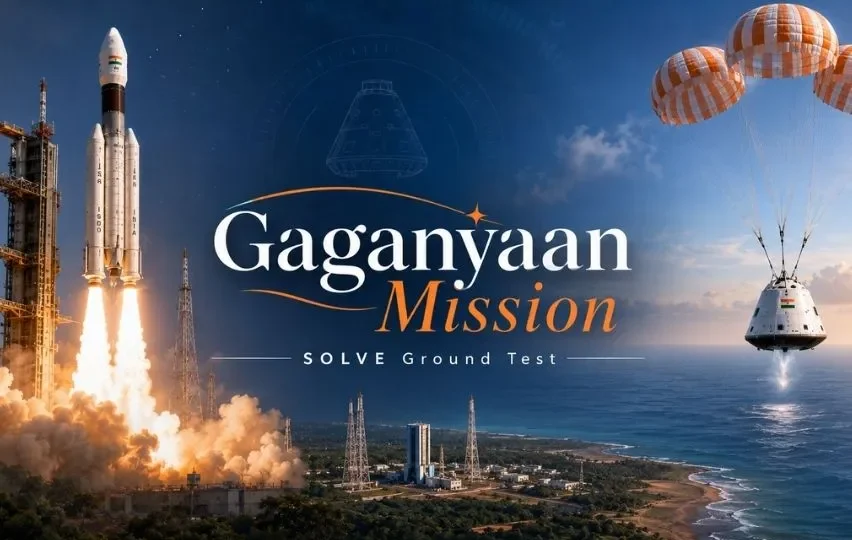
India’s ambitious human spaceflight programme, Gaganyaan, has achieved another significant milestone with the successful testing of the Sub-Orbital Launch Vehicle for Experiments (SOLVE) solid motor. Conducted by the Indian Space Research Organisation (ISRO) at the Static Test Facility of Satish Dhawan Space Centre (SDSC), Sriharikota, this ground test marks an important step in validating the safety systems that will be used during India’s first crewed space mission.
The SOLVE test platform has been specifically developed to evaluate the Crew Module’s parachute-based deceleration and recovery system, which is one of the most critical components of the Gaganyaan mission. The successful completion of this test demonstrates ISRO’s continued progress towards ensuring the safe return of astronauts from space.
Why is Gaganyaan in the News?
The ISRO recently conducted the first successful ground test of the SOLVE (Sub-Orbital Launch Vehicle for Experiments) solid motor at the Satish Dhawan Space Centre, Sriharikota.
This test is a major milestone because the SOLVE platform will be used to carry out Integrated Parachute Tests, ensuring that the Gaganyaan Crew Module can safely descend and splash down into the sea after completing its mission.
The successful test reinforces India’s preparedness for future unmanned and manned Gaganyaan missions.
What is SOLVE?
SOLVE (Sub-Orbital Launch Vehicle for Experiments) is a specially designed solid motor-based experimental launch vehicle developed by ISRO to test and validate critical technologies required for the Gaganyaan programme.
Rather than launching astronauts into space, SOLVE is intended to simulate the final stages of the mission by carrying the Crew Module to a specified altitude and testing its safe recovery system.
It acts as a dedicated experimental platform before actual human spaceflight missions begin.
Objectives of SOLVE
The primary objective of SOLVE is to validate the Crew Module’s deceleration and recovery system, particularly the parachute deployment sequence.
The platform enables ISRO engineers to evaluate:
- Safe separation of the Crew Module
- Sequential deployment of parachutes
- Controlled descent through the atmosphere
- Safe splashdown into the sea
- Performance of recovery systems under real mission conditions
These tests ensure astronaut safety during the return phase of the Gaganyaan mission.
How Does SOLVE Work?
The SOLVE platform carries the Crew Module to an altitude of approximately 10–17 kilometres above the Earth’s surface.
The testing process involves several stages:
Launch Phase
The solid motor propels the Crew Module to the desired altitude.
Module Separation
After reaching the target altitude, the Crew Module separates from the launch vehicle.
Parachute Deployment
A carefully designed sequence of 10 parachutes is deployed to gradually reduce the module’s speed.
Controlled Descent
The parachutes stabilize the module and ensure a safe descent.
Splashdown
The Crew Module lands safely in the sea, where recovery teams retrieve it.
This sequence closely resembles the recovery process that astronauts will experience during the actual Gaganyaan mission.
SOLVE Solid Motor
The SOLVE platform uses a solid rocket motor derived from the Polar Satellite Launch Vehicle (PSLV) Strap-on Motor.
ISRO has modified the existing PSLV technology to suit the specific requirements of parachute validation and crew recovery experiments.
By adapting a proven launch vehicle component, ISRO has reduced development time while maintaining high reliability.
Gaganyaan Mission: India's First Human Spaceflight Programme
The Gaganyaan Mission is India’s first indigenous human spaceflight programme, developed by ISRO.
Its primary objective is to demonstrate India’s capability to safely launch humans into space and bring them back to Earth.
Mission Objectives
- Send three Indian astronauts into space.
- Place them in a Low Earth Orbit (LEO) at an altitude of approximately 400 km.
- Keep the crew in orbit for three days.
- Ensure their safe return through atmospheric re-entry.
- Achieve a controlled splashdown in the Indian Ocean.
The mission will establish India among the select group of nations capable of independently conducting human spaceflight missions.
Vyommitra: India's Humanoid Space Robot
Before sending astronauts into space, ISRO plans to conduct an uncrewed Gaganyaan mission.
This mission will carry Vyommitra, a female humanoid robot developed to simulate human activities during spaceflight.
Role of Vyommitra
- Monitor cabin environment
- Operate spacecraft systems
- Demonstrate life-support systems
- Simulate astronaut activities
- Collect mission performance data
- Validate crew safety mechanisms
The successful performance of Vyommitra will help ISRO evaluate spacecraft readiness before the first crewed mission.
Importance of the SOLVE Test
The successful SOLVE ground test is significant for several reasons:
- Validates the Crew Module’s parachute recovery system.
- Reduces mission risk before human flights.
- Enhances astronaut safety during re-entry.
- Confirms the reliability of indigenous recovery technologies.
- Strengthens India’s human spaceflight capabilities.
- Accelerates preparations for upcoming Gaganyaan missions.
The test represents another crucial milestone in India’s journey toward becoming a major spacefaring nation.
Significance for UPSC Examination
The Gaganyaan Mission is highly relevant for UPSC under multiple subjects.
UPSC Prelims
- Gaganyaan Mission
- SOLVE Test Platform
- Vyommitra Robot
- ISRO Missions
- Low Earth Orbit (LEO)
- PSLV Technology
UPSC Mains
GS Paper III
- Science and Technology
- Space Technology
- Indigenous Research and Development
- Strategic Technological Advancements
GS Paper III
- India’s Space Programme
- Technology for National Development
- Innovation and Self-Reliance
Conclusion
The successful testing of the SOLVE platform marks another major achievement in India’s Gaganyaan Mission. By validating the Crew Module’s parachute recovery system, ISRO has taken an important step toward ensuring the safety of Indian astronauts during future human spaceflight missions. With upcoming uncrewed missions featuring Vyommitra and continued technological advancements, Gaganyaan is steadily moving closer to making India the fourth nation to independently send humans into space and safely return them to Earth.



Frequently Asked Questions (FAQs) About the Gaganyaan Mission
What is the Gaganyaan Mission?
The Gaganyaan Mission is India’s first indigenous human spaceflight programme developed by ISRO. It aims to send three astronauts to a 400 km Low Earth Orbit (LEO) for up to three days and safely return them to Earth with a splashdown in Indian seas.
What is the SOLVE test in the Gaganyaan Mission?
SOLVE (Sub-Orbital Launch Vehicle for Experiments) is a solid motor-based test platform developed by ISRO to validate the Crew Module’s parachute-based deceleration and recovery system. It helps ensure the safe landing of astronauts during the Gaganyaan mission.
What is the role of Vyommitra in the Gaganyaan Mission?
Vyommitra is a female humanoid robot developed by ISRO for the first uncrewed Gaganyaan mission. It will simulate astronaut activities, monitor spacecraft systems, and help test life-support and crew safety mechanisms before the first human spaceflight.
Why is the SOLVE ground test important?
The SOLVE ground test is important because it validates the Crew Module’s parachute deployment and recovery system, ensuring a safe descent and splashdown. It is a crucial step in enhancing astronaut safety and mission reliability.
Why is the Gaganyaan Mission important for UPSC preparation?
The Gaganyaan Mission is an important UPSC topic under Science and Technology, Space Technology, ISRO Missions, and India’s Space Programme. Questions may be asked about SOLVE, Vyommitra, Low Earth Orbit (LEO), Crew Module, and human spaceflight technology in both Prelims and Mains examinations.