Table of Contents
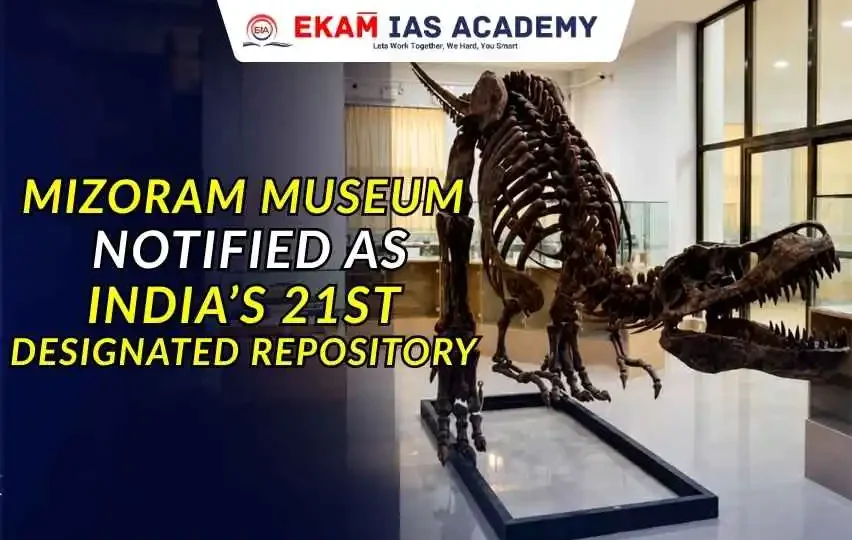
ToggleMizoram Museum Notified as India’s 21st Designated Repository
The Ministry of Environment, Forest and Climate Change has notified the Natural History Museum, Mizoram University, Aizawl as India’s 21st Designated Repository under the Biological Diversity Act, 2002. The notification was issued on the recommendation of the National Biodiversity Authority.
What are Designated Repositories?
Under the Biological Diversity Act, 2002, Designated Repositories are important institutions responsible for preserving authenticated biological specimens.
They help in:
- Scientific identification of species
- Conservation of biological resources
- Maintaining verified biological records
- Supporting research and taxonomy
- Ensuring traceability of biological specimens
These repositories form a key part of India’s biodiversity governance system.
About Natural History Museum, Mizoram
The Natural History Museum, Mizoram was established in 2022 under Mizoram University, a Central University. It is located in the Indo-Burma Biodiversity Hotspot, one of the world’s most ecologically significant biodiversity regions.
The museum is important because Mizoram and the wider North-eastern Region are home to more than 7,500 species of flowering plants and over 2,000 faunal species.
Specimens to be Preserved
The museum will maintain voucher specimens of selected flora and fauna.
These include:
- Pteridophytes
- Macrofungi
- Reptiles
- Amphibians
- Fishes
- Moths
- Beetles
- Butterflies
It will also serve as a designated depository for type specimens of newly discovered species from the region. This will strengthen species identification, scientific research and traceability.
Significance of the Designation
The designation of Mizoram’s Natural History Museum as a Designated Repository is significant for India’s biodiversity conservation.
It will help in:
- Long-term conservation of biological specimens
- Protection of India’s biological wealth
- Documentation of lesser-studied species
- Ecological restoration after habitat loss or natural disasters
- Conservation of endemic species of the North-east
- Strengthening India’s scientific biodiversity infrastructure
It also reduces logistical challenges by preserving biological specimens closer to their source region.
Link with Global Biodiversity Framework
The designation supports National Biodiversity Target 4 of India’s National Biodiversity Strategy and Action Plan 2024–2030.
It also aligns with Target 4 of the Kunming–Montreal Global Biodiversity Framework, which focuses on strengthening ex situ conservation and conserving genetic diversity.
Conclusion
The notification of Mizoram’s Natural History Museum as India’s 21st Designated Repository is a major step towards strengthening biodiversity documentation, scientific research and ex situ conservation. It highlights the ecological importance of North-east India and reinforces India’s commitment to protecting biological resources under national and global biodiversity frameworks.



What Makes Personalized Mentorship Effective in UPSC Coaching Hyderabad-FAQs Answered
Why is Mizoram Museum in news?
Mizoram’s Natural History Museum has been notified as India’s 21st Designated Repository under the Biological Diversity Act, 2002.
What is a Designated Repository?
A Designated Repository is an institution responsible for preserving verified biological specimens for biodiversity conservation, research and species identification.
Where is the Natural History Museum, Mizoram located?
It is located under Mizoram University, a Central University, in the Indo-Burma Biodiversity Hotspot.
What specimens will the Mizoram Museum preserve?
The museum will preserve specimens of pteridophytes, macrofungi, reptiles, amphibians, fishes, moths, beetles and butterflies.
Why is this designation important for biodiversity conservation?
It strengthens ex situ conservation, supports ecological restoration, protects biological wealth and helps in scientific research on newly discovered species.