
Table of Contents
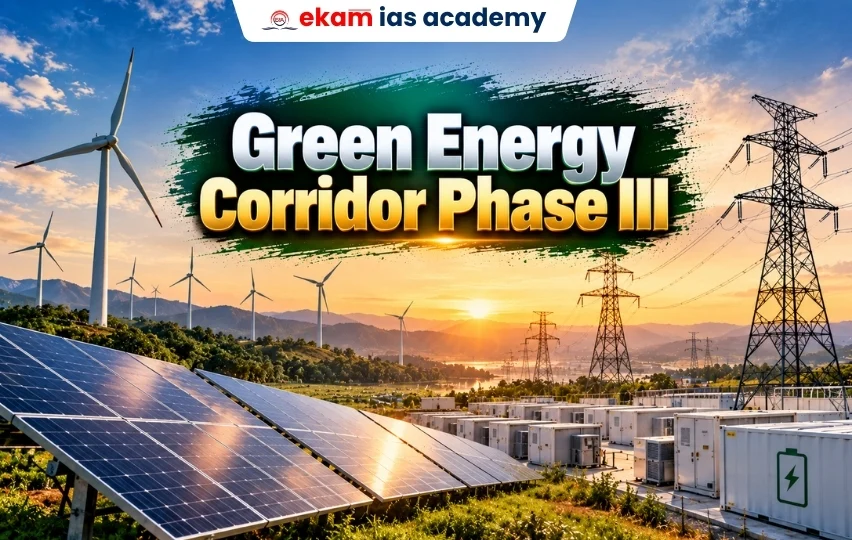
ToggleGreen Energy Corridor Phase 3
The Centre has approved the third phase of the Green Energy Corridor (GEC-III) with an estimated outlay of ₹1.86 lakh crore. The initiative aims to strengthen transmission infrastructure for evacuating up to 135 GW of renewable energy and integrating it efficiently into the national grid.
What Is the Green Energy Corridor?
The Green Energy Corridor is a flagship programme designed to develop dedicated transmission networks for connecting large-scale solar and wind power projects with electricity-consuming regions.
The focus is not merely on increasing renewable generation but also on ensuring that clean electricity can be transmitted reliably to the grid.
What’s New in GEC Phase III?
For the first time, GEC includes a dedicated Battery Energy Storage System (BESS) component. The phase provides for deployment of 50 GWh of battery storage.
Energy storage can absorb surplus electricity during periods of high renewable generation and release it when demand increases or renewable output falls, thereby improving grid flexibility.
Why Does the Evacuation Problem Matter?
India’s renewable capacity is expanding rapidly, but transmission infrastructure has not always kept pace. During periods of strong solar generation, particularly during the daytime, grid congestion can result in curtailment of renewable electricity.
In FY2026, around 6,900 GWh of clean electricity reportedly faced restrictions because of transmission constraints.
How Will ₹1.86 Lakh Crore Be Used?
The major components include:
- Intra-State Transmission Systems: More than ₹1.36 lakh crore.
- Battery Storage: ₹50,000 crore for 50 GWh of BESS.
- Central Financial Support: ₹54,082 crore to reduce transmission-related costs.
Greenfield projects will increasingly use Tariff-Based Competitive Bidding (TBCB), while brownfield network strengthening will follow a Cost-Plus Basis model.
The programme targets completion by FY2033.
Significance of GEC-III
India may add nearly 400 GW of renewable capacity between 2030 and 2035–36, requiring substantial additional transmission infrastructure. GEC-III is expected to support around 135 GW of this requirement.
It can also encourage geographical diversification of renewable energy beyond the states where capacity is currently concentrated and attract greater private investment into transmission projects.
Why Battery Storage Is Important
Storage is becoming critical as renewable generation increases. India currently has approximately 2.9 GW of BESS and 7.2 GW of pumped hydro storage.
The Central Electricity Authority envisages total storage capacity of about 174 GW/888 GWh by 2035–36, including 80 GW/321 GWh of BESS and 94 GW/567 GWh of pumped storage.
Challenges
Earlier GEC phases have experienced implementation delays. GEC-I is now expected to be completed by March 2027, while GEC-II projects are targeted for completion by 2028.
Timely execution of transmission projects, faster storage deployment and stronger coordination between states and the Centre will therefore be crucial.
Conclusion
GEC-III marks a shift from focusing only on renewable generation towards building the transmission and storage ecosystem required to absorb it. For India’s clean-energy transition, generating electricity is only one part of the challenge; efficiently moving, storing and integrating renewable power will determine whether the country can convert its ambitious capacity targets into reliable and sustainable electricity.


FAQs – Green Energy Corridor Phase III
What is the Green Energy Corridor (GEC)?
The Green Energy Corridor is a transmission infrastructure programme designed to connect large-scale solar and wind projects with electricity-consuming regions and integrate renewable power into the national grid.
What is the main objective of GEC Phase III?
GEC-III aims to strengthen transmission infrastructure for evacuating up to 135 GW of renewable energy and efficiently integrating it into India’s electricity grid.
What is new in Green Energy Corridor Phase III?
For the first time, GEC-III includes a dedicated Battery Energy Storage System (BESS) component, with 50 GWh of battery storage planned.
What is the estimated outlay of GEC Phase III?
GEC-III has an estimated outlay of ₹1.86 lakh crore, including more than ₹1.36 lakh crore for intra-state transmission systems and ₹50,000 crore for battery storage.
Why is battery storage important for GEC-III?
Battery storage can store surplus renewable electricity when generation is high and release it when demand rises or renewable output falls, improving grid flexibility and reliability.