
Table of Contents
ToggleCanada-India Defence Collaboration for a Secure Future
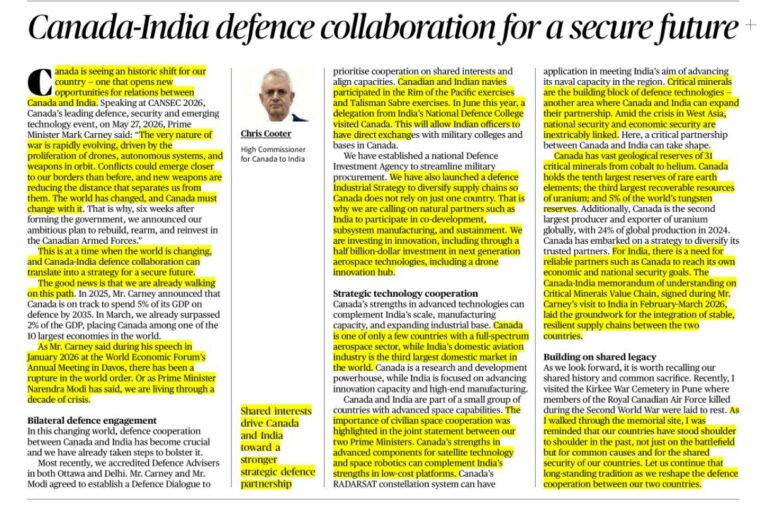
Canada and India are witnessing a historic shift in defence collaboration, opening new opportunities for shared strategic, technological, and economic gains. Recent engagements, including CANSEC 2026 and high-level bilateral visits, highlight growing cooperation in naval exercises, defence technology, and critical minerals. This partnership aims to strengthen national security while promoting economic resilience and industrial growth.
Bilateral Defence Engagement
Naval Exercises and Officer Exchanges
Canadian and Indian navies have actively participated in Rim of the Pacific (RIMPAC) and Talisman Sabre exercises, enhancing operational interoperability. In June 2026, a delegation from India’s National Defence College visited Canada, providing officers with direct exposure to military colleges and operational bases. Such exchanges strengthen tactical understanding and foster long-term strategic trust.
Defence Industrial Strategy
India and Canada are collaborating to diversify defence supply chains. Initiatives include co-development of subsystems, manufacturing partnerships, and investment in next-generation aerospace technologies, including a drone innovation hub. This collaboration ensures India’s defence industrial capabilities are aligned with global standards and reduces dependency on single-country suppliers.
Strategic Technology Cooperation
Advanced Technologies and Space Capabilities
Canada’s strengths in aerospace, satellite technology, and critical minerals complement India’s domestic aviation and deep-tech sectors. Joint research and development initiatives, along with training programs, enhance India’s technological edge in defence, space, and critical minerals exploitation.
Critical Minerals and Economic Security
Critical minerals like cobalt, helium, uranium, and rare earth elements are central to advanced defence technologies. Canada possesses vast geological reserves, while India requires reliable partners to secure these resources. The Canada-India MoU on Critical Minerals Value Chain, signed during Prime Minister Carney’s visit, lays the foundation for stable, resilient supply chains.
Opportunities for India
Industrial Growth and Strategic Autonomy
The partnership encourages India to boost domestic production, improve supply chain resilience, and enhance national security capabilities. Engagement with Canada also allows India to integrate advanced defence technologies while fostering economic growth through joint projects and private sector involvement.
Long-Term Strategic Benefits
Collaboration strengthens diplomatic ties, encourages knowledge transfer, and prepares both nations to address emerging regional threats in West Asia and the Indo-Pacific. These efforts support India’s long-term objective of a secure, technologically advanced, and economically resilient defence infrastructure.
Conclusion
The Canada-India defence collaboration represents a critical opportunity to enhance national security, diversify defence supply chains, and strengthen strategic autonomy. With coordinated naval exercises, technology partnerships, and critical minerals agreements, both nations are building a secure and innovative defence future. For UPSC aspirants, this topic is important under India-Canada relations, defence diplomacy, critical minerals, strategic partnerships, and national security policy.
Vocabulary Boost
Interoperability → Ability of armed forces to operate together effectively.
Critical Minerals → Minerals essential for defence and high-tech industries.
Co-development → Joint development of defence technologies or platforms.
Supply Chain Resilience → Ability to withstand disruptions in production and trade.
Strategic Partnership → Long-term cooperation based on shared security and economic interests.
Frequently Asked Questions (FAQs)
What is the Canada-India defence collaboration about?
It focuses on strengthening bilateral defence ties, joint exercises, technology cooperation, and strategic industrial partnerships.
Which naval exercises have Canada and India participated in?
Both countries have participated in the Rim of the Pacific (RIMPAC) and Talisman Sabre exercises to enhance operational interoperability.
How does the collaboration benefit India’s defence industry?
It helps diversify supply chains, develop subsystems, foster innovation in aerospace and drones, and improve domestic production capabilities.
Why are critical minerals important in this partnership?
Critical minerals like cobalt, helium, uranium, and rare earth elements are essential for advanced defence technologies and economic security. Canada’s reserves complement India’s needs.
Why is this topic important for UPSC?
It is relevant under India-Canada relations, defence diplomacy, national security, critical minerals, and strategic partnerships.
Source From : The Hindu
Anna Hazare to Sonam Wangchuk: A Tale of Two Fasts and Democracy
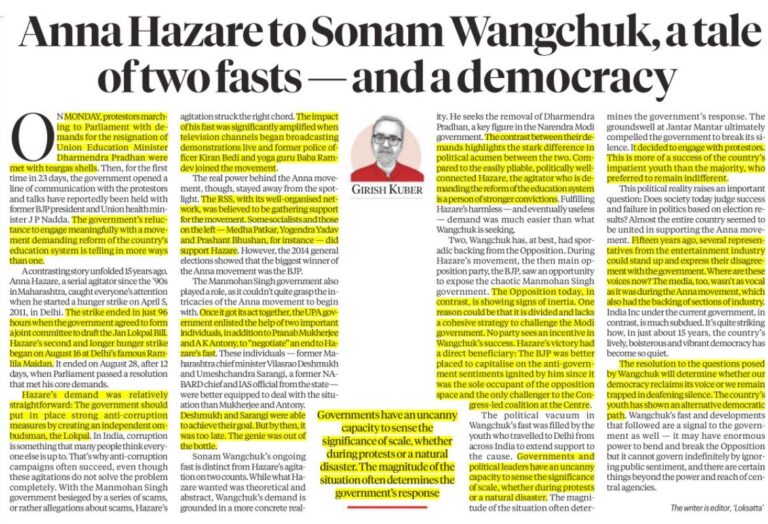
The article explores the role of fasting as a tool for civic activism in India, drawing parallels between Anna Hazare’s anti-corruption movement and Sonam Wangchuk’s educational protest. Both exemplify how individual and collective moral action can catalyse public awareness and policy change in a democracy.
Fasts as Political Instruments
Anna Hazare’s Movement
Hazare’s 2011 hunger strike at Jantar Mantar aimed to push for the Jan Lokpal Bill and highlighted systemic corruption. It captured national attention through media coverage and social mobilisation, resulting in widespread public support and eventual legislative action.
Sonam Wangchuk’s Protest
Wangchuk’s fast targeted reform in India’s education system. Unlike Hazare, his protest was largely non-partisan and focused on systemic change rather than immediate political gain. Both fasts underscore the ability of individual moral action to influence policy and public discourse.
Media and Public Engagement
Media coverage amplified the impact of both movements. Television, social media, and public forums turned individual protests into national conversations. This demonstrates how civic activism interacts with modern media ecosystems to shape political narratives.
Political and Institutional Response
The article emphasizes that governments and political leaders often struggle to respond to moral and symbolic protests. While Hazare achieved concrete policy outcomes, Wangchuk’s fast highlights the challenge of institutional inertia and the difficulty of implementing systemic reforms.
Lessons for Civic Democracy
- Fasts can highlight moral urgency and catalyse public attention.
- Media plays a critical role in amplifying civic movements.
- Individual leadership combined with strategic public engagement can influence policy even in a complex democracy.
- Civic activism exposes gaps between public expectation and institutional responsiveness.
Conclusion
Both Hazare and Wangchuk demonstrate the power of non-violent, moral-based activism in India. Their movements illustrate that while the state may initially resist change, sustained civic action can reshape public discourse, influence policy, and strengthen democratic engagement. For UPSC aspirants, this topic is relevant under governance, civil society, political movements, ethics, and public accountability.
Vocabulary Boost
Civil Society → Non-governmental groups representing public interests.
Public Mobilisation → Organising citizens around a common cause.
Democratic Accountability → Governments being answerable to the people.
Political Agitation → Organised public protest seeking policy change.
Participatory Democracy → Citizens actively participating in governance beyond elections.
Frequently Asked Questions (FAQs)
What is the main focus of the article?
The article explores how hunger strikes by Anna Hazare and Sonam Wangchuk highlight the role of individual moral action in influencing public policy and democracy in India.
How did Anna Hazare use fasting as a tool for activism?
Hazare’s 2011 fast at Jantar Mantar sought the Jan Lokpal Bill, mobilized public support, and drew national attention to corruption.
What was the goal of Sonam Wangchuk’s fast?
Wangchuk’s fast aimed at reforming India’s education system, focusing on systemic change rather than immediate political gains.
What role did media play in these movements?
Media amplified the impact of both fasts by turning individual protests into nationwide conversations through television and social media.
Why is this topic important for UPSC?
It is important under governance, civil society, political movements, ethics, and public accountability.