

Table of Contents
ToggleTransparency and Institutional Credibility
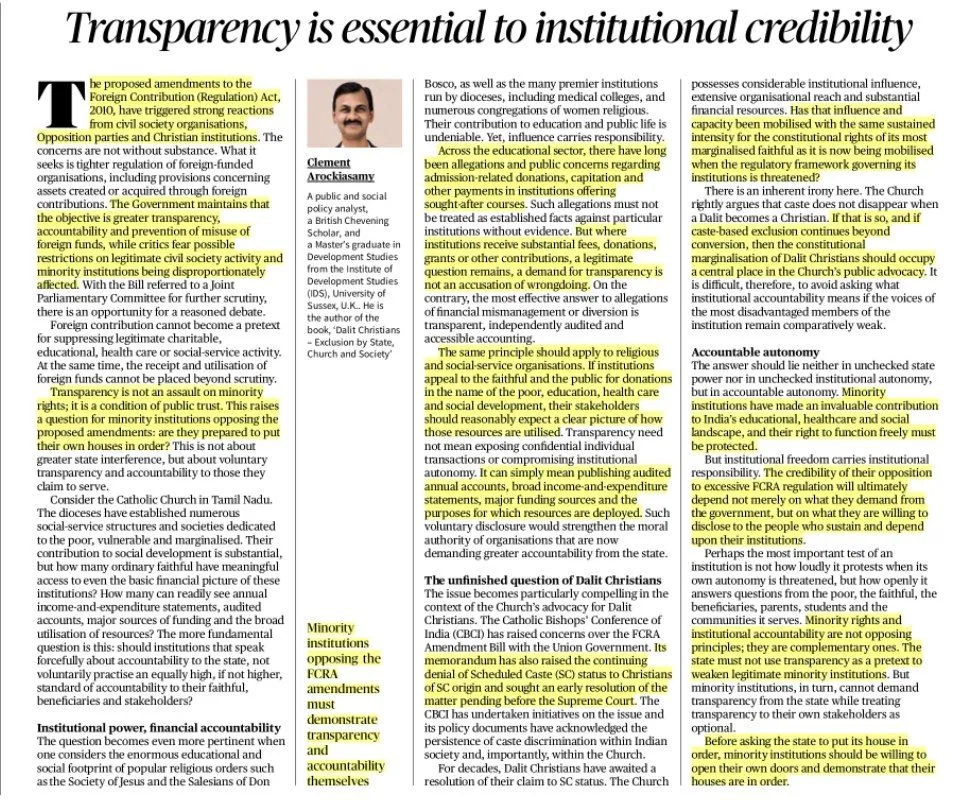
Proposed amendments to the Foreign Contribution (Regulation) Act, 2010 (FCRA) have triggered concerns among civil society organisations, opposition parties and Christian institutions. The debate centres on how to balance regulation of foreign contributions with institutional autonomy, transparency and minority rights.
Need for Transparency in Foreign Funding
The FCRA framework seeks to regulate foreign contributions and prevent their misuse while ensuring that legitimate civil-society activities are not unnecessarily restricted.
Transparency is particularly important for institutions that receive substantial foreign or domestic donations because:
- Public trust requires clarity about the source and use of funds.
- Financial accountability helps prevent misuse of charitable resources.
- Independent audits can strengthen institutional credibility.
- Donors and stakeholders should know how resources are deployed.
- Transparency should apply equally to religious, educational and social-service institutions.
The editorial argues that transparency is not an assault on minority rights; rather, it can strengthen public confidence in institutions.
Minority Rights and Institutional Autonomy
The issue becomes more complex when regulation affects institutions serving religious or minority communities.
The Catholic Bishops’ Conference of India (CBCI) has raised concerns regarding the proposed FCRA amendments and has also highlighted the continuing demand for Scheduled Caste status for Christians of Dalit origin.
The editorial links this issue to the broader question of caste-based exclusion. It argues that constitutional protection of minority rights and institutional accountability should be viewed as complementary rather than contradictory.
Accountability with Autonomy
Institutions possessing significant educational, social and financial influence also carry corresponding responsibilities.
A balanced approach should ensure:
- Accountable autonomy, rather than unchecked autonomy.
- Transparent and independently audited financial records.
- Clear disclosure of funding sources and expenditure.
- Protection of legitimate minority and religious freedoms.
- Regulatory procedures that are proportionate and non-discriminatory.
Excessive regulation can undermine institutional freedom, while complete absence of accountability can weaken public trust.
Conclusion
The debate over FCRA regulation highlights the need to reconcile transparency, accountability, minority rights and institutional autonomy. Regulatory frameworks should prevent misuse of foreign contributions without becoming instruments that unnecessarily restrict legitimate civil-society or minority institutions. Ultimately, credible institutions require both freedom to function and responsibility to remain transparent.
Vocabulary
1. Institutional Autonomy – Freedom from undue external interference.
2. Financial Accountability – Responsibility for transparent fund utilisation.
3. Public Trust – Confidence in institutional integrity.
Prelims MCQs
MCQ 1
With reference to minority educational institutions in India, consider the following statements:
Article 30 guarantees religious and linguistic minorities the right to establish and administer educational institutions.
Minority educational institutions are completely exempt from government regulations.
The State cannot discriminate against educational institutions in granting aid solely on the ground that they are managed by minorities.
Which of the statements given above are correct?
A) 1 and 2 only
B) 1 and 3 only
C) 2 and 3 only
D) 1, 2 and 3
Answer: B) 1 and 3 only
MCQ 2
With reference to the Foreign Contribution (Regulation) Act (FCRA), 2010, consider the following statements:
It regulates the acceptance and utilisation of foreign contributions by certain individuals and organisations.
It is administered by the Ministry of Finance.
Organisations registered under the FCRA are subject to prescribed financial reporting requirements.
Which of the statements given above are correct?
A) 1 only
B) 2 and 3 only
C) 1 and 3 only
D) 1, 2 and 3
Answer: C) 1 and 3 only
UPSC Mains Question
“Institutional autonomy and financial accountability are complementary.” Examine in the context of minority institutions. (10 Marks)
Key points to cover:
- FCRA Amendments: Proposed changes to the FCRA, 2010 raise concerns over regulation of foreign-funded institutions.
- Minority Rights: Institutional autonomy must coexist with financial transparency and public accountability.
- Financial Disclosure: Audited accounts, funding sources and expenditure details strengthen institutional credibility.
- Accountable Autonomy: Minority institutions must protect constitutional rights while ensuring transparency to stakeholders.
Frequently Asked Questions (FAQs)
What is the FCRA?
The Foreign Contribution (Regulation) Act regulates the acceptance and utilisation of foreign contributions by specified individuals and organisations.
Why is transparency important for minority institutions?
It strengthens public trust and ensures that financial resources are used for declared objectives.
Does institutional autonomy mean absence of accountability?
No. Institutional autonomy should operate alongside financial and administrative accountability.
What is the issue concerning Dalit Christians?
The editorial highlights the continuing demand for Scheduled Caste status for Christians of Dalit origin and the concerns raised by the CBCI.
Source From : The Hindu
Arrest and Detention: Supreme Court on Article 22 and Personal Liberty
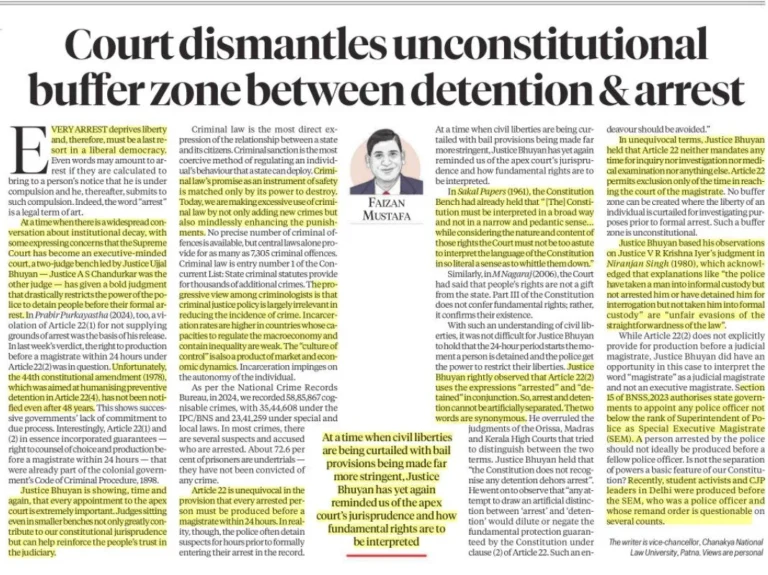
The Supreme Court has reiterated that arrest and detention cannot be separated through an artificial legal distinction to bypass constitutional safeguards. The observations are significant in the context of growing concerns over personal liberty, prolonged custody and the safeguards guaranteed under Article 22 of the Constitution.
Arrest as a Deprivation of Liberty
Arrest directly restricts an individual’s personal liberty and therefore triggers constitutional protections.
Article 22(1) provides that a person who is arrested must:
- Be informed of the grounds of arrest as soon as possible.
- Be allowed to consult and be defended by a legal practitioner of their choice.
Article 22(2) requires every arrested person to be produced before the nearest magistrate within 24 hours, excluding the time necessary for the journey.
The editorial argues that these safeguards cannot be diluted by describing custody as merely “detention” rather than “arrest”.
Supreme Court’s Constitutional Approach
The editorial refers to Prabir Purkayastha v. State (2024), where the Supreme Court held that failure to communicate the grounds of arrest violated the constitutional protection under Article 22(1).
Justice Bhuyan’s observations emphasise that the Constitution must be interpreted broadly and liberally to protect individual liberty.
The editorial highlights the principle that there should be no unconstitutional buffer zone between arrest and detention. If a person is effectively deprived of liberty for interrogation or investigation, constitutional safeguards cannot simply be avoided by changing terminology.
24-Hour Rule and Judicial Oversight
The 24-hour production requirement acts as an important safeguard against arbitrary detention.
Judicial scrutiny ensures that:
- Police custody does not become indefinite.
- The legality of detention is examined promptly.
- Individual liberty is protected from executive excess.
- Investigative powers remain subject to constitutional limitations.
The editorial also raises concerns regarding the use of Special Executive Magistrates (SEMs) under the Bharatiya Nagarik Suraksha Sanhita (BNSS), 2023, particularly where police officials exercise executive-magisterial functions.
Significance for Fundamental Rights
The issue directly concerns:
- Article 21 – Protection of life and personal liberty.
- Article 22 – Safeguards against arbitrary arrest and detention.
- Rule of law – Executive power must remain within constitutional limits.
- Judicial oversight – Courts act as a safeguard against unlawful deprivation of liberty.
Conclusion
The constitutional protection against arbitrary arrest is meaningful only when it operates from the moment liberty is actually curtailed. Legal terminology cannot be used to create a gap in constitutional protection. Strong judicial oversight, prompt production before a magistrate and effective communication of grounds of arrest are essential for preserving the rule of law and public confidence in criminal justice.
Vocabulary
1. Personal Liberty – Freedom from arbitrary state interference.
2. Due Process – Fair and lawful legal procedures.
3. Informal Detention – Restriction of liberty without formal arrest.
Prelims MCQs
MCQ 1
Consider the following statements:
Article 22(2) mandates production before a magistrate within 24 hours, excluding journey time.
Informal police detention is automatically exempt from constitutional safeguards.
Article 22 provides safeguards against arbitrary arrest and detention.
Which are correct?
A) 1 and 2 only
B) 1 and 3 only
C) 2 and 3 only
D) 1, 2 and 3
Answer: B
MCQ 2
Consider the following statements:
Article 21 protects life and personal liberty.
Article 22(2) applies equally to preventive detention under a valid preventive detention law.
Article 22(1) guarantees an arrested person the right to consult a legal practitioner.
Which are correct?
A) 1 and 2 only
B) 2 and 3 only
C) 1 and 3 only
D) 1, 2 and 3
Answer: C
UPSC Mains Question
“Artificial distinctions between arrest and detention undermine personal liberty.” Examine with reference to Article 22. (10 Marks)
Key points to cover:
- Article 22(2): Every arrested person must be produced before a magistrate within 24 hours, excluding travel time.
- Judicial Interpretation: The Supreme Court rejected artificial distinctions between arrest and detention.
- Constitutional Safeguards: Police cannot prolong custody through informal detention before formal arrest.
- Personal Liberty: The judgment reinforces due process, judicial oversight and protection against arbitrary detention.
Frequently Asked Questions (FAQs)
What does Article 22(1) protect?
It protects an arrested person’s right to know the grounds of arrest and to consult and be defended by a legal practitioner.
What does Article 22(2) require?
An arrested person must generally be produced before the nearest magistrate within 24 hours, excluding journey time.
What was the significance of Prabir Purkayastha case?
The Supreme Court emphasised that failure to communicate the grounds of arrest violates the constitutional protection under Article 22(1).
Why is the distinction between arrest and detention important?
The editorial argues that an artificial distinction cannot be used to bypass constitutional safeguards when a person’s liberty has actually been curtailed.
Which Fundamental Rights are primarily involved?
Articles 21 and 22 are central to the protection of personal liberty against arbitrary state action.