
Table of Contents
ToggleSupreme Court and Due Process in Death Penalty Cases
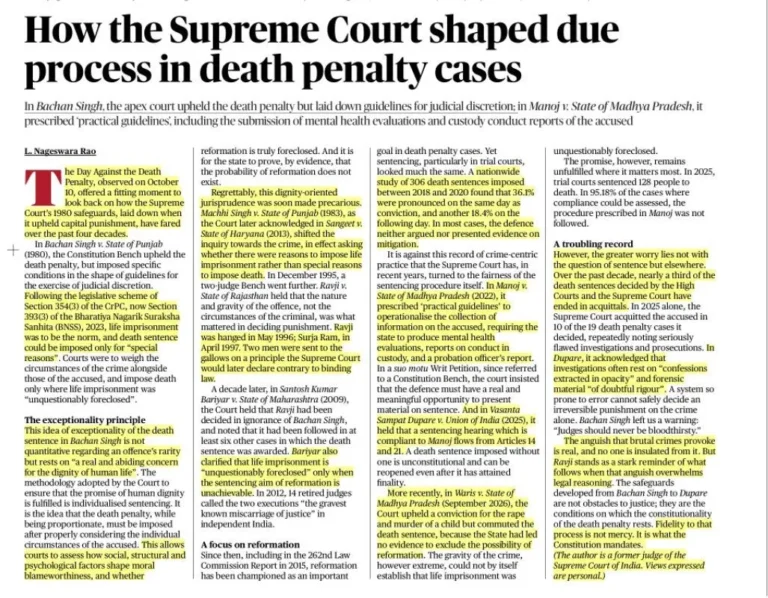
The death penalty remains one of the most consequential punishments in India because it permanently takes away an individual’s life. Over the decades, the Supreme Court has developed safeguards to ensure that capital punishment is imposed only after careful consideration of the crime, the circumstances of the accused and the possibility of their reformation. The judgments in Bachan Singh and Manoj v. State of Madhya Pradesh have been particularly important in shaping this due-process framework.
Bachan Singh and the “Rarest of Rare” Principle
In Bachan Singh v. State of Punjab (1980), the Supreme Court upheld the constitutional validity of the death penalty but imposed strict guidelines on judicial discretion.
The Court established that:
- Death penalty should be an exception rather than the norm.
- Life imprisonment should ordinarily be the rule.
- Courts must consider both the crime and the circumstances of the accused.
- The possibility of reformation and rehabilitation must be examined.
This became associated with the “rarest of rare” doctrine, requiring a careful and individualised assessment before imposing the death sentence.
Focus on Reformation
Subsequent judgments strengthened the importance of reformation. The article highlights that the Court has increasingly recognised life imprisonment as an alternative where the possibility of reform cannot be ruled out.
The underlying principle is that the State must establish that the possibility of the accused’s reformation is genuinely foreclosed before imposing the irreversible punishment of death.
Manoj v. State of Madhya Pradesh
In Manoj v. State of Madhya Pradesh (2022), the Supreme Court prescribed practical safeguards for sentencing in death penalty cases.
These include obtaining relevant information about the accused, including:
- Mental health evaluations.
- Conduct reports from custody.
- Background and social circumstances.
- Evidence relevant to mitigation and the possibility of reform.
The objective is to ensure that the defence receives a meaningful opportunity to present mitigating circumstances before sentencing.
Why Due Process MattersWhy Due Process Matters
The article highlights concerns about the implementation of these safeguards. Despite judicial guidelines, many death penalty cases may not adequately consider evidence relating to mitigation and reformation.
The concern is especially serious because the death penalty is irreversible. Procedural safeguards are therefore not technical requirements but essential protections against wrongful or unjust punishment.
Conclusion
The Supreme Court’s jurisprudence has gradually transformed death penalty sentencing from a purely crime-centric approach towards a more individualised, evidence-based and reform-oriented process. The principles established in Bachan Singh and strengthened through Manoj emphasise fairness, mitigation and the possibility of rehabilitation. Ensuring that these safeguards are consistently followed is essential to preserving constitutional due process and preventing irreversible miscarriages of justice.
Vocabulary
1. Food Loss – Food lost before reaching consumers.
2. Circular Economy – Reusing resources and minimising waste.
3. Traceability – Tracking food across the supply chain.
Prelims MCQs
MCQ 1
Consider the following statements regarding the Supreme Court’s death penalty jurisprudence:
- In Bachan Singh v. State of Punjab (1980), the Supreme Court held that life imprisonment should ordinarily be the rule and death penalty an exception.
- The “rarest of rare” principle requires courts to consider both the circumstances of the crime and the circumstances of the accused.
- In Manoj v. State of Madhya Pradesh (2022), the Supreme Court emphasised obtaining information such as mental health, custody conduct and social background for meaningful mitigation.
Which of the statements given above is/are correct?
A. 1 and 2 only
B. 2 and 3 only
C. 1 and 3 only
D. 1, 2 and 3
Answer: D. 1, 2 and 3
UPSC Mains Question
“The Supreme Court’s death penalty jurisprudence has progressively shifted from a crime-centric approach towards an individualised and reform-oriented sentencing process.” Discuss with reference to Bachan Singh v. State of Punjab and Manoj v. State of Madhya Pradesh. (250 words)
Frequently Asked Questions (FAQs)
What did Bachan Singh establish?
Bachan Singh v. State of Punjab (1980) upheld the death penalty but established the “rarest of rare” principle and required careful consideration of mitigating circumstances.
What is the “rarest of rare” doctrine?
It means that the death penalty should be imposed only in exceptional cases where the alternative of life imprisonment is unquestionably foreclosed.
What is the significance of Manoj v. State of Madhya Pradesh?
The judgment prescribed practical safeguards, including consideration of mental health, custody conduct and other mitigating circumstances before sentencing.
Why is reformation important in death penalty cases?
Courts must consider whether the accused can be rehabilitated. If the possibility of reformation cannot be ruled out, imposing the irreversible death penalty becomes difficult to justify.
Why are procedural safeguards essential in capital punishment?
Because the death penalty is irreversible, due process and proper consideration of mitigating evidence are essential to prevent wrongful convictions and unjust sentencing.