Table of Contents
ToggleA Middle Power Moment in a Fragmenting World
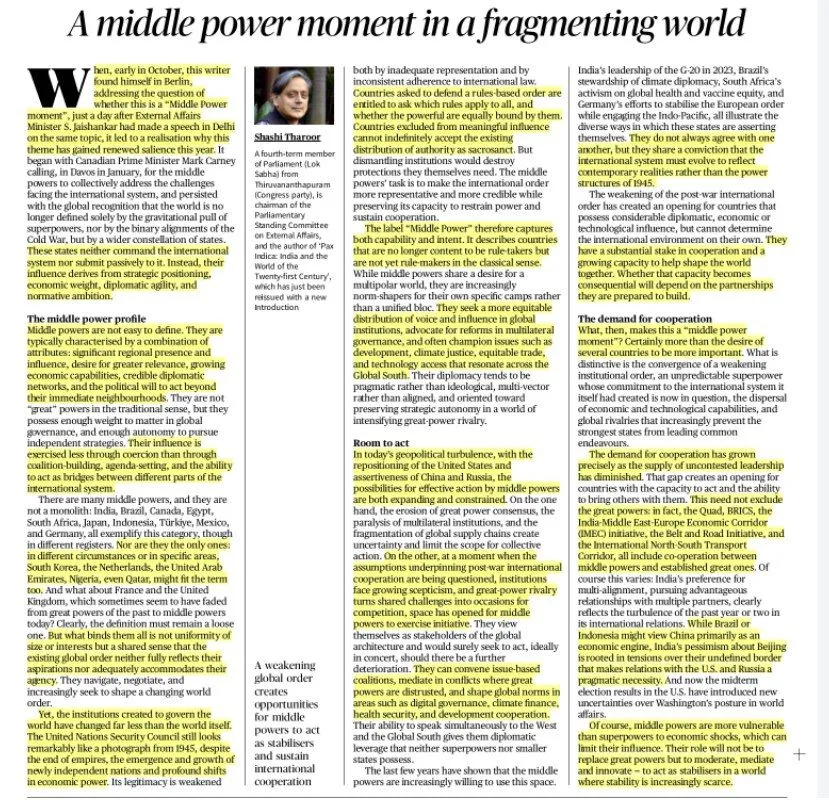
The changing global order has increased the significance of middle powers—countries that lack the overwhelming capabilities of superpowers but possess sufficient economic, diplomatic, technological and regional influence to shape international affairs. The article argues that fragmentation of the global order is creating a new “middle power moment”, with countries such as India gaining greater strategic space.
What are Middle Powers?
Middle powers are generally characterised by:
- Significant regional presence and influence.
- Growing economic and technological capabilities.
- Credible diplomatic networks.
- Strategic autonomy in foreign policy.
- Ability to build coalitions and bridge different groups.
Countries such as India, Brazil, Canada, Japan, Indonesia, Mexico, South Africa, Türkiye and Germany can be considered middle powers in different contexts.
Their influence increasingly comes through coalition-building, agenda-setting, mediation and norm-shaping, rather than coercive power.
Why is the Middle Power Moment Emerging?
The post-war international order is facing several challenges:
- Institutions such as the UN Security Council continue to reflect the power structure of 1945.
- Multilateral institutions face growing legitimacy and effectiveness concerns.
- Great-power rivalry between the US, China and Russia is intensifying.
- Economic and technological capabilities are becoming more dispersed.
- Global supply chains and geopolitical alignments are becoming fragmented.
This creates space for middle powers to influence global governance while protecting their strategic autonomy.
India's Role
India represents an important example of middle-power diplomacy. Its approach combines multi-alignment, strategic autonomy and issue-based partnerships.
India can work simultaneously with different groupings and partners, including:
- Quad
- BRICS
- G20
- India-Middle East-Europe Economic Corridor (IMEC)
- International North-South Transport Corridor (INSTC)
- Global South platforms
India’s diplomatic leverage also comes from its ability to engage both Western countries and the Global South.
Opportunities and Challenges
Middle powers can contribute to:
- Conflict mediation.
- Climate diplomacy.
- Digital governance.
- Health security.
- Development cooperation.
- Global trade and technology access.
However, they remain vulnerable to economic shocks and great-power competition. Their influence therefore depends on their ability to build partnerships and coalitions.
Conclusion
The emerging middle-power moment does not imply the replacement of great powers. Instead, it reflects a world where uncontested leadership is declining and cooperation is becoming more difficult. Countries such as India can use this space to act as stabilisers, mediators and bridge-builders while advancing a more representative and effective multilateral order.
Vocabulary
1. Middle Power – State with significant regional and diplomatic influence.
2. Multipolarity – Distribution of global power among multiple centres.
3. Multi-alignment – Engagement with multiple powers without exclusive alliances.
Prelims MCQs
MCQ 1
Consider the following statements regarding middle powers:
- They can influence global governance despite not being superpowers.
- They may use issue-based coalitions to advance common interests.
- Their foreign policy necessarily requires joining permanent military alliances.
Which of the statements given above are correct?
A) 1 and 2 only
B) 2 and 3 only
C) 1 and 3 only
D) 1, 2 and 3
Answer: A) 1 and 2 only
MCQ 2
With reference to multi-alignment, consider the following statements:
- It involves engagement with multiple major powers.
- It allows countries to pursue cooperation on specific issues without exclusive alliances.
- It is synonymous with complete neutrality in international affairs.
Which of the statements given above are correct?
A) 1 only
B) 1 and 2 only
C) 2 and 3 only
D) 1, 2 and 3
Answer: B) 1 and 2 only
UPSC Mains Question
“Middle powers can reshape global governance amid rising multipolarity.” Examine India’s role. (10 Marks)
Key points to cover:
- Emerging Influence: Middle powers like India, Brazil and Indonesia are gaining diplomatic and economic importance.
- Changing World Order: US–China rivalry and weakening multilateral institutions create space for middle-power leadership.
- Strategic Autonomy: Middle powers pursue multi-alignment, issue-based coalitions and independent foreign policies.
- Global Cooperation: They can bridge geopolitical divides and promote climate justice, equitable trade and institutional reforms.
Frequently Asked Questions (FAQs)
What is a middle power?
A middle power is a country with substantial economic, diplomatic or technological capabilities but without the comprehensive power of a superpower.
Why are middle powers becoming important?
The weakening of multilateral institutions and increasing great-power rivalry have created greater opportunities for middle powers to shape international outcomes.
What is India's middle-power strategy?
India broadly combines strategic autonomy, multi-alignment and issue-based partnerships to maximise its diplomatic space.
How can middle powers influence global governance?
They can build coalitions, mediate conflicts, shape norms and contribute to areas such as climate, health, technology and development.
What is the major challenge for middle powers?
Their influence remains vulnerable to economic shocks, geopolitical rivalry and dependence on larger powers.
Source From : The Hindu
India as a Middle Power in a Bi-Multipolar World
India’s growing economic, diplomatic and strategic capabilities have increased its influence in global affairs. However, the editorial argues that India should presently be understood as a middle power in a bi-multipolar world, rather than as a global superpower. The international system is increasingly shaped by the United States and China, alongside several influential middle powers.
India’s Rise as a Middle Power
India’s long-term economic growth has significantly strengthened its global position. The expansion of the Indian economy, technological capabilities and strategic partnerships has enabled India to exercise greater diplomatic influence.
India’s importance is also supported by its:
- Large economy and growing market
- Strategic geographical position
- Nuclear capability
- Demographic strength
- Expanding technological capacity
- Role in the Global South
At one stage, India was viewed as a major representative of the post-colonial and developing world. Its democratic institutions and relatively independent foreign policy further contributed to this perception.
The Bi-Multipolar World
The emerging global order combines two dominant powers—the US and China—with several middle powers that influence regional and issue-specific outcomes.
India therefore needs to avoid an approach based on claiming global pre-eminence prematurely. Instead, it can strengthen its position by developing partnerships with other middle powers such as:
- Japan
- European Union
- United Kingdom
- Brazil
- South Africa
- Russia
Such cooperation can strengthen India’s voice in a fragmented international system.
Strategic Challenges
India faces challenges from both major powers. China remains a strategic and economic competitor, while the US is an important partner but also has its own strategic interests.
The editorial therefore highlights the importance of balancing relations with both Washington and Beijing. India’s strategic autonomy requires flexibility rather than exclusive alignment with any single power.
Conclusion
India’s global influence will ultimately depend on the sustainability of its economic growth, technological advancement, institutional strength and diplomatic capacity. Rather than rushing to claim great-power status, India can use its position as a middle power to build coalitions, strengthen multilateralism and shape the emerging bi-multipolar world order.
Vocabulary
1. Bi-Multipolarity – Two dominant powers operating within a wider multipolar system.
2. Middle Power – State with significant but limited global influence.
3. Strategic Autonomy – Independent decision-making in foreign policy.
Prelims MCQs
MCQ 1
Consider the following statements regarding a bi-multipolar world:
- It combines two dominant global powers with several influential middle powers.
- Middle powers can shape different centres of global influence.
- It necessarily requires all countries to align with either of the two dominant powers.
Which of the statements given above are correct?
A) 1 and 2 only
B) 2 and 3 only
C) 1 and 3 only
D) 1, 2 and 3
Answer: A) 1 and 2 only
MCQ 2
With reference to India’s foreign policy in a bi-multipolar world, consider the following statements:
- India can strengthen its position through partnerships with other middle powers.
- Maintaining stable relations with both the US and China can serve India’s strategic interests.
- India’s middle-power status prevents it from influencing global affairs.
Which of the statements given above are correct?
A) 1 only
B) 1 and 2 only
C) 2 and 3 only
D) 1, 2 and 3
Answer: B) 1 and 2 only
UPSC Mains Question
“India remains a middle power in an emerging bi-multipolar world.” Examine the opportunities and challenges for its global ambitions. (10 Marks)
Key points to cover:
- Middle Power Status: India’s growing economic and diplomatic influence has not yet translated into great-power status.
- Bi-Multipolar Order: The US and China dominate global politics, while India and other middle powers shape regional and multilateral affairs.
- Economic Constraints: Slower growth and technological gaps limit India’s ability to compete with major powers.
- Strategic Priorities: India must strengthen economic capabilities, maintain strategic autonomy and build partnerships with middle powers.
Frequently Asked Questions (FAQs)
What is a middle power?
A middle power is a country with significant economic, diplomatic and strategic capabilities but without the comprehensive global power of a superpower.
What is a bi-multipolar world?
It refers to an international system where two dominant powers coexist with several influential middle powers.
Why is India considered a middle power?
India possesses substantial economic, military, technological and diplomatic capabilities but has not yet acquired comprehensive global power.
What should India do in a bi-multipolar world?
India should strengthen strategic partnerships, maintain strategic autonomy and cooperate with other middle powers.
What is the major challenge for India?
India must manage competition with China while maintaining a productive strategic relationship with the United States.