

Table of Contents
ToggleWOMEN WORKFORCE IN TAMIL NADU
TOPIC: (GS3) ECONOMY: THE HINDU
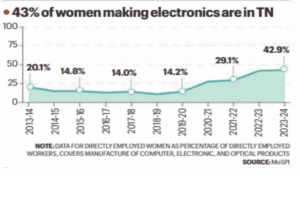
Recent MoSPI data (2023–24) shows Tamil Nadu leading India in female labour force participation, especially in electronics manufacturing.
Key Highlights
- Tamil Nadu accounts for 43% of women employed in electronics manufacturing.
- Growth trajectory: from 20.1% in 2013–14 to 42.9% in 2021–24.
- Cities like Coimbatore (41.3%) and Madurai (37%) report participation rates far above the national average of 27.7%.
- Foxconn expansion in Tamil Nadu.
- Women‑only residential complex inaugurated at Vallam Vadagal.
- MoU with Vikram Solar for Battery Energy Storage System facility.
Drivers of Success
- Policy Support: State government’s proactive labour and industrial policies.
- Infrastructure: Establishment of Thozhil hostels (19 hostels with 87% occupancy) for women workers.
- Global Model: Inspired by China’s women‑led manufacturing workforce, ensuring large‑scale female participation.
- Corporate Practices: Electronics and optical product industries prefer women for precision‑based work.
Socio‑Economic Dimensions
- Employment Scale: Example – Karnataka’s Devanahalli iPhone plant employs 240,000 workers, mostly women.
- Wages:
- National average wage for women workers (2025): ₹22,919 vs all‑India average of ₹23,707.
- Regional wages: Coimbatore (₹19,149), Madurai (₹18,427), Telangana (₹24,500).
- Empowerment: Women’s participation improves household income, education access, and social mobility.
- Challenges: Wage disparities, occupational safety, and need for gender‑sensitive labour reforms.
Comparative Perspective
- China & South Korea: Women’s participation in manufacturing linked to rapid industrial growth.
- India’s Context: Tamil Nadu and Kerala show higher female participation compared to northern states.
- Policy Lesson: Inclusive labour policies can accelerate industrial competitiveness and social equity.
Challenges:
- Occupational Safety and Labour Welfare: Industrial accidents remain frequent. Over 4,000 workplace fatalities annually, mostly in construction and mining.
- Skill Gaps and Low Productivity: NSDC report (2024) shows only 7% of India’s workforce has formal skill training, compared to 75% in Germany and 96% in South Korea.
- Informal Employment Dominance: Over 80% of India’s workforce is employed in the informal sector (ILO estimate, 2023). Informal jobs lack social security, health insurance, and pension benefits.
Way Forward
- Expand women‑friendly hostels and housing facilities across industrial clusters.
- Ensure equal wages and social security benefits.
- Promote skill development programs in electronics, renewable energy, and IT sectors.
- Encourage public‑private partnerships for women‑centric industrial zones.
- Integrate gender equity into National Skill Development Mission and Make in India.
Conclusion:
Tamil Nadu’s success in women’s workforce participation proves that inclusive industrial growth is the real engine of social transformation.
PRIVATE SPACE LAUNCH AND INDIA’S NEW SPACE ERA
TOPIC: (GS3) SCIENCE AND TECHNOLOGY: THE HINDU
Skyroot Aerospace successfully launched its Vikram‑1 rocket, marking a major milestone in India’s private space sector. This event signals a shift from state‑dominated ISRO missions to private enterprise‑driven innovation.
Key Highlights of the Launch
- Vikram‑1 targets Low Earth Orbit (LEO), crucial for small satellites and commercial applications.
- India now has 400+ space start‑ups working across the value chain – from launch vehicles to downstream applications.
- The sector is valued at ₹70,000 crore, expected to grow 4–5 times in the next decade.
- Collaboration continues between ISRO and private firms, ensuring synergy in missions like Chandrayaan and Gaganyaan.
Significance for India’s Space Economy
- Diversification: Private players reduce dependence on ISRO and expand commercial opportunities.
- Global Competitiveness: India aims to capture a larger share of the $440 billion global space economy.
- Innovation: Start‑ups bring agility, cost‑effective solutions, and new technologies (e.g., reusable rockets, space‑grade electronics).
- Employment: Expanding sector generates high‑skill jobs in engineering, data analytics, and AI.
Policy and Institutional Support
- IN‑SPACe (Indian National Space Promotion and Authorization Centre) facilitates private participation.
- Space Policy 2023 allows private firms to build, launch, and operate satellites independently.
- Government encourages FDI in space technology and partnerships with global firms.
- Example: Skyroot’s success mirrors global private ventures like SpaceX (USA) and Rocket Lab (New Zealand).
Challenges Ahead
- Funding: Start‑ups need sustained investment; venture capital in India’s space sector is still limited.
- Regulation: Balancing innovation with national security concerns.
- Technology Transfer: Dependence on ISRO for advanced tech must gradually reduce.
- Global Competition: Competing with established giants like SpaceX requires scale and innovation.
Way Forward
- Strengthen public‑private partnerships in satellite launches and deep‑space missions.
- Promote research collaborations with IITs and IISc for advanced propulsion and AI‑based space systems.
- Expand international cooperation under initiatives like Artemis Accords.
- Encourage start‑up incubation and funding through schemes like Startup India and Digital India.
Conclusion:
The Vikram‑1 launch by Skyroot marks the dawn of a new space age in India, where private innovation complements ISRO’s legacy to propel the nation into global leadership.
REVIVAL OF DEMOCRATIC POLITICS
TOPIC: (GS2) POLITY: THE HINDU
On July 20, 2026, a mass protest at Jantar Mantar, Delhi brought together students, activists, and citizens, seen as a revival of democratic politics.
Nature of the Protest
- The protest was spontaneous and organic, not organized by political parties.
- Participants included youth, civil society groups, and ordinary citizens.
- Reflected unity across diverse social backgrounds.
- Significance: Shows that democratic activism can emerge outside formal institutions, echoing Gandhian mass mobilization traditions.
Historical Parallels
- Comparable to the JP Movement (1974–77), which mobilized students against authoritarianism.
- Similar to the farmers’ protest (2020–21), which sustained pressure through peaceful gatherings.
- Reflects the continuity of protest culture in India’s democracy.
- Significance: Reinforces the constitutional right to protest under Article 19(1)(a) & 19(1)(b) (freedom of speech and assembly).
Democratic Dimensions
- Highlights concerns about authoritarian tendencies and shrinking space for dissent.
- Youth participation signals renewed political engagement.
- Civil society’s role shows resilience of grassroots democracy.
- Significance: Acts as a corrective mechanism in democracy, ensuring accountability of ruling institutions.
Socio‑Political Impact
- Revives public discourse on rights and freedoms.
- Encourages collective action beyond electoral politics.
- Strengthens pluralism and inclusivity in democratic practice.
- Example: Anna Hazare’s anti‑corruption movement (2011) reshaped governance debates and led to institutional reforms like the Lokpal Act.
Way Forward
- Promote dialogue between state and citizens to avoid confrontation.
- Institutional reforms to protect freedom of assembly and press.
- Encourage youth forums and civic education to sustain democratic participation.
- Balance between law and order and citizens’ rights must be maintained.
- Reference: The National Human Rights Commission (NHRC) guidelines emphasize safeguarding peaceful protests while ensuring public safety.
Conclusion:
The Jantar Mantar protest of July 2026 proves that democracy flourishes when citizens reclaim their voice through collective action.
BLAST AT SIKKIM HYDROELECTRIC TUNNEL
TOPIC: (GS3) DISASTER MANAGEMENT: THE HINDU
A methane gas leak and explosion at an under‑construction tunnel of the Teesta Stage‑VI Hydroelectric Project in Namchi district, Sikkim on July 21, 2026, killed 20 people and left 5 trapped.
Incident Details
- Location: Samardung, Namchi district, Sikkim.
- Project: Teesta Stage‑VI Hydroelectric Project.
- Victims included personnel from NHPC (National Hydroelectric Power Corporation) and Patel Engineering.
- Blast suspected due to methane gas accumulation inside the 7‑km tunnel.
Industrial Safety Concerns
- Methane is a highly flammable gas, often found in underground construction sites.
- Lack of gas detection systems and ventilation mechanisms can lead to such disasters.
- Similar accidents have occurred in coal mines and hydro projects, showing systemic safety gaps.
- Example: The 2023 Silkyara tunnel collapse in Uttarakhand raised similar concerns about worker safety and emergency preparedness.
Impact on Development Projects
- Hydroelectric projects are crucial for renewable energy goals under India’s National Electricity Plan.
- Accidents delay projects, increase costs, and erode public trust.
- Safety lapses undermine India’s target of 500 GW renewable capacity by 2030.
Government & Legal Dimensions
- Labour Ministry and Power Ministry expected to initiate inquiries.
- The Factories Act, 1948 and Mines Act, 1952 mandate safety standards, but enforcement remains weak.
- National Disaster Management Authority (NDMA) guidelines stress on risk assessment and emergency drills, often ignored in practice.
Socio‑Economic Angle
- Victims often include migrant labourers from poor states, highlighting labour vulnerability.
- Families face loss of livelihood and compensation delays.
- Raises ethical questions about development vs. human cost.
Way Forward
- Mandatory gas detection and ventilation systems in tunnels.
- Strict third‑party safety audits before project clearance.
- Training and insurance coverage for workers.
- Integration of IoT sensors and AI monitoring for early warning.
- Learning from global best practices (e.g., Japan’s tunnel safety protocols).
Conclusion: The Sikkim tunnel blast is a grim reminder that development without safety is unsustainable, and India must prioritize worker protection and risk management in all infrastructure projects.
ARTIFICIAL INTELLIGENCE IN JUDICIARY
TOPIC: (GS3) SCIENCE AND TECHNOLOGY: THE HINDU
The Supreme Court of India has released draft regulations for the use of Artificial Intelligence (AI) in judicial processes.
Features of Draft Regulations
- Proposed guidelines to govern AI use in public matters like case scheduling, document management, and legal research.
- Emphasis on institutional and architectural changes – creation of governance bodies, committees, and research centres.
- Focus on standards for transparency, explainability, and acceptable error rates.
- Example: Different tolerance levels for errors in bail decisions vs routine tasks like court scheduling.
Significance of AI in Judiciary
- Efficiency: AI can reduce case pendency (over 5 crore cases pending in Indian courts as per NJDG, 2025).
- Accessibility: Helps digitize records and improve access to justice for citizens.
- Consistency: AI tools can assist judges with precedents and legal research, ensuring uniformity.
- Global Context: Countries like UK and Singapore already use AI for case management and predictive analytics.
Challenges and Concerns
- Transparency: AI systems must explain decisions – “What must a system explain, and to whom?”
- Bias in Data: Training datasets may reflect social or institutional biases, affecting fairness.
- Error Rates: Defining acceptable error margins in sensitive matters like bail or sentencing.
- Accountability: Who is responsible if AI‑assisted decisions go wrong – judges, developers, or institutions?
- Privacy: Handling sensitive legal data requires strict safeguards under Data Protection Act, 2023.
Institutional Measures Proposed
- Establishment of Centres of Excellence in AI & Law.
- Creation of judicial technology committees for oversight.
- Collaboration with NITI Aayog’s AI initiatives and Digital India programme.
- Integration with e‑Courts Mission Mode Project (Phase III) for digitization and automation.
Way Forward
- Develop ethical frameworks for AI use in justice delivery.
- Ensure human oversight in critical judicial decisions.
- Promote capacity building and training for judges and lawyers.
- Encourage public consultations to build trust in AI‑enabled justice.
- Adopt global best practices while tailoring them to India’s socio‑legal context.
Conclusion:
The Supreme Court’s draft regulations mark a crucial step towards a tech‑enabled judiciary, ensuring that AI strengthens justice delivery without compromising fairness and accountability.
GOVERNMENT SPENDING PRIORITIES AND SHIFTS IN BUDGET ALLOCATION
TOPIC: (GS2) POLITY: THE HINDU
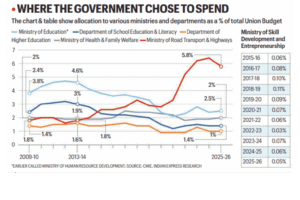
Recent budget data (2009–10 to 2025–26) shows declining allocations to education and skill development, while infrastructure spending, especially roads, has sharply increased.
Trends in Allocation
- Ministry of Education: Declined from 4.6% (2013–14) to 2.5% (2025–26) of total Union Budget.
- Department of School Education & Literacy: Continuous fall, affecting basic education quality.
- Department of Higher Education: Share reduced, impacting research and innovation.
- Ministry of Health & Family Welfare: Around 2.1% (2025–26), modest compared to needs.
- Ministry of Road Transport & Highways: Rose sharply to 5.8% (2020–21), currently 4.5% (2025–26).
- Skill Development & Entrepreneurship: Minimal allocation – only 0.03% (2025–26).
Significance of Trends
- Infrastructure Push: Higher road spending reflects government’s focus on logistics efficiency, connectivity, and economic growth.
- Education Decline: Lower allocations risk weakening human capital formation, crucial for long‑term productivity.
- Skill Development Gap: Minimal funding undermines employment readiness, especially for youth entering new industries.
- Health Sector: Limited rise in health spending despite post‑COVID needs for stronger public health systems.
Broader Implications
- Economic Dimension: Roads and highways boost GDP growth but neglect of education may reduce competitiveness in the knowledge economy.
- Social Dimension: Reduced education spending affects equity and access, especially for rural and marginalized groups.
- Governance Dimension: Budget priorities reflect policy choices – balancing physical infrastructure vs social infrastructure.
- Global Comparison: Countries like South Korea and China invested heavily in education during industrial growth, ensuring sustainable development.
Way Forward
- Increase education and skill development allocations to align with National Education Policy (NEP 2020) goals.
- Strengthen health sector funding to meet SDG‑3 (Good Health and Well‑Being) targets.
- Maintain infrastructure push but integrate human capital investment for balanced growth.
- Encourage public‑private partnerships in skill training and higher education.
- Adopt outcome‑based budgeting to measure impact of allocations.
Conclusion:
India’s budget priorities show a tilt towards infrastructure, but sustainable growth demands equal focus on education, skills, and health to build strong human capital for the future.

DIGITAL LOCAL PASS SYSTEM
TOPIC: (GS3) ECONOMY: THE HINDU
The National Highways Authority of India (NHAI) has introduced a Digital Local Pass System on the RajmargYatra mobile app. It allows commuters to buy monthly toll passes digitally without visiting toll plazas.
About the System
- Initially launched at Mundka‑Bakkarwala Toll Plaza on Urban Extension Road‑II (UER‑II), Delhi.
- Residents within a 20 km radius of eligible toll plazas can purchase a Local Pass for unlimited travel for one month.
- Uses consent‑based integration with DigiLocker and VAHAN to verify address, vehicle registration, and FASTag details.
- Eligibility further checked using GIS‑based validation.
Features & Benefits
- Convenience: Eliminates the need to physically visit toll plazas.
- Transparency: Automated verification ensures authenticity.
- Efficiency: Reduces congestion at toll booths.
- Integration: Linked with RajmargYatra app, which also provides highway information, toll plaza details, nearby amenities (fuel stations, hospitals, EV charging points), and weather updates.
Broader Significance
- Digital Governance: Supports the government’s Digital India mission by promoting paperless services.
- Citizen‑Centric Approach: Enhances commuter experience and reduces administrative burden.
- Environmental Impact: Less waiting time at tolls reduces fuel wastage and emissions.
- Policy Dimension: Reflects NHAI’s move towards smart highway management and integration of technology in infrastructure.
Conclusion:
The Digital Local Pass System is a step towards seamless, transparent, and citizen‑friendly highway travel, strengthening India’s digital### Digital Local Pass System – Highway Travel Made Easier
WTO AGREEMENT ON FISHERIES SUBSIDIES
TOPIC: (GS3) ECONOMY: THE HINDU
India has formally deposited its Instrument of Acceptance of the WTO Agreement on Fisheries Subsidies (AFS).
About the Agreement
- Adopted at the 12th WTO Ministerial Conference, Geneva (June 2022).
- First multilateral WTO agreement with a clear environmental sustainability objective.
- Prohibits subsidies that encourage illegal, unreported, and unregulated (IUU) fishing and exploitation of overfished stocks.
- Focuses on marine wild capture fishing and related activities at sea.
- Aquaculture and inland fisheries are excluded from its scope.
Key Features
- Restricts harmful subsidies that benefit large industrial fleets of distant‑water fishing nations.
- Promotes equitable fisheries governance, protecting small‑scale and traditional fishers.
- Uses global cooperation to safeguard marine biodiversity and ensure long‑term sustainability of fish stocks.
- Encourages transparency in subsidy reporting by WTO members.
Significance for India
- India’s acceptance strengthens its image as a responsible stakeholder in global environmental governance.
- Protects livelihoods of coastal communities, aligning with national schemes like Pradhan Mantri Matsya Sampada Yojana (PMMSY).
- Helps India balance developmental needs with sustainability commitments under SDG‑14 (Life Below Water).
- Provides leverage in WTO negotiations against heavily subsidised foreign fleets that threaten Indian fishers.
Conclusion:
India’s accession to the WTO Fisheries Subsidies Agreement reflects its commitment to sustainable oceans and fair global trade, ensuring protection of both marine ecosystems and traditional fishing communities.