
Table of Contents
ToggleFCRA REFORMS AND INSTITUTIONAL ACCOUNTABILITY
TOPIC: (GS2) POLITY: THE HINDU
Proposed amendments to the Foreign Contribution (Regulation) Act (FCRA), 2010, have raised concerns over stricter monitoring of foreign donations and assets created using such funds.
FCRA: Legal Framework
- Objective: Regulates foreign contributions received by individuals, associations and NGOs to protect national interests and ensure lawful utilisation.
- Nodal Ministry: Ministry of Home Affairs (MHA).
- FCRA Amendment Act, 2020: Introduced tighter compliance requirements, including designated bank accounts and restrictions on transferring foreign contributions to other entities.
- Section 12: Provides for registration and prior permission, subject to statutory conditions.
Arguments Supporting Stronger Regulation
- Financial accountability: Helps detect diversion, unauthorised expenditure and misuse of donations.
- National security: Reduces risks of foreign funding influencing activities contrary to national interests.
- Public confidence: Transparent financial reporting improves trust among donors, beneficiaries and regulators.
- Asset monitoring: Proper records help establish how foreign-funded buildings, equipment and other properties are used.
Concerns Raised by Civil Society
- Regulatory burden: Complex procedures may disadvantage smaller NGOs with limited administrative resources.
- Institutional autonomy: Excessive government discretion could discourage legitimate charitable and advocacy activities.
- Service delivery: Funding disruptions may affect education, healthcare and welfare programmes.
- Selective enforcement: Uniform, evidence-based regulation is essential to prevent discrimination against minority institutions.
Constitutional and Legal Dimensions
- Article 19(1)(c): Protects the freedom to form associations, subject to constitutional restrictions.
- Article 25: Guarantees freedom of conscience and religion.
- Article 30: Protects minorities’ right to establish and administer educational institutions.
- Article 14: Requires equality before law and guards against arbitrary state action.
- Supreme Court: In Noel Harper v. Union of India (2022), upheld key provisions of the 2020 FCRA amendments.
Internal Accountability of Minority Institutions
- Voluntary disclosure: Publish independently audited accounts, major funding sources and broad expenditure details.
- Stakeholder participation: Create accessible grievance mechanisms for students, parents, donors and beneficiaries.
- Ethical governance: Transparent admission and donation procedures can address concerns about unfair financial practices.
- Accountable autonomy: Protect institutional independence while ensuring responsible management of public contributions.
Way Forward
- Proportionate regulation: Use risk-based audits instead of unnecessarily burdensome blanket controls.
- Due process: Ensure clear rules, reasoned decisions, appeal mechanisms and independent oversight.
- Transparent governance: Encourage public financial summaries without exposing sensitive personal information.
- Inclusive accountability: Involve marginalised beneficiaries in institutional decision-making.
Conclusion
Institutional credibility rests on accountable autonomy—where transparent governance, constitutional freedoms and social justice reinforce one another.
OBC CREAMY LAYER AND RESERVATION AND ECONOMIC EQUALITY
TOPIC: (GS2) POLITY: THE HINDU
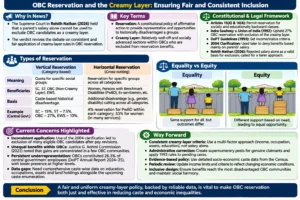
The Supreme Court’s 2026 ruling, as discussed in the editorial, questioned the exclusion of OBC candidates from reservation benefits solely on their parents’ salaries.
What is Reservation?
- Reservation is a constitutional affirmative-action measure providing opportunities to historically disadvantaged groups in education, public employment and political representation.
- It promotes substantive equality by addressing discrimination, social exclusion and unequal starting conditions.
- Constitutional provisions: Articles 15(4), 15(5), 16(4) enable special measures; Articles 15(6), 16(6) provide for EWS reservation.
Vertical vs Horizontal Reservation
- Vertical reservation: Separate category-based quotas for SCs, STs, OBCs and EWS.
- Example: Central government direct recruitment generally provides 15% SC, 7.5% ST, 27% OBC and 10% EWS reservation.
- Horizontal reservation: Cross-cutting benefits for groups such as women, persons with benchmark disabilities and ex-servicemen.
- Example: A woman selected under an OBC women’s horizontal quota is counted within the OBC category, not against an additional quota.
What is the OBC Creamy Layer?
- The creamy layer refers to relatively advanced OBC sections excluded from OBC reservation benefits.
- Indra Sawhney v. Union of India (1992): Upheld 27% OBC reservation in central services while requiring creamy-layer exclusion.
- 1993 guidelines: Established criteria involving parental occupational status and income.
- Income ceiling: The central creamy-layer income threshold was raised to ₹8 lakh annually in 2017, subject to applicable exclusions and category-specific rules.
Recent Judicial and Administrative Issues
- Salary controversy: The editorial reports that parental salary alone cannot establish social advancement.
- 2004 clarification: Its application allegedly excluded candidates following salary increases without corresponding occupational advancement.
- Service allocation: Retrospective corrections raise questions about administrative certainty and remedies for affected candidates.
- Fairness: Eligible candidates should receive consistent treatment regardless of their ability to pursue litigation.
Challenges
- Unequal representation: The editorial cites 26.3% OBC representation in central government employment, with lower representation in senior positions.
- Uneven benefits: The Justice G. Rohini Commission examined disparities among OBC communities.
- Data limitations: Caste counts alone cannot explain differences in education, occupation, assets and landownership.
- Multiple disadvantages: Caste discrimination may persist even when some families achieve economic advancement.
Way Forward
- Uniform criteria: Apply creamy-layer rules consistently, distinguishing occupational status from salary increases.
- Evidence-based policy: Collect disaggregated socioeconomic data while protecting privacy.
- Fair remedies: Consider lawful corrective measures for eligible candidates affected by administrative errors.
- Inclusive development: Combine reservation with quality education, scholarships, skill development and anti-discrimination enforcement.
Conclusion
Reservation achieves lasting social justice when it recognises caste-based exclusion, addresses inequalities within communities and applies transparent rules fairly.
STARLINK IN INDIA AND SATELLITE COMMUNICATIONS
TOPIC: (GS3) SCIENCE AND TECHNOLOGY: THE HINDU
The debate over Starlink’s entry into India has raised concerns about foreign control over satellite Internet services and national security.
What is Starlink?
- Starlink, operated by SpaceX, provides broadband through Low Earth Orbit (LEO) satellites, generally offering lower latency than traditional geostationary satellites.
- Unlike fibre networks, satellite Internet can serve remote areas without extensive ground infrastructure.
- Limitation: Satellite capacity is shared, making it less suitable than fibre for densely populated areas.
Importance for India
- Digital inclusion: Connects remote villages, islands, mountains and border settlements.
- Disaster management: Restores communications when floods, cyclones or earthquakes damage terrestrial networks.
- National security: Supports military communication, surveillance, drones and emergency coordination.
- Blue economy: Improves connectivity for ships, offshore installations and maritime operations.
Major Strategic Concerns
- Foreign dependence: SpaceX controls satellite operations, software updates and terminal access.
- Service disruption: Connectivity could be restricted during geopolitical disagreements or technical failures.
- Digital sovereignty: Foreign-controlled networks create challenges for lawful interception and data protection.
- Regulatory enforcement: Satellite-to-satellite links make independent verification of traffic routing difficult.
- Resilience trade-off: Mandatory domestic gateways strengthen oversight but may reduce alternative routing during outages.
International Experiences
- Iran: According to the editorial, unauthorised Starlink operations continued despite repeated complaints before the International Telecommunication Union.
- Ukraine: Cooperation with SpaceX helped restrict unauthorised terminals, demonstrating the importance of operator support.
- Conflict risks: Reported connectivity disruptions underline the dangers of relying on one privately controlled system for critical military functions.
India’s Regulatory and Institutional Framework
- Department of Telecommunications (DoT): Regulates telecom licensing and security conditions.
- IN-SPACe: Authorises and promotes non-governmental space activities.
- Telecommunications Act, 2023: Provides the legal framework for telecommunications and spectrum assignment.
- Satellite spectrum: The Act provides for administrative assignment for specified satellite services, subject to applicable conditions.
- Indian gateways: Domestic routing, monitoring and compliance requirements aim to protect national security.
Way Forward
- Strategic diversification: Encourage multiple satellite providers to avoid dependence on one operator.
- Domestic capability: Strengthen ISRO-supported technology development and private satellite manufacturing.
- Infrastructure expansion: Improve BharatNet, optical fibre and mobile coverage in underserved regions.
- Security audits: Develop independent technical checks for traffic routing and compliance.
- Operational backups: Maintain alternative communication systems for defence and disaster-response agencies.
- International cooperation: Strengthen coordination through the ITU and trusted technology partnerships.
Conclusion
India must welcome satellite innovation without surrendering control over essential communications, ensuring connectivity remains resilient, secure and strategically independent.
WOMEN’S EMPLOYMENT IN INDIA
TOPIC: (GS3) ECONOMY: THE HINDU
A recent ICRIER report, The Participation Paradox, highlights that increasing women’s employment has not resulted in equally secure, productive or well-paid jobs. Analysis of PLFS and Time Use Survey data reveals persistent wage inequality, agricultural dependence and unequal unpaid care responsibilities.
Status of Women’s Employment
- Employment growth: Working women increased from 104 million in 2017–18 to 201 million in 2025.
- Worker Population Ratio (WPR): Increased from 22% to 38%, indicating greater participation in employment.
- Rural concentration: Most additional employment emerged in agriculture, household enterprises and self-employment.
- Structural transformation: Unlike men, women have not significantly shifted from agriculture towards higher-productivity industries.
Challenges
- Agricultural dependence: Rural women’s employment share in agriculture increased from 70.7% to 73.3%, while men’s declined.
- Informal employment: Women increasingly work in garments, retail and construction, often without job security or social protection.
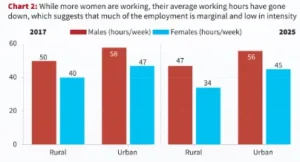
- Declining working hours: Rural women worked approximately six fewer hours weekly, suggesting limited or irregular employment.
- Self-employment: Own-account work expanded substantially, while regular salaried employment among rural women declined.
Gender Wage Inequality
- Earnings disparity: Rural women’s earnings were approximately 45% of rural men’s earnings, compared with 53% earlier.
- Sectoral differences: Men earned around twice as much per hour in certain education and manufacturing activities.
- Employment quality: Low wages, limited formal contracts and inadequate benefits restrict women’s economic independence.
- Example: Home-based garment workers may receive piece-rate payments without paid leave or employment security.
Unpaid Domestic and Care Work
- Double burden: Women combine paid employment with cooking, cleaning, childcare and elderly care.
- Time Use Survey 2024: Women spent approximately 3.7 additional hours daily on domestic work compared with men.
- Care responsibilities: Around 60% of women outside the labour force cited household or childcare duties.
- Economic invisibility: Unpaid household services are generally excluded from GDP despite their contribution to economic well-being.
Constitutional and Government Initiatives
- Article 39(d): Promotes equal pay for equal work.
- Article 42: Provides for humane working conditions and maternity relief.
- Maternity Benefit Act, 1961: Provides eligible women with maternity benefits and specified childcare protections.
- DAY-NRLM: Supports rural women’s self-help groups, livelihoods and financial inclusion.
- Palna Scheme: Promotes childcare facilities to support working mothers.
- Stand-Up India: Supports entrepreneurship among women and eligible disadvantaged groups.
Way Forward
- Care infrastructure: Expand affordable crèches, community childcare and shared parental responsibilities.
- Quality employment: Promote formal contracts, social security and fair remuneration.
- Women-friendly industries: Provide safe transport, hostels, workplace facilities and digital training.
- Rural opportunities: Strengthen women-led producer organisations, food-processing clusters and local enterprises.
- Gender-responsive policy: Link MSME incentives with women’s recruitment, retention and career advancement.
Conclusion
India’s employment transformation will be truly inclusive only when women’s growing participation translates into dignified work, equal earnings and freedom from disproportionate unpaid care burdens.

SUPREME COURT STRENGTHENS SAFEGUARDS AGAINST ARBITRARY ARREST AND DETENTION
TOPIC: (GS2) POLITY: THE HINDU
The Supreme Court, in a recent drug-smuggling case from Tripura, ruled that the 24-hour limit for producing an arrested person before a magistrate begins when personal liberty is actually restricted.
Constitutional Protection Against Arrest
- Article 21: Protects life and personal liberty except through a procedure established by law that must be fair, just and reasonable.
- Article 22(1): Guarantees information about arrest grounds and the right to consult a legal practitioner.
- Article 22(2): Requires production before the nearest magistrate within 24 hours, excluding necessary travel time.
- Exception: These safeguards under Article 22(1)–(2) do not apply to enemy aliens and persons detained under preventive-detention laws, as specified in Article 22(3).
Background of the Case
- Interception: Customs officers detained individuals carrying approximately 60 kg of methamphetamine tablets at 2 p.m.
- Delayed documentation: Formal arrest records were prepared at 11 a.m. the following day.
- Judicial production: The accused appeared before a magistrate at 4:45 p.m., exceeding 24 hours from their initial restraint.
- Dispute: Investigators argued that searches and questioning occurred before formal arrest.
Major Supreme Court Observations
- Actual custody matters: The constitutional clock begins when authorities effectively prevent a suspect from leaving.
- No investigative exemption: Interrogation, searches and seizures cannot suspend the prescribed deadline.
- Substance over paperwork: Delaying an arrest memo cannot legitimise prolonged custody.
- Judicial scrutiny: Magistrates must examine detention circumstances instead of automatically approving remand.
Relevant Legal Framework
- BNSS, 2023 — Section 58: Restricts detention without a warrant to a reasonable period, ordinarily not exceeding 24 hours without judicial authorisation.
- NDPS Act, 1985: Authorises investigation of narcotics offences; Section 37 imposes strict bail conditions for specified offences.
- Constitutional supremacy: Special statutory restrictions cannot justify detention violating fundamental rights.
- Union of India v. K.A. Najeeb (2021): Recognised constitutional courts’ power to grant bail where prolonged incarceration violates personal liberty.
Custodial Accountability and Wider Significance
- CCTV monitoring: The Supreme Court’s Paramvir Singh Saini directions require surveillance arrangements in police stations and designated investigative offices, with safeguards for footage preservation.
- Preventing torture: Recording custody-related activities can discourage coercion and illegal interrogation.
- Rule of law: Investigative efficiency must remain consistent with constitutional guarantees.
- Public confidence: Independent judicial supervision strengthens accountability and protects vulnerable detainees.
Conclusion
Personal liberty cannot depend on administrative paperwork; constitutional safeguards must operate from the moment the State takes effective control of an individual’s freedom.