
An analysis of CPCB air-quality data revealed that nearly 70% of reporting monitoring stations recorded peak PM2.5 concentrations of at least 250 µg/m³ during Deepavali.
Key Findings of the Report
- Nationwide pollution: Of 551 reporting stations, 375 recorded hourly PM2.5 peaks of 250 µg/m³ or above, compared with 96 before Deepavali.
- Geographical spread: High pollution was observed in Delhi, Maharashtra, Uttar Pradesh, Rajasthan, Haryana, Madhya Pradesh, Gujarat and Andhra Pradesh.
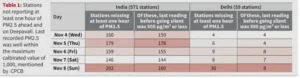
- Monitoring gaps: Only 571 of CPCB’s 634 stations were operational during the festival.
- Example: In Tamil Nadu, only nine of 37 stations reported PM2.5 readings during the analysed hours.
Understanding PM2.5 Pollution
- PM2.5: Fine particulate matter measuring 2.5 micrometres or less in diameter.
- Sources: Firecrackers, vehicles, industries, construction dust and biomass burning.
- Health effects: Fine particles can enter deep into the lungs and bloodstream, increasing respiratory and cardiovascular risks.
- WHO guideline: The recommended 24-hour PM2.5 average is 15 µg/m³.
- Important distinction: The report’s 250 µg/m³ threshold refers to hourly peaks, not India’s official daily AQI classification.
Why Does Pollution Increase During Deepavali?
- Firecracker emissions: Release particulate matter, sulphur dioxide (SO₂) and other pollutants.
- Weather conditions: Low wind speeds and temperature inversions can trap pollutants near the ground.
- Existing pollution: Vehicle emissions, industrial activity and regional biomass burning worsen the cumulative burden.
- Green crackers: Their effectiveness depends on product standards, enforcement and actual emission reductions.
Air-Quality Monitoring Challenges
- Data interruptions: Several stations stopped reporting during periods of intense pollution.
- CPCB explanation: Some analysers have an upper measurement range of 1,000 µg/m³, potentially causing missing readings.
- Unresolved concern: Some stations stopped reporting even when their last recorded values were below that limit.
- Governance issue: Incomplete data can weaken pollution alerts, scientific assessment and public accountability.
Government Measures
- Air (Prevention and Control of Pollution) Act, 1981: Provides the legal framework for controlling air pollution.
- National Clean Air Programme (NCAP): Supports city-level action to reduce particulate pollution.
- GRAP: Introduces graded emergency measures during worsening air-quality episodes in Delhi-NCR.
- CAAQMS network: Enables continuous measurement of major air pollutants.
Way Forward
- Reliable monitoring: Upgrade sensors, strengthen maintenance and publicly explain data gaps.
- Emission control: Enforce firecracker standards and regulate transport, industrial and construction emissions.
- Regional coordination: Address pollution across State boundaries through joint action.
- Public health: Strengthen early warnings, hospital preparedness and protection for vulnerable groups.
- Long-term planning: Promote cleaner transport, energy efficiency and evidence-based urban management.
Conclusion
India needs year-round emission reduction and transparent pollution monitoring to ensure that festive celebrations do not come at the cost of public health.
The Ministry of Home Affairs (MHA) has simplified India’s visa system by reducing visa categories from 13 to nine and shortening application forms by 65–70%.
Key Features of the Visa Reforms
- Category rationalisation: Main visa categories reduced from 13 to nine, while sub-categories declined from 49 to 23.
- Earlier reforms: In October 2025, main categories were reduced from 22 to 13.
- Simplified applications: Fewer information fields will reduce paperwork and processing difficulties.
- Digital modernisation: MHA is upgrading IT systems to implement the revised visa framework.
- International practices: Reforms draw on visa-management systems and standards followed by other countries.

New Visitor Visa Framework
- Renaming: Tourist Visa becomes Visitor Visa, covering a wider range of short-term activities.
- V-1 Visa: Valid for 30 days with multiple entries.
- Covers tourism, business meetings, medical consultations, wellness activities and short courses in Indian arts and languages.
- V-2 Visa: Available for one, five or ten years.
- Includes V-1 activities and mountaineering.
Special Visa for Technical Experts
- Production Investment Business Visa: Introduced for foreign engineers, specialists and technical professionals.
- Permitted activities: Machinery installation, quality testing, plant commissioning, maintenance and technical training.
- Technology transfer: Facilitates industrial knowledge-sharing and production support.
- Example: A foreign semiconductor engineer assisting with equipment installation at an Indian manufacturing facility.
Medical Visa Reforms
- M-1 Visa: Covers treatment under conventional medical systems.
- M-3 Visa: Covers treatment under AYUSH systems, including Ayurveda and Yoga-based wellness services.
- Validity: Both categories generally provide one-year validity with multiple entries.
- Medical attendants: Separate provisions support accompanying caregivers.
Significance of the Reforms
- Ease of doing business: Simplifies entry procedures for foreign investors and skilled professionals.
- Tourism growth: Encourages international visitors and supports hospitality employment.
- Medical value travel: Strengthens India’s position in affordable healthcare and traditional medicine.
- Make in India: Supports manufacturing, technology transfer and industrial modernisation.
- Administrative efficiency: Enables more focused scrutiny of applications and reduces processing burdens.
Way Forward
- Security concerns: Simplification must not weaken identity verification or immigration checks.
- Digital access: Ensure reliable portals, multilingual assistance and accessible application systems.
- Inter-agency coordination: Improve cooperation among MHA, immigration authorities and Indian missions abroad.
- Monitoring: Regularly assess processing times, visitor satisfaction and compliance.
Conclusion
A simpler, secure and technology-driven visa system can strengthen India’s global connectivity, investment climate and service-sector competitiveness.
The LIGO-Virgo-KAGRA collaboration released an expanded catalogue containing 390 candidate gravitational-wave events, enabling large-scale studies of black holes.
What Are Gravitational Waves?
- Definition: Gravitational waves (G-waves) are tiny ripples in spacetime produced by accelerating massive objects.
- Theory: Predicted by Albert Einstein’s General Theory of Relativity (1915).
- Speed: They travel at the speed of light.
- Sources: Mergers of black holes and neutron stars, and certain stellar explosions.
- First detection: In 2015, LIGO detected waves from merging black holes.
How Are They Detected?
- LIGO: Laser Interferometer Gravitational-Wave Observatory measures extremely small changes in distance using laser beams.
- Other observatories: Virgo (Italy) and KAGRA (Japan).
- Chirp: Increasing wave frequency as two black holes spiral closer.
- Ringdown: Fading vibrations after the merger.

Major Scientific Discoveries
- Statistical astronomy: Hundreds of observations help scientists identify patterns in black-hole masses and spins.
- Testing Einstein: Gravitational-wave observations provide evidence supporting General Relativity.
- Cosmology: Wave signals can help estimate the universe’s expansion rate.
- Stellar evolution: Black-hole populations reveal how massive stars form and die.
Significance of LIGO-India
- Location: Hingoli district, Maharashtra.
- Expected operations: Around 2030, according to the article.
- Benefit: Improves identification of gravitational-wave sources through triangulation.
- Strategic importance: Strengthens India’s capabilities in advanced physics, precision engineering and international scientific cooperation.
Conclusion
Gravitational waves offer humanity a new window into the universe, transforming invisible cosmic events into measurable scientific evidence.
The Archaeological Survey of India (ASI) has initiated steps to declare Raniwas Mound in Bihar a monument of national importance.
Location and Background
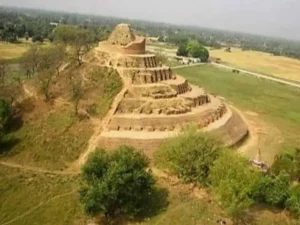
- Location: East Champaran district, Bihar.
- Nearby landmark: Situated northeast of the famous Kesariya Buddha Stupa.
- Area: Approximately 1.63 acres.
- Historical association: Believed to contain remains of a Buddhist vihara or temple-monastery.
Archaeological Importance
- Alexander Cunningham, the first Director General of ASI, examined and excavated the mound.
- He reported remains of an ancient Buddhist establishment.
- Important findings included a small temple structure and a large Buddha image.
- The site may provide evidence about Buddhist religious practices and monastic settlements.
About the Archaeological Survey of India
- Established: 1861, under the leadership of Alexander Cunningham.
- Ministry: Functions under the Ministry of Culture.
- Responsibilities: Archaeological exploration, excavation, conservation and protection of important monuments.
- Legal framework: The Ancient Monuments and Archaeological Sites and Remains Act, 1958, governs protection of centrally recognised monuments.
Significance of National Importance Status
- Legal protection: Helps prevent unauthorised construction, encroachment and damage.
- Scientific conservation: Facilitates archaeological research and preservation.
- Cultural tourism: Can strengthen Bihar’s Buddhist heritage circuit.
- Historical awareness: Encourages public understanding of India’s Buddhist past.
Way Forward
- Conduct systematic excavations and scientific documentation.
- Ensure community participation and responsible heritage tourism.
- Improve conservation facilities without damaging archaeological remains.
Conclusion
Protecting Raniwas Mound can preserve India’s Buddhist heritage while strengthening archaeological research and sustainable cultural tourism.
Khushbu Rajakbhai Darjada, a young athlete from the Siddi community, reportedly won a judo silver medal at the Dakar Youth Olympics.
Origin and Historical Background
- Siddis are an Indian ethnic community with ancestral connections to East Africa.
- Their ancestors arrived through maritime trade, migration, military service and historical slave-trading networks.
- Some served under Indian rulers, including the Nawabs of Junagadh.
- Their history reflects centuries of cultural interaction across the Indian Ocean.

Geographical Distribution
- Mainly found in Gujarat, Karnataka, Maharashtra and Goa.
- Jambur village, near Gir National Park in Gujarat, is popularly called “Mini Africa”.
- Communities have adopted regional languages while preserving distinct cultural traditions.
Culture and Traditions
- Dhamal: Traditional group dance reflecting African cultural influences.
- Baba Gor: Revered Sufi saint associated with Siddi spiritual traditions.
- Religion: Community members follow Islam, Hinduism or Christianity depending on regional histories.
- Cultural identity: Music, dance and oral traditions preserve ancestral connections.
Constitutional and Social Status
- Scheduled Tribe status: Recognised for specified Siddi communities and geographical areas under applicable government notifications.
- Article 342: Provides the constitutional framework for specifying Scheduled Tribes.
- PVTG classification: Certain Siddi groups have been identified among Particularly Vulnerable Tribal Groups.
Way Forward
- Challenges: Educational disadvantages, livelihood insecurity, discrimination and limited access to opportunities.
- Measures: Improve scholarships, sports infrastructure, skill development and culturally sensitive welfare programmes.
- Example: Supporting talented Siddi athletes can promote both representation and social mobility.
Conclusion
The Siddi community represents India’s multicultural heritage, making inclusive development and preservation of its unique traditions equally essential.