
Table of Contents
ToggleIndia Must Lead in Securing the Strait of Bab el-Mandeb
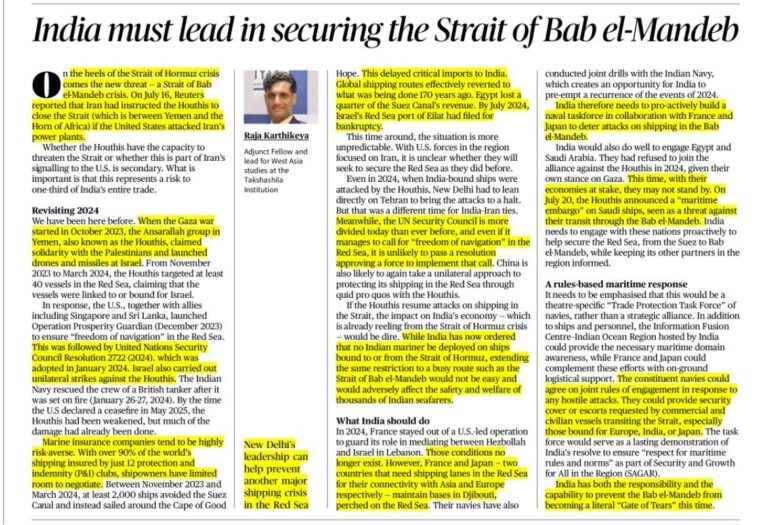
Following the Strait of Hormuz crisis, the Strait of Bab el-Mandeb has emerged as a critical maritime chokepoint affecting India’s trade and energy security. Recent geopolitical developments, including Houthi threats and regional conflicts, underscore the need for proactive measures to secure this strategic corridor.
Geopolitical Context
Threats to Maritime Security
The Houthi group in Yemen has targeted commercial shipping and aligned with Palestinian interests during the Gaza conflict. The closure of key ports, attacks on vessels, and threats to the Red Sea and Suez Canal demonstrate vulnerabilities in global maritime trade. Marine insurance constraints further complicate shipping operations, highlighting the economic risks of maritime instability.
Strategic Importance for India
India depends on the Bab el-Mandeb Strait for critical imports and energy security. Delays or disruptions here could impact the movement of goods, fuel, and resources, affecting domestic supply chains and economic stability.
India’s Strategic Response
Naval Task Force and International Cooperation
India must proactively build a naval task force in collaboration with France and Japan to deter attacks and protect shipping lanes. Engagement with Egypt, Saudi Arabia, and other regional partners is necessary to ensure safe passage through the Red Sea and the Bab el-Mandeb corridor.
Rules-Based Maritime Security
A rules-based approach, including joint drills, security escorts, and information fusion centers, is essential. The task force should protect commercial and civilian vessels transiting the Strait, particularly those bound for Europe, India, or Japan. These measures reinforce India’s maritime influence and promote regional stability.
Strategic and Economic Benefits
Protecting Trade and Energy Flows
Securing the Strait ensures uninterrupted trade, reduces insurance and shipping costs, and safeguards India’s energy imports. It strengthens India’s position in West Asian geopolitics and mitigates risks arising from regional instability.
Long-Term Partnerships
Collaboration with international partners enhances India’s strategic autonomy, builds operational experience for the navy, and fosters long-term economic and security cooperation across the Indo-Pacific and West Asian maritime routes.
Conclusion
India’s leadership in securing the Strait of Bab el-Mandeb is vital for its national security, trade, and energy interests. By engaging proactively with regional and global partners, India can protect critical maritime routes, enhance naval readiness, and strengthen its influence in global maritime affairs. For UPSC aspirants, this topic is relevant under international relations, maritime security, energy security, West Asia, and defence diplomacy.
Vocabulary Boost
Chokepoint → Narrow strategic passage crucial for trade.
Freedom of Navigation → Right of vessels to navigate international waters.
Maritime Domain Awareness → Monitoring activities and threats at sea.
Rules-Based Order → International conduct governed by agreed laws and norms.
SAGAR → Security and Growth for All in the Region.
Frequently Asked Questions (FAQs)
What is the strategic importance of the Strait of Bab el-Mandeb for India?
It is a key maritime chokepoint for energy imports, trade, and connecting the Indian Ocean with the Red Sea and Mediterranean routes.
What threats are affecting the Bab el-Mandeb Strait?
Houthi attacks on shipping, regional conflicts, and geopolitical tensions in Yemen and surrounding areas pose significant risks.
How is India planning to secure the Strait?
India aims to build a naval task force, conduct joint exercises with France and Japan, and engage regional partners like Egypt and Saudi Arabia for maritime security.
What are the economic implications of securing the Strait?
Securing the Strait ensures uninterrupted trade, reduces shipping and insurance costs, and protects India’s energy imports and critical resources.
Why is this topic important for UPSC?
It is relevant under international relations, maritime security, energy security, West Asia geopolitics, and defence diplomacy.
Source From : The Hindu
The Voice of India’s Youth Must Be Heard Inside Parliament
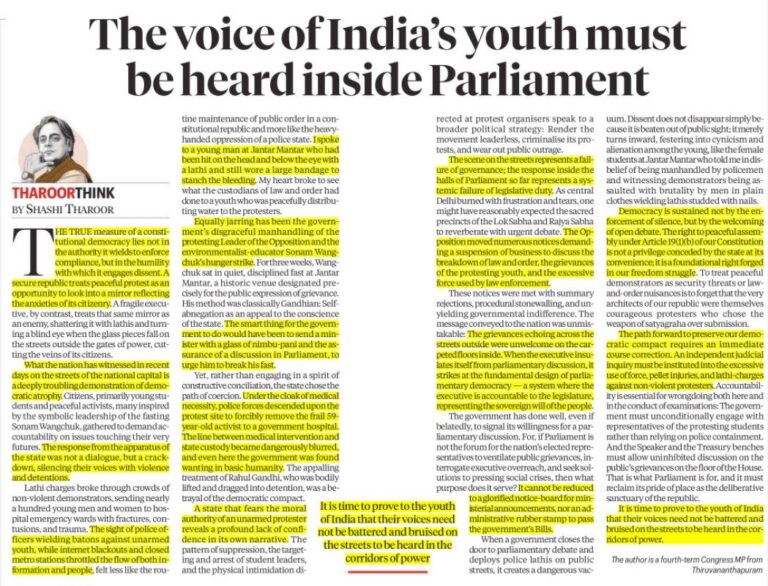
The article discusses the Jantar Mantar protest in Delhi, highlighting the growing role of youth in shaping India’s democracy. Citizens, especially students and young professionals, organised peacefully to demand accountability on education, employment, and systemic governance issues. The piece emphasises that democratic politics must ensure youth voices are heard inside Parliament and corridors of power, not just on the streets.
Key Features of the Protest
Youth-Led Mobilisation
The protest was largely self-mobilised, with participants from across India, including elite universities, rural areas, and government and private institutions. Social media played a crucial role in organising travel, communication, and awareness.
Focus on Education and Employment
The protest addressed systemic issues such as exam cancellations, NEET/CBSE challenges, and unemployment. The underlying demand was for equitable, meaningful access to education and a universal right to employment.
Institutional Response and Challenges
Government and Political Reaction
Authorities responded with police action, yet the movement highlighted gaps in governance. The article notes that governments and political leaders often struggle to respond proportionally and transparently to large-scale, spontaneous civic mobilisation.
Media Amplification
The media coverage helped amplify the youth’s message, making it a national conversation. The visibility of youth action demonstrates how citizens can influence public debate even without formal party support.
Lessons for Democracy
- Youth engagement is critical for policy accountability and systemic reforms.
- Peaceful, self-organised civic action can create pressure on authorities.
- Digital and social media are powerful tools for coordination and amplification.
- Parliament and institutional channels must be responsive to citizens’ demands.
Conclusion
The Jantar Mantar protest exemplifies how India’s youth are actively shaping democratic politics. Civic activism, media amplification, and sustained engagement can influence governance and policy. For UPSC aspirants, this topic is relevant under governance, civil society, youth participation, democratic accountability, and policy reforms.
Vocabulary Boost
Dissent → Public disagreement with prevailing authority or policy.
Deliberation → Careful discussion before taking decisions.
Accountability → Obligation to explain and take responsibility for actions.
Coercion → Using force or threats to compel behaviour.
Democratic compact → The implicit relationship of rights, duties and accountability between citizens and the state.
Frequently Asked Questions (FAQs)
What was the main focus of the Jantar Mantar protest in Delhi?
The protest focused on systemic issues in education, employment, and governance, demanding accountability from authorities.
How was the protest organised?
It was largely self-mobilised, coordinated via social media, with participants from across India including students and young professionals.
Who participated in the protest?
Participants included youth from elite universities, rural areas, and citizens concerned about education and employment issues.
How did the media influence the protest?
Media coverage amplified the youth’s voice, creating national visibility and turning local civic action into a broader public debate.
Why is this topic important for UPSC?
It is relevant under governance, civil society, youth participation, democratic accountability, and policy reforms.