Table of Contents
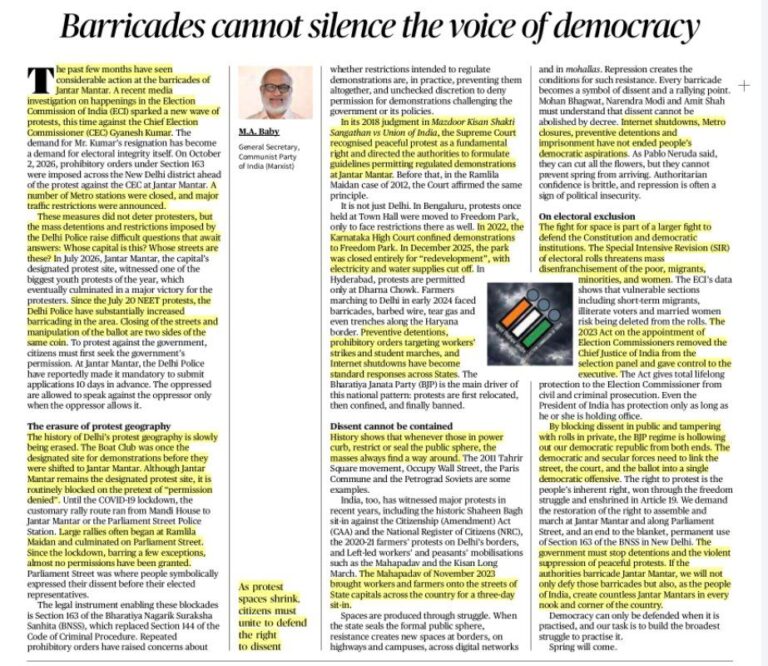
ToggleBarricades Cannot Silence the Voice of Democracy
The recent restrictions around Jantar Mantar have renewed the debate over the right to protest in India and the balance between public order and democratic freedoms. The article highlights how barricades, restrictions on demonstrations and increasing regulation of protest spaces can affect citizens’ ability to express dissent. While governments have legitimate concerns regarding security and public order, excessive restrictions may weaken the democratic space for peaceful expression.
Right to Protest and Constitutional Freedom
The right to peaceful protest is closely connected with the fundamental freedoms guaranteed under the Indian Constitution. Article 19 provides citizens with freedoms of speech and expression and the right to assemble peacefully and without arms.
However, these freedoms are not absolute. Reasonable restrictions can be imposed in the interests of public order, sovereignty and integrity of India and other constitutionally recognised grounds.
The Supreme Court has also recognised that peaceful demonstrations are an important part of democracy. The article refers to the 2018 Mazdoor Kisan Shakti Sangathan case, where the Court recognised the need to balance the right to protest with the concerns of residents and authorities while permitting regulated demonstrations.
Shrinking Spaces for Protest
The article argues that the geography of protest is gradually changing. Restrictions around established protest locations such as Jantar Mantar can make it increasingly difficult for citizens to gather and express collective grievances.
Examples of protests and demonstrations in different parts of the country show that citizens often move to alternative spaces when conventional avenues become restricted. This demonstrates that suppressing a protest location does not necessarily eliminate public dissatisfaction.
The growing use of barricades, prohibitory orders, preventive detention and restrictions on public gatherings can therefore raise questions about proportionality and democratic accountability.
Protest and Electoral Democracy
The article also connects the right to protest with broader concerns regarding electoral processes, including the Special Intensive Revision (SIR) of electoral rolls. It highlights concerns about potential disenfranchisement and stresses that democratic participation extends beyond voting.
A healthy democracy requires citizens to question government decisions, mobilise peacefully and demand accountability.
Conclusion
The debate surrounding Jantar Mantar and the right to protest demonstrates the importance of maintaining a balance between public order and democratic freedoms. Peaceful dissent is not a threat to democracy; it is an essential mechanism through which citizens communicate grievances and hold institutions accountable. Restrictions on protests should therefore remain lawful, necessary and proportionate, ensuring that security concerns do not permanently shrink the democratic space available to citizens.
Vocabulary
1. Dissent – Expression of disagreement with authority.
2. Civil Liberties – Fundamental freedoms of citizens.
3. Prohibitory Orders – Legal restrictions on certain public activities.
Prelims MCQs
MCQ 1
Consider the following statements:
1. Article 19(1)(b) guarantees peaceful assembly without arms.
2.The right to protest is absolute.
3. Article 19(3) permits reasonable restrictions on peaceful assembly.
Which are correct?
A) 1 and 2 only
B) 1 and 3 only
C) 2 and 3 only
D) 1, 2 and 3
Answer: B
UPSC Mains Question
“The right to peaceful protest is essential for democratic accountability.” Examine the constitutional safeguards and challenges. (10 Marks)
Frequently Asked Questions (FAQs)
Is the right to protest a fundamental right in India?
Yes. The right to peaceful assembly and freedom of speech and expression are protected under Article 19, subject to reasonable constitutional restrictions.
Can the government restrict protests?
Yes. Authorities can impose reasonable restrictions on protests in situations involving legitimate concerns such as public order and security, but restrictions must remain constitutionally justified.
What is the significance of Jantar Mantar?
Jantar Mantar has traditionally served as an important public space for demonstrations and expression of political and social grievances in Delhi.
What did the Mazdoor Kisan Shakti Sangathan case address?
The Supreme Court examined the balance between the right to protest and the rights of residents and the need to maintain public order.
Why is the right to protest important in democracy?
Peaceful protest enables citizens to express dissent, raise grievances, demand accountability and participate actively in democratic governance.
Source From : The Hindu
The Next Farm Revolution: Raising Farmers’ Incomes in India
India’s agricultural transformation has entered a new phase. The next farm revolution in India must move beyond increasing production and focus on significantly raising farmers’ incomes, improving resource efficiency and creating sustainable agricultural growth. The experience of Gujarat and subsequent national-level initiatives provide important lessons for building a more resilient and prosperous farm sector.
Gujarat’s Agricultural Transformation
During Narendra Modi’s tenure as Gujarat Chief Minister from 2001-02 to 2013-14, the State recorded agricultural growth of more than 9% per year, according to the article. The transformation was supported by investments in irrigation, water availability, rural roads and agricultural extension.
The expansion of irrigation through check dams and access to Narmada waters helped improve agricultural productivity. Separate feeder lines for irrigation and rural households also strengthened the reliability of agricultural power supply. Initiatives such as Krishi Mahotsav promoted interaction between farmers, government agencies and the private sector, helping spread modern agricultural technologies.
India’s Agricultural Progress
At the national level, agriculture has remained important for food security and rural livelihoods. Greater irrigation coverage, crop insurance and agricultural infrastructure have supported production. India has also emerged as a major producer and exporter of several agricultural commodities.
However, the article highlights that agricultural growth under the Modi government has averaged around 4%, considerably below the growth required to achieve the objective of doubling farmers’ real incomes.
Correcting the Crop Imbalance
One major challenge is the mismatch between India’s production and consumption patterns. The country produces large quantities of rice and wheat while remaining dependent on imports of products such as pulses and edible oils.
The article suggests improving incentives for pulses and oilseeds to encourage crop diversification, reduce pressure on groundwater and improve environmental sustainability.
Agri-Photovoltaics: A New Opportunity
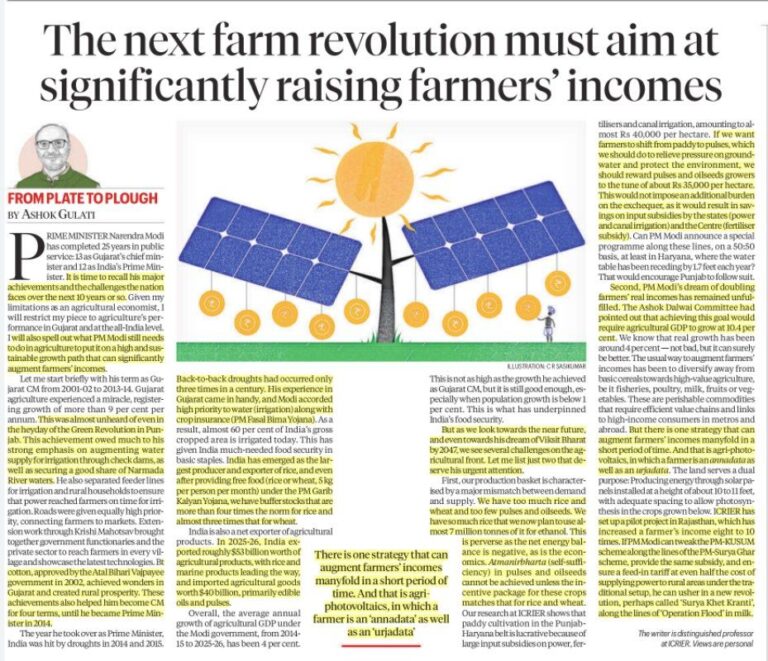
A promising strategy highlighted in the article is agri-photovoltaics, where agricultural land is used simultaneously for farming and solar-energy generation. Solar panels installed at an appropriate height can allow crops to grow underneath while generating electricity.
Such a model can potentially transform farmers into both “annadatas” and “urjadatas”, creating an additional source of rural income.
Conclusion
The next agricultural revolution must focus on income growth, diversification, sustainability and value addition, rather than production alone. Better incentives for pulses and oilseeds, high-value agriculture and agri-photovoltaics can help create new income opportunities while conserving natural resources. India’s agricultural future will depend on making farmers more productive, resilient and economically secure.
Vocabulary
1. Agri-photovoltaics – Combining farming with solar power generation.
2. Crop Diversification – Cultivating different crops to reduce risks.
3. Real Farm Income – Farmers’ earnings adjusted for inflation.
Prelims MCQs
MCQ 1
Consider the following benefits of agri-photovoltaics:
1. Additional income from solar power
2. Dual use of agricultural land 3. Complete elimination of irrigation needs
Which are correct?
A) 1 and 2 only
B) 2 and 3 only
C) 1 and 3 only
D) 1, 2 and 3
Answer: A
UPSC Mains Question
“India’s next agricultural revolution must shift from maximising production to enhancing farmers’ real incomes.” Discuss. (10 Marks)
Frequently Asked Questions (FAQs)
What should be the focus of India’s next farm revolution?
The next farm revolution should focus on raising farmers’ incomes, improving productivity, crop diversification and sustainable resource use.
What contributed to Gujarat’s agricultural growth?
The article highlights irrigation expansion, check dams, Narmada water, reliable agricultural power, roads and agricultural extension services.
Why is crop diversification important?
Diversification towards pulses and oilseeds can reduce dependence on water-intensive crops, address import dependence and help conserve groundwater.
What is agri-photovoltaics?
Agri-photovoltaics combines agricultural cultivation with solar power generation, allowing farmers to produce crops and electricity on the same land.
How can agri-photovoltaics increase farmers’ income?
It can provide farmers with an additional income stream through solar-energy generation, potentially making them both food producers and energy producers.