

Table of Contents
ToggleAI’s Next Test — Reaching India’s Informal Women Workers
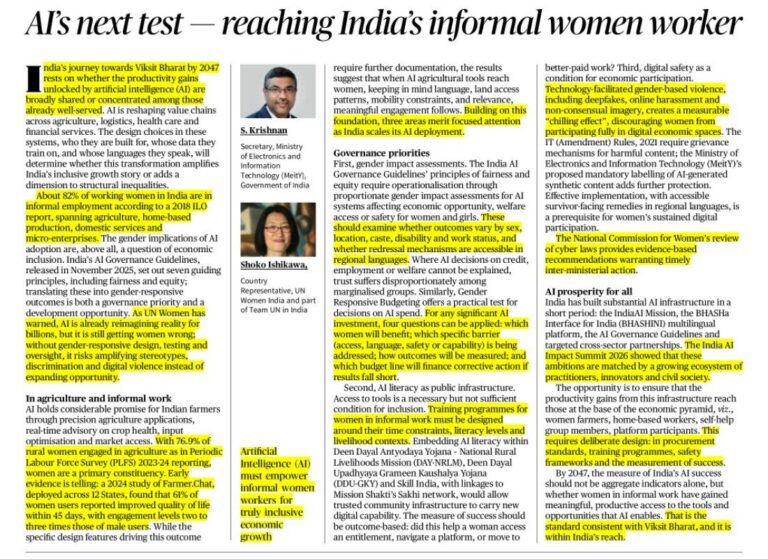
India’s journey towards becoming a developed economy by 2047 (Viksit Bharat) depends on whether emerging technologies like Artificial Intelligence (AI) create inclusive growth opportunities. A major challenge is ensuring that AI benefits India’s large population of informal women workers, who contribute significantly to the economy but often remain excluded from technological advancements.
Informal Women Workers in India
Economic Contribution and Challenges
According to the International Labour Organization (ILO), a large majority of working women in India are engaged in informal employment, including:
- Agriculture
- Domestic work
- Home-based production
- Micro-enterprises
- Self-employment
While AI can improve productivity and access to markets, unequal access to technology may deepen existing gender inequalities.
Role of AI in Empowering Women Workers
Improving Livelihood Opportunities
AI can support women workers through:
- Precision agriculture tools for women farmers
- Digital platforms for market access
- Skill development and training
- Better financial inclusion
- Improved healthcare and welfare services
For example, AI-based agricultural advisory systems can provide information on crops, weather, and markets, helping women farmers make better decisions.
Challenges in AI Adoption
Digital Divide
Many informal women workers face barriers such as:
- Limited digital literacy
- Lack of smartphone and internet access
- Language barriers
- Financial constraints
Without inclusive design, AI may benefit only educated and urban populations.
Gender-Based Digital Risks
AI-generated deepfakes, online harassment, and cyber exploitation create additional risks for women. Strong data protection, digital safety measures, and accessible grievance mechanisms are essential.
Governance Priorities
Gender-Responsive AI Development
India needs policies that ensure AI systems consider:
- Gender impact assessment
- Accessibility for rural women
- Regional language support
- Transparent decision-making
AI Literacy as Public Infrastructure
Training programmes should focus on informal women workers through initiatives like:
- Deen Dayal Antyodaya Yojana
- National Rural Livelihood Mission
- Skill India initiatives
- Mission Shakti networks
Way Forward
To ensure AI becomes a tool of inclusion, India should:
- Expand digital infrastructure
- Promote women-centric AI solutions
- Encourage responsible AI development
- Improve digital literacy among rural women
- Create safe and accessible technology platforms
Conclusion
AI has the potential to transform the lives of India’s informal women workers by improving productivity, income opportunities, and access to services. However, achieving inclusive growth requires ensuring that technology reaches women at the grassroots level. The success of AI in India will be measured not only by innovation but by its ability to empower the most vulnerable sections of society.
Vocabulary
1. Informal Employment – Work without formal protection
2. Gender Impact Assessment – Study of effects on women
3. Digital Inclusion – Equal access to technology
4. Algorithmic Bias – Unfair AI outcomes
5. Digital Safety – Protection from online harm
Frequently Asked Questions (FAQs)
Why are informal women workers important for India’s economy?
Informal women workers contribute significantly to sectors like agriculture, domestic work, home-based production, and micro-enterprises, supporting household incomes and economic growth.
How can Artificial Intelligence (AI) benefit women workers in India?
AI can improve women’s livelihoods through better agricultural advice, digital market access, financial inclusion, skill development, and improved access to government services.
What challenges prevent women workers from benefiting from AI?
Major challenges include the digital divide, lack of digital literacy, limited internet access, language barriers, financial constraints, and online safety risks.
What is gender-responsive AI?
Gender-responsive AI refers to designing and implementing AI systems that consider women’s specific needs, accessibility barriers, safety concerns, and equal opportunities.
Why is AI inclusion among women workers important for UPSC?
This topic is relevant under women empowerment, inclusive growth, digital governance, Artificial Intelligence, technology policy, and sustainable development (GS Paper 1, GS Paper 2 & GS Paper 3).
Source From : The Hindu
Fixing Exam System Won’t Be Enough: Bigger Task is Restoring Trust
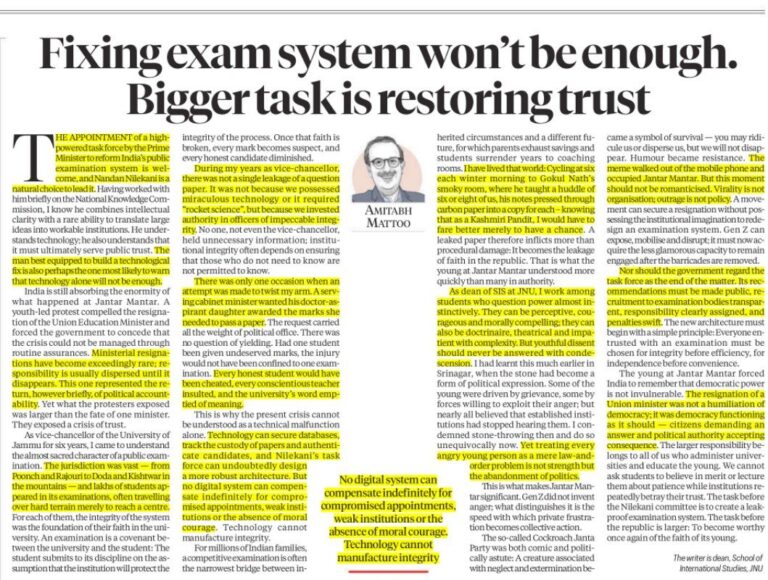
India’s examination system is facing a deeper challenge beyond technical failures and paper leaks — the erosion of public trust. Recent controversies surrounding competitive examinations have raised concerns about transparency, accountability, and institutional credibility. The article argues that while technology can improve efficiency, rebuilding faith in the examination system requires ethical governance and stronger institutions.
Crisis of Trust in Examination System
Beyond Paper Leaks and Technology Failures
Examination integrity is not only a matter of:
- Digital security
- Data protection
- Question paper management
- Authentication systems
Technology can prevent certain failures, but it cannot replace institutional honesty and moral responsibility.
A secure examination system requires:
- Transparent processes
- Independent oversight
- Accountability of officials
- Ethical decision-making
Role of Institutions and Accountability
Restoring Institutional Credibility
Examinations represent a social contract between students and institutions. Candidates invest years of preparation, money, and personal effort based on the belief that the system will reward merit fairly.
When irregularities occur:
- Student confidence declines
- Social inequality increases
- Faith in public institutions weakens
Therefore, accountability mechanisms must ensure that those responsible for failures face consequences.
Lessons from Student Movements
Youth as Stakeholders
Student protests highlight that young citizens are not merely examination candidates but active participants in democracy.
Their concerns reflect:
- Demand for fairness
- Need for responsive governance
- Expectation of institutional accountability
The government must engage with students through dialogue rather than viewing every protest only as a law-and-order issue.
Way Forward
Building a Trust-Based Examination Ecosystem
India needs:
- Independent examination authorities
- Transparent recruitment processes
- Strong grievance redressal mechanisms
- Regular audits of examination systems
- Ethical training for administrators
- Clear accountability frameworks
Technology should support reforms, but institutional integrity must remain the foundation.
Conclusion
Reforming India’s examination system requires more than advanced technology and digital security. The bigger challenge is restoring trust between students and institutions. A credible examination system must combine technological innovation with transparency, accountability, and ethical governance.
Vocabulary
1. Integrity – Honesty and ethical conduct
2. Accountability – Responsibility for actions
3. Institutional Trust – Confidence in public institutions
4. Transparency – Openness in decision-making
5. Governance – System of administration and oversight
Frequently Asked Questions (FAQs)
What is the main issue affecting India’s examination system?
The major issue is the loss of trust among students and citizens due to paper leaks, irregularities, lack of transparency, and weak accountability mechanisms.
Can technology alone solve examination system problems?
No. Technology can improve security and efficiency, but it cannot replace institutional integrity, ethical governance, transparency, and accountability.
Why is restoring trust important in competitive examinations?
Competitive exams decide career opportunities for millions of students. A lack of trust affects merit-based selection, social justice, and confidence in public institutions.
What reforms are needed to strengthen the examination system?
Key reforms include independent examination authorities, transparent processes, strong grievance redressal systems, regular audits, and strict accountability for violations.
Why is this topic important for UPSC preparation?
It is relevant under Governance, Transparency, Accountability, Public Administration Ethics, Education Reforms, and Institutional Credibility (GS Paper 2 & GS Paper 4).