Table of Contents
ToggleTripuri Session 1939
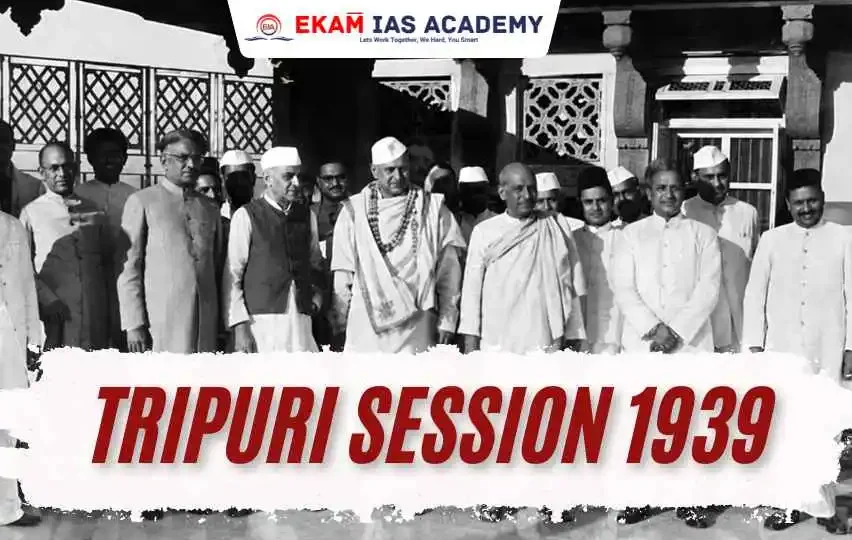
The Tripuri Session 1939 stands as a pivotal turning point in Modern Indian History UPSC preparation. Held in Tripuri (near Jabalpur, Madhya Pradesh), this Tripuri Congress Session exposed deep ideological rifts within the Indian National Congress 1939 regarding leadership, mass struggle strategies, and ideological directions during the Indian Freedom Struggle.
Historical Background
In the late 1930s, left-wing ideologies gained momentum within the Congress under leaders like Netaji Subhas Chandra Bose and Jawaharlal Nehru. Following his successful tenure after the Haripura Session 1938, Bose advocated for an uncompromising, militant struggle against British imperialism, setting the stage for ideological friction.
Subhas Chandra Bose's Re-election as Congress President
In the Congress Presidential Election 1939, Bose decided to contest for a second term. Despite opposition from Mahatma Gandhi, who backed Pattabhi Sitaramayya, Bose won decisively. Gandhi famously declared that “Pattabhi’s defeat is my defeat,” intensifying the Bose Gandhi conflict.
Tripuri Congress Session, 1939
During the Tripuri Session of INC, severe illness affected Subhas Chandra Bose Congress President duties. Despite his health, Bose insisted on giving a 6-month ultimatum to the British government to grant National Demand for independence.
Pant Resolution
A major crisis erupted when Govind Ballabh Pant moved the historic Pant Resolution. Passed by the Working Committee, it mandated that the Congress President must appoint the Working Committee in strict accordance with Gandhi’s wishes.
Bose-Gandhi Differences
The core conflict between Gandhi and Bose stemmed from tactical and ideological divergence: Bose urged immediate mass civil disobedience capitalizing on global crises, whereas Gandhi believed the nation was not yet prepared for non-violent resistance.
Resignation of Subhas Chandra Bose
Unable to reach a compromise over the formation of the Working Committee, Netaji submitted his resignation in April 1939. Subsequently, Dr. Rajendra Prasad was appointed as Congress President.
Formation of the Forward Bloc
Following his resignation, Bose founded the Forward Bloc in May 1939 within the Congress fold to unify leftist elements and push for immediate radical mass action (Subhas Chandra Bose Forward Bloc).
Significance of the Tripuri Session
The Tripuri Session UPSC module illustrates the internal democratic dynamism and structural ideological debate within the freedom movement.
Tripuri Session and the Second World War
The rift influenced Congress policy just prior to the outbreak of WWII, shaping India’s refusal to support the British war effort without immediate independence.
Tripuri Session – Key Personalities
Key figures at Tripuri Congress 1939 included Netaji Subhas Chandra Bose, Mahatma Gandhi, Dr. Pattabhi Sitaramayya, Govind Ballabh Pant, and Dr. Rajendra Prasad.
Tripuri Session vs Haripura Session
- Haripura Session 1938: Characterized by unanimous election of Bose and ideological unity on national planning.
- Tripuri Session 1939: Marked by fierce contestation, internal ideological schisms, and structural re-alignment.
Conclusion
Mastering the Subhas Chandra Bose Tripuri Session timeline is essential for revising your UPSC History Notes. It highlights a critical phase of internal transition and strategic re-orientation during the Indian National Movement.
UPSC Prelims: PYQs & Practice Questions
Previous Year Questions
Q: With reference to the Congress Presidential Election of 1939, Subhas Chandra Bose defeated whom to become the Congress President?
(a) Maulana Abul Kalam Azad
(b) Pattabhi Sitaramayya
(c) Jawaharlal Nehru
(d) Vallabhbhai Patel
Answer: (b) Pattabhi Sitaramayya
Explanation:
In the Congress Presidential Election of January 1939,
Subhas Chandra Bose contested for a second term against
Dr. Pattabhi Sitaramayya, who had the support of Mahatma Gandhi.
Bose defeated Sitaramayya by
1,580 votes to 1,377 votes.
Following the result, Gandhi famously remarked that
“Pattabhi’s defeat is my defeat.”
The election subsequently intensified ideological and organisational differences within the Congress before the
Tripuri Session of 1939.
Q: Who among the following was the President of the
Indian National Congress when the
National Planning Committee was set up?
(a) Jawaharlal Nehru
(b) Subhas Chandra Bose
(c) Maulana Abul Kalam Azad
(d) Sarojini Naidu
Answer: (b) Subhas Chandra Bose
Explanation:
At the Haripura Session of the Indian National Congress in 1938,
Subhas Chandra Bose served as Congress President.
During his presidency, the
National Planning Committee (NPC) was initiated, with
Jawaharlal Nehru appointed as its Chairman.
The initiative reflected Bose's emphasis on
industrialisation, economic planning and socialist-oriented development,
which formed part of the ideological background to the
Tripuri Session of 1939.
Practice Questions
Q: With reference to the Tripuri Session of the Indian National Congress, 1939, consider the following statements:
1. Govind Ballabh Pant moved a resolution requesting the Congress President to nominate the Working Committee in accordance with Mahatma Gandhi's wishes.
2. Following his resignation as Congress President, Subhas Chandra Bose immediately formed the Indian National Army (INA) in Singapore.
3. Dr. Rajendra Prasad was elected as the President of the Indian National Congress after Bose’s resignation.
Which of the statements given above are correct?
(a) 1 and 2 only
(b) 1 and 3 only
(c) 2 and 3 only
(d) 1, 2 and 3
Answer: (b) 1 and 3 only
Explanation:
Statement 1 is correct. At the
Tripuri Session of 1939, Govind Ballabh Pant moved the
Pant Resolution, which called upon Subhas Chandra Bose to constitute the
Congress Working Committee in accordance with Mahatma Gandhi’s wishes.
Statement 2 is incorrect. Bose resigned as Congress President in
April 1939 and subsequently formed the
Forward Bloc in May 1939. His association with the
Indian National Army came much later, in 1943, in Southeast Asia.
Statement 3 is correct. After Bose’s resignation,
Dr. Rajendra Prasad was chosen to complete the remaining term as President of the Indian National Congress.
Q: Consider the following events associated with Subhas Chandra Bose:
1. Presidency at the Haripura Session
2. Passing of the Pant Resolution at Tripuri
3. Formation of the Forward Bloc
4. Resignation from the Civil Services
What is the correct chronological sequence of the above events?
(a) 4 - 1 - 2 - 3
(b) 1 - 4 - 2 - 3
(c) 4 - 2 - 1 - 3
(d) 1 - 2 - 4 - 3
Answer: (a) 4 - 1 - 2 - 3
Explanation:
The correct chronological sequence is:
1. Resignation from the Indian Civil Service – 1921
2. Haripura Congress Presidency – February 1938
3. Pant Resolution at Tripuri – March 1939
4. Formation of the Forward Bloc – May 1939
Therefore, the correct sequence is
4 - 1 - 2 - 3.
UPSC Mains – Previous Year & Practice Questions
Mains Previous Year Questions
[15 Marks | 250 Words]
Question: Evaluate the ideological and strategic differences between Mahatma Gandhi and Subhas Chandra Bose during the late 1930s, especially in the context of the Tripuri Session. (UPSC CSE Mains 2022, GS Paper I)
[10 Marks | 150 Words]
Question: Highlight the differences in the approach of Subhas Chandra Bose and Mahatma Gandhi in the struggle for India's freedom. (UPSC CSE Mains 2016, GS Paper I)
[10 Marks | 150 Words]
Question: Discuss the circumstances that led to the resignation of Subhas Chandra Bose from the presidency of the Indian National Congress in 1939. (UPSC CSE Mains 2009, Modern History)
[10 Marks | 150 Words]
Question: Write a short essay on the genesis and objectives of the Forward Bloc formed by Netaji Subhas Chandra Bose. (UPSC CSE Mains 2001, Modern History)
[15 Marks | 250 Words]
Question: Assess the significance of the Haripura and Tripuri Sessions of the Indian National Congress in the Indian freedom movement. (UPSC CSE Mains 1994, Modern History)
Mains Practice Questions
[15 Marks | 250 Words]
Question: “The Tripuri Crisis of 1939 was not merely a contest between two individuals, but a manifestation of deep-seated tactical and ideological divisions over the future trajectory of the Indian Freedom Movement.” Critically analyse.
[15 Marks | 250 Words]
Question: Examine the impact of the Pant Resolution on internal democratic norms within the Indian National Congress during the Tripuri Session of 1939. How did it shape the eventual departure of Subhas Chandra Bose from Congress leadership?
[10 Marks | 150 Words]
Question: Compare the strategic visions of Mahatma Gandhi and Subhas Chandra Bose regarding the utilisation of global geopolitical conflicts, particularly the Second World War, for achieving Indian independence.
Tripuri Session 1939-FAQs
What was the Tripuri Session 1939?
The Tripuri Session 1939 was an important Congress session held near Jabalpur, where ideological differences between Subhas Chandra Bose and the Gandhi-led Congress leadership became visible.
Who won the Congress Presidential Election in 1939?
Subhas Chandra Bose defeated Pattabhi Sitaramayya, who was supported by Mahatma Gandhi.
What was the Pant Resolution?
The Pant Resolution required Bose to form the Congress Working Committee according to Gandhi’s wishes, creating a major leadership crisis.
Why did Subhas Chandra Bose resign?
Bose resigned because he could not form a Working Committee acceptable to both his ideological position and the Gandhi-led Congress group.
Why is the Tripuri Session important for UPSC?
It is important because it explains Bose-Gandhi differences, Congress internal democracy, left-wing politics, Forward Bloc formation and the strategic debate before World War II.