Table of Contents
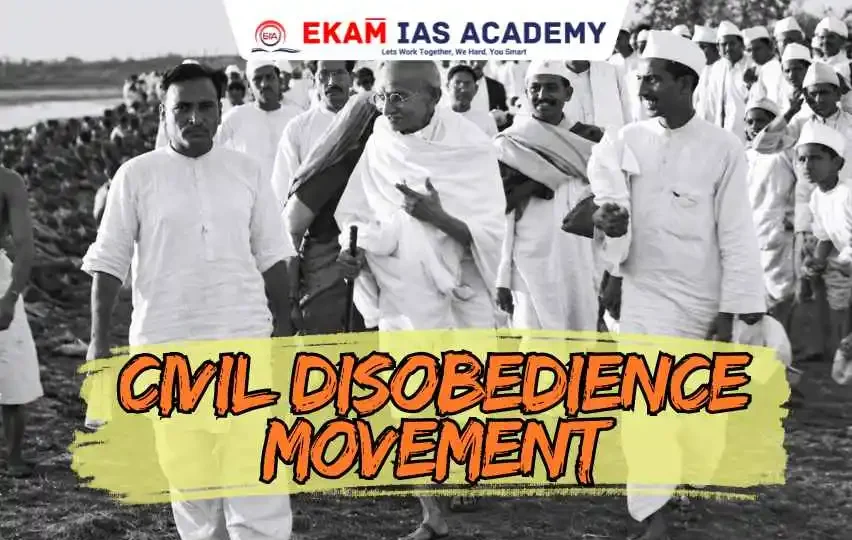
ToggleThe Civil Disobedience Movement launched in 1930 under the dynamic leadership of Mahatma Gandhi is a pivotal milestone in Modern Indian History UPSC preparation. It marked a radical escalation in the Indian National Movement, transitioning from peaceful non-cooperation to actively defying colonial laws to secure complete independence.
Background of the Civil Disobedience Movement
The historic Lahore Session 1929 of the Indian National Congress, presided over by Jawaharlal Nehru, officially declared Purna Swaraj (Complete Independence) as the ultimate national goal. This paved the way for launching Mahatma Gandhi movements across the country.
Causes of the Civil Disobedience Movement
Primary Civil Disobedience Movement causes included:
- British rejection of the Nehru Report and its mandate for Dominion Status.
- Economic distress caused by the Great Depression affecting peasants and workers.
- The British monopoly and oppressive taxation on salt, impacting rich and poor alike.
Launch of the Civil Disobedience Movement
The movement formally commenced with the historic Salt Satyagraha and Dandi March (Gandhi Salt March). On March 12, 1930, Gandhi marched from Sabarmati Ashram to Dandi, breaking the salt law on April 6, 1930.
Programme of the Movement
The structured Civil Disobedience Movement programme included:
- Defiance of salt laws and forest laws.
- Non-payment of land revenue, taxes, and * चौकीदारी * (chowkidari) tax.
- Picketing of foreign cloth shops and liquor outlets.
Spread of the Civil Disobedience Movement
The movement triggered widespread participation across provinces. Massive salt satyagrahas took place in Vadala (Bombay), Dharasana (Gujarat), and the coastal belts of Bengal and Orissa.
Important Leaders and Regional Movements
- C. Rajagopalachari: Led the Vedaranyam Salt March in Tamil Nadu.
- K. Kelappan: Organized the Payyanur Salt March in Malabar.
- Khan Abdul Ghaffar Khan: Formed the “Frontier Gandhi” and led the Khudai Khidmatgars (Red Shirts) in North-West Frontier Province.
British Response
The colonial administration resorted to severe repression, arresting over 90,000 satyagrahis, outlawing Congress organizations, and suppressing the press.
Gandhi-Irwin Pact (1931)
To break the political deadlock, the Gandhi Irwin Pact was signed in March 1931. The government agreed to release non-violent political prisoners, while the Congress agreed to suspend the movement and attend the next conference.
Second Round Table Conference
Mahatma Gandhi attended the Second Round Table Conference in London in 1931 as the sole representative of the Congress. However, the talks collapsed over the issue of minority representation.
Second Phase of the Civil Disobedience Movement
Following the failure of the London conference, Gandhi restarted the movement in 1932. The government responded with swift arrests and heavy emergency ordinances.
Communal Award and Poona Pact
In August 1932, Ramsay MacDonald announced the Communal Award, granting separate electorates for depressed classes. Gandhi undertook a fast unto death, leading to the historic Poona Pact (1932) signed with Dr. B.R. Ambedkar, which secured reserved seats instead of separate electorates.
Withdrawal of the Civil Disobedience Movement
The movement gradually lost momentum and witnessed its official Civil Disobedience Movement withdrawal in May 1934.
Significance of the Civil Disobedience Movement
The Civil Disobedience Movement significance lies in mobilizing women, peasants, and urban merchants at an unprecedented scale, undermining the moral authority of the British Raj.
Limitations of the Civil Disobedience Movement
- Muslim participation was lower compared to the Non-Cooperation phase.
- Industrial workers participated only in specific pockets like Sholapur.
Non-Cooperation Movement vs Civil Disobedience Movement
While Non-Cooperation focused on refusing assistance to the government, Civil Disobedience actively broke colonial laws and administrative regulations.
Timeline of the Civil Disobedience Movement
- December 1929: Declaration of Purna Swaraj.
- March–April 1930: Dandi March and launch of Civil Disobedience Movement 1930.
- March 1931: Gandhi Irwin Pact.
- September 1932: Signing of the Poona Pact.
- May 1934: Movement formally called off.
Conclusion
In conclusion, studying Civil Disobedience Movement Notes is critical for revising Civil Disobedience Movement UPSC themes and UPSC History Notes. It irreversibly changed the trajectory of the freedom struggle toward complete national liberation.
UPSC Prelims: PYQs & Practice Questions
Previous Year Questions (Prelims)
Q: With reference to the Chattogram Armoury Raid, Dandi March and Salt Satyagraha, who among the following organized the famous Vedaranyam Salt Satyagraha in Tamil Nadu?
(a) K. Kamaraj
(b) C. Rajagopalachari
(c) Annie Besant
(d) V.O. Chidambaram Pillai
Answer: (b) C. Rajagopalachari
Explanation:
Inspired by Mahatma Gandhi’s
Dandi March,
C. Rajagopalachari organized and led the
Vedaranyam Salt Satyagraha in Tamil Nadu.
He led a group of satyagrahis from
Trichinopoly (Tiruchirappalli) to Vedaranyam on the Tanjore coast in April 1930.
The march formed part of the wider
Salt Satyagraha and Civil Disobedience Movement against the British salt laws.
Q: Which one of the following began with the
Dandi March?
(a) Home Rule Movement
(b) Non-Cooperation Movement
(c) Civil Disobedience Movement
(d) Quit India Movement
Answer: (c) Civil Disobedience Movement
Explanation:
The historic
Dandi March, also known as the Salt March, began on
12 March 1930 from Sabarmati Ashram and culminated at Dandi on
6 April 1930.
At Dandi, Mahatma Gandhi broke the
British salt law by manufacturing salt, symbolically launching the
Civil Disobedience Movement.
The movement subsequently spread across India through salt law violations, boycott of foreign goods, refusal to pay certain taxes and other forms of
non-violent civil disobedience.
Practice Questions
Q: With reference to the Gandhi-Irwin Pact of 1931, consider the following statements:
1. The British Government agreed to release all political prisoners, including those convicted of violent acts.
2. The Indian National Congress agreed to suspend the Civil Disobedience Movement and participate in the Second Round Table Conference.
3. The right to make salt for peaceful consumption in coastal villages was conceded by the Government.
Which of the statements given above are correct?
(a) 1 and 2 only
(b) 2 and 3 only
(c) 1 and 3 only
(d) 1, 2 and 3
Answer: (b) 2 and 3 only
Explanation:
Statement 1 is incorrect. The British Government agreed to release political prisoners who had
not been convicted of violence. The demand for commutation of the death sentences of
Bhagat Singh, Sukhdev and Rajguru was not accepted.
Statement 2 is correct. The Indian National Congress agreed to
suspend the Civil Disobedience Movement and participate in the
Second Round Table Conference, where Mahatma Gandhi represented the Congress.
Statement 3 is correct. The Government permitted people living in coastal areas to
manufacture salt for personal consumption, subject to specified conditions.
Q: Who among the following founded the Khudai Khidmatgar, popularly known as the Red Shirts, and led the non-violent movement in the North-West Frontier Province during the Civil Disobedience Movement?
(a) Hasrat Mohani
(b) Saifuddin Kitchlew
(c) Khan Abdul Ghaffar Khan
(d) Maulana Abul Kalam Azad
Answer: (c) Khan Abdul Ghaffar Khan
Explanation:
Khan Abdul Ghaffar Khan, popularly known as the
Frontier Gandhi, organised the
Khudai Khidmatgar or
“Servants of God”.
Its members were popularly called the
Red Shirts because of their distinctive uniform.
The organisation adopted
non-violence and played an important role in the Civil Disobedience Movement, particularly in
Peshawar and the North-West Frontier Province.
UPSC Mains – Previous Year & Practice Questions
Mains Previous Year Questions
[15 Marks | 250 Words]
Question: Bring out the constructive programmes of Mahatma Gandhi during the Non-Cooperation Movement and the Civil Disobedience Movement. (UPSC CSE Mains 2021)
[10 Marks | 150 Words]
Question: “The Salt Satyagraha was not merely about salt, but symbolised a wider challenge to British imperial authority.” Discuss. (UPSC CSE Mains 2017)
[10 Marks | 150 Words]
Question: Analyse the significance of the Poona Pact of 1932 in resolving the conflict between Mahatma Gandhi and Dr. B.R. Ambedkar over political representation for the depressed classes. (UPSC CSE Mains 2015)
[10 Marks | 150 Words]
Question: Evaluate the role of women during the Civil Disobedience Movement, 1930–1934. How did their participation transform their social and political visibility in India? (UPSC CSE Mains 2009)
[15 Marks | 250 Words]
Question: Compare and contrast the Non-Cooperation Movement, 1920–22 and the Civil Disobedience Movement, 1930–34 in terms of their objectives, social base and methods of struggle. (UPSC CSE Mains 1997)
Mains Practice Questions
[15 Marks | 250 Words]
Question: Why was salt chosen as the central symbol for launching the Civil Disobedience Movement in 1930? Evaluate its political and psychological impact on Indian society.
[15 Marks | 250 Words]
Question: Critically examine the factors that led to the breakdown of the Gandhi-Irwin Pact and the revival of the second phase of the Civil Disobedience Movement in 1932.
[10 Marks | 150 Words]
Question: Discuss the extent and nature of participation of different social groups— peasants, business classes, industrial labour and Muslims—during the Civil Disobedience Movement.
Civil Disobedience Movement-FAQs
What was the Civil Disobedience Movement?
The Civil Disobedience Movement was a mass nationalist movement launched by Mahatma Gandhi in 1930 to actively defy unjust colonial laws.
When did the Civil Disobedience Movement start?
It started with the Dandi March, which began on 12 March 1930 and culminated in the breaking of the salt law at Dandi.
What were the main causes of the Civil Disobedience Movement?
Major causes included the demand for Purna Swaraj, rejection of the Nehru Report, economic distress during the Great Depression, and British monopoly over salt.
What was the Gandhi-Irwin Pact?
The Gandhi-Irwin Pact of 1931 was an agreement under which Congress suspended the movement and agreed to attend the Round Table Conference, while the government agreed to release non-violent political prisoners.
Why is the Civil Disobedience Movement important for UPSC?
It is important because it marked active defiance of colonial laws, mass participation of women and peasants, Salt Satyagraha, Gandhi-Irwin Pact, Poona Pact and the shift toward complete independence.