Table of Contents
ToggleOne Nation One Election: Impact on India’s Federal Democracy
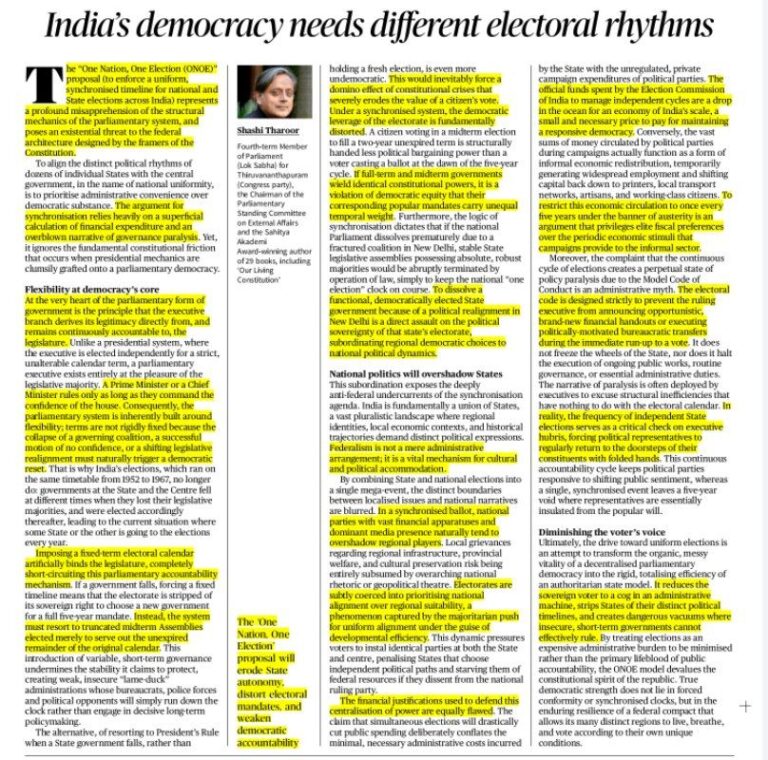
The debate over One Nation One Election (ONOE) has intensified as the proposal seeks to synchronise elections to the Lok Sabha and State Legislative Assemblies. Supporters argue that simultaneous elections could reduce expenditure and administrative disruption. However, the article highlights serious concerns regarding federalism, democratic accountability and the independent political mandate of States.
Why Different Electoral Rhythms Matter in India
India follows a parliamentary system in which governments may lose their majority before completing a five-year term. This flexibility allows the legislature to hold the executive accountable and enables political change when circumstances demand it.
Synchronising elections could impose an artificial electoral timetable on States. If a State government collapses midway, maintaining a common national election cycle may require shortened legislative terms, temporary arrangements or other mechanisms that could weaken the voter’s mandate.
One Nation One Election and Federalism
India is a Union of States, with each State having distinct political, economic, linguistic and cultural priorities. State elections allow regional issues to receive focused democratic attention.
Conducting national and State elections simultaneously could allow national political narratives to overshadow local concerns. The article argues that this may gradually reduce the political autonomy of States and weaken India’s federal character.
Does ONOE Really Reduce Election Costs?
A major justification for simultaneous elections is reducing campaign and administrative expenditure. However, the article questions whether election costs alone justify restructuring India’s democratic system.
Political parties may continue spending heavily on campaigning regardless of whether elections are simultaneous. Therefore, electoral expenditure should be addressed through campaign finance reforms and stronger regulation rather than changing the basic electoral cycle.
Elections as a Tool of Democratic Accountability
Regularly occurring elections provide citizens with opportunities to evaluate governments at different levels. They also act as periodic checks on political power.
Staggered elections ensure that governments remain responsive throughout their tenure. A single nationwide electoral event followed by a long election-free period could reduce this continuous democratic scrutiny.
Conclusion
The One Nation One Election debate goes beyond administrative convenience and financial savings. It involves fundamental questions about federalism, parliamentary democracy, State autonomy and voter accountability.
India’s diverse democracy benefits from different electoral rhythms that reflect regional political realities. Electoral reforms should therefore strengthen democratic participation and accountability without weakening the constitutional balance between the Union and the States.
Vocabulary
1. ONOE – One Nation, One Election
2. Electoral Mandate – Authority given by voters
3. Federalism – Constitutional division of power between Centre and States
4. Political Accountability – Responsibility of governments to citizens
5. Electoral Synchronisation – Holding different elections together
Frequently Asked Questions (FAQs)
What is One Nation One Election (ONOE)?
One Nation One Election refers to holding Lok Sabha and State Assembly elections together on a common electoral cycle. The idea aims to reduce repeated elections, expenditure and administrative disruptions.
Why are staggered elections important in India?
Staggered elections allow voters to judge governments at different times and keep political leaders continuously accountable. They also ensure that State-specific issues receive separate democratic attention.
How can ONOE affect federalism in India?
Simultaneous elections may allow national political narratives to dominate regional concerns. This could weaken the independent political space of States and affect India’s federal balance.
Does One Nation One Election reduce election expenditure?
Supporters argue that simultaneous elections can reduce administrative and campaign costs. However, the article suggests that campaign spending may continue and should instead be addressed through stronger electoral finance reforms.
What are the major concerns related to ONOE?
Key concerns include State autonomy, voter accountability, parliamentary flexibility and federalism. Critics argue that forcing all governments into one fixed electoral cycle may weaken the natural functioning of India’s parliamentary democracy.
Source From : The Hindu
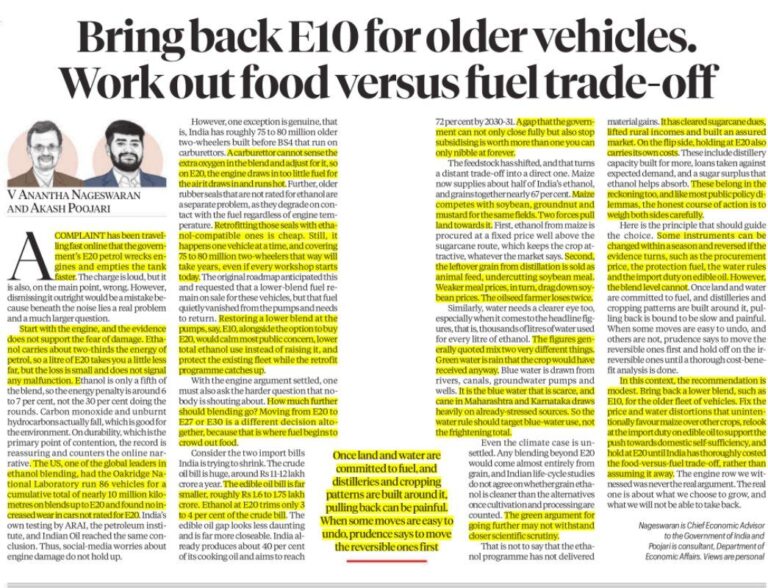
E20 Ethanol Blending in India: Why E10 May Still Be Needed
India’s push towards E20 petrol, containing 20% ethanol, aims to reduce dependence on imported crude oil and support domestic agriculture. However, concerns over older vehicles, fuel efficiency, food security and water use have reopened the debate over how far ethanol blending in India should go.
Is E20 Petrol Harmful to Vehicles?
The article argues that fears of widespread engine damage from E20 are largely exaggerated. Studies cited, including vehicle testing in India and research by the Oak Ridge National Laboratory in the U.S., did not find significantly higher engine wear with E20.
However, India still has millions of older two-wheelers manufactured before BS-IV norms. Some use carburettors and rubber seals that may not be fully compatible with higher ethanol blends.
Why Bring Back E10 for Older Vehicles?
A practical solution suggested is to make E10 petrol available alongside E20 for older vehicles until retrofitting is completed.
The article also notes that E20 may slightly reduce fuel economy because ethanol contains less energy than petrol, but the reduction is far smaller than some exaggerated claims circulating online.
The Food Versus Fuel Trade-Off
The bigger concern is whether India should increase ethanol blending beyond E20.
Maize has emerged as an important ethanol feedstock and competes with crops such as soybean, groundnut and mustard for agricultural land. Higher incentives for maize used in ethanol production can influence cropping patterns and potentially affect food and edible-oil production.
By-products from grain-based ethanol production may also affect animal-feed and soybean markets, creating additional pressure on oilseed farmers.
Water Use and Environmental Concerns
Sugarcane-based ethanol is particularly water-intensive. When sugarcane is cultivated using irrigation from rivers, canals or groundwater, ethanol production can place additional pressure on already stressed water resources.
The environmental benefits of increasing grain-based ethanol blending beyond E20 also remain uncertain when cultivation, irrigation and processing emissions are considered.
Conclusion
India’s ethanol programme has delivered benefits, including improved markets for farmers, reduced sugarcane dues and lower dependence on petroleum imports. However, pushing blending beyond E20 requires careful assessment of food security, water availability and agricultural incentives.
A balanced approach would retain E20 as the current limit, restore E10 for older vehicles and address distortions that encourage fuel crops at the expense of food and oilseeds. India’s energy transition must ensure that fuel security does not come at the cost of food and water security.
Vocabulary
1. E20 – Petrol containing 20% ethanol
2. Ethanol Blending – Mixing ethanol with petrol
3. Food-Fuel Trade-off – Competition between crops for food and energy
4. Blue Water – Surface and groundwater used for irrigation
5. Green Water – Rainwater stored in soil
Frequently Asked Questions (FAQs)
What is E20 petrol?
E20 petrol is a fuel containing 20% ethanol and 80% petrol. India is promoting it to reduce crude oil imports and increase the use of domestically produced biofuels.
Is E20 petrol safe for older vehicles?
Most modern vehicles are designed to handle E20, but some older vehicles may have carburettors or rubber components that are less compatible with ethanol. Providing E10 temporarily could help protect such vehicles.
Does E20 reduce vehicle mileage?
Ethanol has lower energy content than petrol, so E20 can cause a small decline in fuel efficiency. However, the article argues that claims of extremely large mileage losses are not supported by testing.
How can ethanol blending affect food security?
Using maize and other food crops for ethanol can increase competition for agricultural land, water and crop incentives. Higher blending levels could therefore influence food prices and oilseed production.
Why should India be cautious about going beyond E20?
Higher blending could intensify competition between food and fuel crops, increase water stress and create long-term changes in cropping patterns. The article recommends fully evaluating these trade-offs before expanding beyond E20.