Table of Contents
ToggleTribal Movements
The Tribal Movements During British Period constitute a heroic chapter of fierce armed resistance against colonial exploitation. These Tribal Movements in India were spontaneous, intense, and popular uprisings directed against the British colonial state, greedy non-tribal landlords, and predatory moneylenders (dikus). A high-yield topic for Tribal Movements UPSC aspirants, mastering these rebellions is essential for Modern Indian History UPSC.
Causes of Tribal Movements
The fundamental drivers behind Tribal Revolts Against British rule lay in the systematic destruction of the traditional tribal way of life:
- Infiltration of outsiders (dikus)—moneylenders, traders, revenue farmers, and British officials into isolated tribal tracts.
- Imposition of heavy cash land revenues, widespread land alienation, and debt bondage.
- Disruption of customary communal land-holding systems like the Munda Khuntkatti tenure system.
- Imposition of forced unremunerated labor (beth-begari) and aggressive proselytization by Christian missionaries.
Major Tribal Movements During British Rule
Numerous Tribal Revolts in India posed serious military challenges to the East India Company and the British Crown:
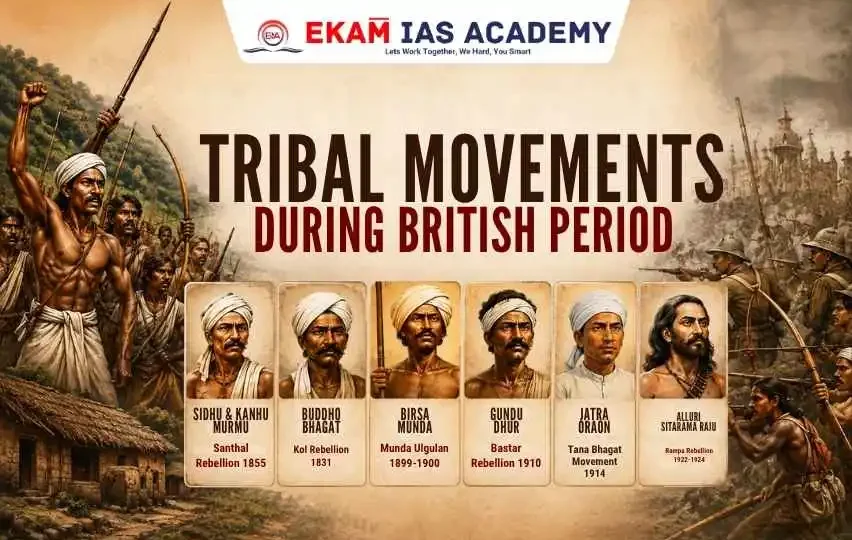
- Santhal Rebellion 1855: Led by Sidhu, Kanhu, Chand, and Bhairav in the Rajmahal Hills (Damin-i-Koh) against zamindars and Company administration.
- Kol Rebellion 1831: Led by Buddho Bhagat in Chota Nagpur to protest against massive land transfers to non-tribal farmers.
- Munda Ulgulan (1899–1900): Spearheaded by Birsa Munda, aiming to expel dikus and establish a sovereign, self-governing Munda Raj.
- Bastar Rebellion 1910: Popularly called the Bhumkal or Gundu Dhur uprising in Jagdalpur, fighting against the takeover of village forests.
- Rampa Rebellion (1922–1924): Led by Alluri Sitarama Raju in Andhra Pradesh, using sophisticated guerrilla tactics against colonial authorities.
- Tana Bhagat Movement (1914): Initiated by Jatra Oraon among the Oraon tribe, blending socio-religious reform with non-violent anti-taxation campaigns.
Tribal Movements and Forest Policies
The enforcement of restrictive Forest Laws and Tribal Movements went hand in hand. British enactments like the Indian Forest Acts of 1865 and 1878 declared vast forest areas as “Reserved” or “Protected,” stripping indigenous communities of their customary rights to collect forest produce, graze cattle, and practice shifting cultivation (jhum).
Nature of Tribal Movements
- Entire tribes organized together as cohesive units, with active participation from women.
- Deeply messianic and millenarian, led by charismatic figures believed to possess divine powers.
- Directed against all forms of foreign exploitation, targeting both the British state and domestic dikus.
Role of Tribal Leaders
Key visionary leaders mobilized, organized, and transformed localized grievances into mass uprisings:
- Birsa Munda: Spearheaded the Munda Ulgulan, invoking divine authority to unite tribes against British feudal exploitation.
- Alluri Sitarama Raju: Led the Rampa Rebellion by synthesizing indigenous grievances with national liberation goals.
- Jatra Oraon: Founded the Tana Bhagat Movement, preaching Sanskritization, socio-moral reform, and non-violent resistance.
British Response to Tribal Movements
The British colonial administration responded with brutal military repression—burning down entire villages, executing tribal chiefs, and deploying heavy artillery. However, the intensity of Tribal Resistance to British Rule forced the state to concede protective administrative laws, such as creating non-regulated areas through the Santhal Parganas Tenancy Act (1876) and Chota Nagpur Tenancy Act (1908).
Why Did Tribal Movements Fail
- Technological inequality, pitting traditional weapons (bows, arrows, spears) against modern British firepower.
- Lack of centralized national leadership, modern organizational structures, and strategic geographic coordination.
Significance of Tribal Movements
Evaluating Tribal Uprisings in India highlights their immense historic value:
- Shattered colonial myths regarding passive acceptance of foreign rule by marginalized communities.
- Forced colonial authorities to enact protective land legislation for indigenous groups.
- Sowed early seeds of anti-colonial political consciousness across rural hinterlands.
Tribal Movements and the Indian National Movement
While early Tribal Rebellions UPSC topics focus on localized resistance, later 20th-century events like the Tana Bhagat Movement and Rampa Rebellion directly merged with mainstream campaigns led by the Indian National Congress, such as the Non-Cooperation and Civil Disobedience movements.
Important Tribal Movements
| Movement | Year | Region | Key Leaders |
| Bhil Rebellion | 1818–1831 | Western Ghats (Khandesh) | Sewaram |
| Kol Rebellion 1831 | 1831 | Chota Nagpur | Buddho Bhagat |
| Santhal Rebellion 1855 | 1855 | Rajmahal Hills | Sidhu and Kanhu Murmu |
| Munda Ulgulan | 1899–1900 | Ranchi / Chota Nagpur | Birsa Munda |
| Bastar Rebellion 1910 | 1910 | Jagdalpur (Chhattisgarh) | Gundu Dhur |
| Tana Bhagat Movement | 1914 | Chota Nagpur | Jatra Oraon |
| Rampa Rebellion | 1922–1924 | Andhra Pradesh | Alluri Sitarama Raju |
Tribal Movements vs Peasant Movements
- Tribal Movements: Fought for total territorial, forest, and cultural autonomy against all outsiders (dikus and British alike).
- Peasant Movements: Focused on specific agrarian grievances, such as high rents, illegal cesses, eviction, and debt relief.
Timeline of Major Tribal Movements
- 1818: Outbreak of the Bhil Rebellion.
- 1831: Start of the Kol Rebellion 1831.
- 1855: Launch of the Santhal Rebellion 1855.
- 1899: Outbreak of the Munda Ulgulan led by Birsa Munda.
- 1910: Outbreak of the Bastar Rebellion 1910.
- 1914: Formation of the Tana Bhagat Movement by Jatra Oraon.
- 1922: Commencement of the Rampa Rebellion under Alluri Sitarama Raju.
Conclusion
Preparing detailed UPSC History Notes on indigenous resistance is essential for high scores. These fierce Tribal Resistance to British Rule episodes demonstrate that marginalized communities stood at the forefront of anti-colonial resistance, leaving an indelible mark on Modern Indian History UPSC revision.
UPSC Prelims: PYQs & Practice Questions
Previous Year Questions
Q: With reference to the Santhal Uprising (1855–56), which of the following statements is/are correct?
1. The Santhals were granted a separate administrative territory called Damin-i-Koh.
2. Sidhu and Kanhu were the primary leaders of the revolt.
3. The movement was completely non-violent and relied solely on petitions to the British authorities.
Select the correct answer using the code given below:
(a) 1 and 2 only
(b) 2 and 3 only
(c) 1 and 3 only
(d) 1, 2 and 3
Answer: (a) 1 and 2 only
Explanation:
Statements 1 and 2 are correct.
The Santhals inhabited the
Damin-i-Koh region around the Rajmahal Hills.
In 1855, the rebellion was led by
Sidhu Murmu and Kanhu Murmu, along with their brothers
Chand and Bhairav.
The uprising was directed against
British revenue officials, police, landlords and moneylenders,
collectively regarded as oppressive outsiders or
dikus.
Statement 3 is incorrect.
The Santhal Rebellion was an
armed uprising in which traditional weapons such as
bows, arrows and spears were extensively used.
Q: Which among the following was the immediate cause of the Rampa Rebellion (1922–24) in Andhra Pradesh?
(a) Forced conversion of tribals by Christian missionaries
(b) The introduction of the Madras Forest Act, 1882, which restricted tribal access to forest produce and Podu cultivation
(c) Heavy land revenue imposition following the Permanent Settlement
(d) The arrival of Marwari moneylenders into the Agency tracts
Answer: (b) Restrictions imposed under the Madras Forest Act, 1882
Explanation:
The Rampa Rebellion of 1922–24 took place in the
Godavari Agency region and was led by
Alluri Sitarama Raju.
A major trigger was the restrictive forest policy associated with the
Madras Forest Act, 1882, which curtailed the traditional rights of tribal communities over
forest resources and restricted
Podu or shifting cultivation.
Tribal resentment was further aggravated by
forced labour, administrative interference and restrictions on customary forest practices.
Therefore, option (b) is correct.
Practice Questions
Q: With reference to the Munda Ulgulan (1899–1900), consider the following statements:
1. Birsa Munda declared himself a messenger of God and urged the tribals to abandon witch-doctoring and worship a single God, Singbonga.
2. The movement aimed to restore the traditional Khuntkatti joint landholding system by expelling British authorities and dikus.
3. Following the suppression of the revolt, the British government passed the Chota Nagpur Tenancy Act, 1908 to protect tribal land rights.
Which of the statements given above are correct?
(a) 1 and 2 only
(b) 2 and 3 only
(c) 1 and 3 only
(d) 1, 2 and 3
Answer: (d) 1, 2 and 3
Explanation:
All three statements are correct.
Birsa Munda combined
religious reform with anti-colonial resistance
and mobilised the Munda community against the erosion of their traditional social and landholding system.
The movement sought to restore the
Khuntkatti system and resist the domination of
British authorities, landlords, moneylenders and other outsiders or dikus.
Following the uprising and subsequent administrative reforms, the
Chota Nagpur Tenancy Act, 1908
provided safeguards against the transfer of tribal land and recognised aspects of customary tribal land rights.
Q: Which of the following tribal movements/revolts are correctly matched with their respective leaders?
1. Khasi Uprising — Tirot Sing
2. Tana Bhagat Movement — Jatra Oraon
3. Bastar Rebellion (Bhumkal) — Gundu Dhur
4. Kol Rebellion — Buddho Bhagat
Select the correct answer using the code given below:
(a) 1 and 3 only
(b) 2 and 4 only
(c) 1, 2 and 3 only
(d) 1, 2, 3 and 4
Answer: (d) 1, 2, 3 and 4
Explanation:
Pair 1 is correctly matched.
The Khasi Uprising (1829–33) was led by
Tirot Sing against British expansion and road-building activities in the Khasi Hills.
Pair 2 is correctly matched.
The Tana Bhagat Movement, which began in
1914, was led by
Jatra Oraon among the Oraon community of Chota Nagpur.
Pair 3 is correctly matched.
The Bastar Rebellion or Bhumkal of 1910 was associated with
Gunda Dhur and resistance to colonial forest policies and administrative interference.
Pair 4 is correctly matched.
The Kol Rebellion of 1831–32 in the Chota Nagpur region was associated with
Buddhu Bhagat.
Therefore, option (d) is correct.
UPSC Mains – Previous Year & Practice Questions
Mains Previous Year Questions
[15 Marks | 250 Words]
Question: Evaluate the nature and significance of the tribal and civil rebellions in India prior to the Revolt of 1857. (UPSC CSE Mains 2020, GS Paper I)
[15 Marks | 250 Words]
Question: “The tribal uprisings in the 19th century were a reaction against the introduction of colonial administrative and economic systems in isolated tribal tracts.” Discuss. (UPSC CSE Mains 2018, GS Paper I)
[10 Marks | 150 Words]
Question: Analyse the causes and consequences of the Santhal Rebellion of 1855–56. How did it force the British authorities to revise their administrative setup in the region? (UPSC CSE Mains 2011, Modern History)
[10 Marks | 150 Words]
Question: Write a short critical note on Birsa Munda and the Ulgulan Movement. (UPSC CSE Mains 2004, Modern History)
[15 Marks | 250 Words]
Question: How did colonial forest policies transform the traditional socio-economic life of Indian tribes and lead to widespread tribal resistance? (UPSC CSE Mains 1997, Modern History)
Mains Practice Questions
[15 Marks | 250 Words]
Question: “ Colonial forest legislation turned traditional forest dwellers into trespassers on their own ancestral lands.” Examine how British forest laws and policies triggered tribal revolts across different regions of India.
[15 Marks | 250 Words]
Question: Compare the nature, leadership and methods of resistance of the 19th-century messianic tribal revolts with the 20th-century tribal movements that increasingly integrated with the mainstream Indian National Movement.
[10 Marks | 150 Words]
Question: Discuss the role of charismatic leadership in mobilizing tribal communities during anti-colonial uprisings, with special reference to Birsa Munda and Alluri Sitarama Raju.
Tribal Movements-FAQs
What were Tribal Movements During British Period?
Tribal Movements were anti-colonial uprisings by indigenous communities against British rule, landlords, moneylenders, forest laws and outside exploiters.
What were the main causes of Tribal Movements?
Major causes included land alienation, forest restrictions, entry of dikus, heavy revenue demands, debt bondage, missionary activity and destruction of tribal autonomy.
Who led the Munda Ulgulan?
Birsa Munda led the Munda Ulgulan during 1899–1900 in the Chota Nagpur region.
Who led the Rampa Rebellion?
Alluri Sitarama Raju led the Rampa Rebellion of 1922–1924 in Andhra Pradesh.
Why are Tribal Movements important for UPSC?
They are important because they connect anti-colonial resistance, forest policies, tribal rights, land alienation, Birsa Munda, Alluri Sitarama Raju and the Indian freedom struggle.