

...
Daily Current affairs 25 August 2026

Daily Current Affairs 25-August-2026

Share this Post

SMART GLASSES AND PRIVACY GAPS IN INDIA

TOPIC: (GS2) POLITY: THE HINDU

Meta’s launch of AIpowered smart glasses, promoted by celebrities, has sparked debate in India about privacy, surveillance, and gaps in digital regulation, especially after reports of sensitive data misuse.

Features of Smart Glasses

  • Enable calls, messages, and notifications via voice command.
  • Builtin speakers and microphones for music and communication.
  • Integrated camera allows discreet photo and video recording.
  • Marketed as “normallooking eyewear” with hidden tech features.
  • Retail price in India: ₹25,000, with accessories to bypass LED indicators.

Privacy Concerns

  • LED indicators and shutter sounds are weak safeguards; recording can be hidden.
  • Investigations revealed contractors reviewing sensitive user content, including private footage.
  • NCRB 2023 data: 3,678 cybercrime cases against women, with 2,767 involving explicit material.
  • Child safety risks: 698 cases of child sexual abuse material recorded in 2023.
  • Extended battery life (4–9 hours) enables prolonged surveillance of lectures, documents, or private spaces.

Smart Glasses and Privacy Gaps in India

Legal Gaps in Privacy Protection

  • Digital Personal Data Protection Act (DPDPA), 2023 is technologically agnostic, focusing only on the purpose of data collection rather than specific devices.
  • The Act excludes “publicly available information”, weakening safeguards in public spaces where individuals cannot control recording.
  • K.S. Puttaswamy vs Union of India (2017) recognised privacy as a fundamental right under Article 21, establishing the principle of reasonable expectation of privacy.
  • Current law fails to regulate nonconsensual recording in public areas, leaving citizens vulnerable to surveillance through wearable devices.
  • Minimal indicators of recording (e.g., hidden cameras in smart glasses) make surveillance harder to detect compared to mobile phones, compounding risks.

Challenges

  • Rapid tech innovation outpaces legal frameworks.
  • Weak enforcement of data accountability and consent mechanisms.
  • Low public awareness of wearable surveillance risks.
  • Rising cybercrime against women and children highlights vulnerability.
  • Global competition (Google, Reliance entering smart glasses market) complicates regulation.

Way Forward

  • Frame AIaware privacy laws addressing wearable surveillance.
  • Mandate visible recording indicators and stronger safeguards.
  • Conduct privacy impact assessments for emerging technologies.
  • Strengthen NCRB cybercrime monitoring and child protection frameworks.
  • Promote digital literacy campaigns on privacy rights.
  • Monitoring & evaluation through independent audits, user feedback, and performance tracking.

RIGHT TO PRIVACY

The Right to Privacy in India is a constitutionally protected fundamental right, derived from Article 21 (Right to Life and Personal Liberty) and reinforced by landmark Supreme Court judgments, most notably Justice K.S. Puttaswamy v. Union of India (2017). It safeguards dignity, autonomy, and freedom from arbitrary intrusion by the State or private actors.

Constitutional Basis

  • Article 21: Protects life and personal liberty; interpreted to include privacy as intrinsic to dignity and autonomy.
  • Articles 14 & 19: Privacy linked to equality before law and freedoms of speech, association, and movement.
  • Preamble: Liberty and dignity of the individual form the foundation of privacy rights.

Judicial Evolution

  • M.P. Sharma v. Satish Chandra (1954): Initially denied privacy as a fundamental right.
  • Kharak Singh v. State of U.P. (1962): Reiterated no explicit privacy right, but hinted at personal liberty protection.
  • Govind v. State of M.P. (1975): Recognised privacy as a fundamental right, subject to reasonable restrictions.
  • Justice K.S. Puttaswamy v. Union of India (2017): Landmark 9judge bench ruling — privacy declared a fundamental right under Articles 14, 19, and 21. Established the threefold test:

Conclusion

Smart glasses highlight how technology is advancing faster than India’s privacy laws, making urgent reforms essential to protect citizens from invisible surveillance.

LABOUR RIGHTS AND SUPREME COURT’S VERDICT

TOPIC: (GS3) ECONOMY: THE HINDU

On August 20, 2026, the Supreme Court delivered its judgment on the reference concerning the correctness of the landmark Bangalore Water Supply and Sewerage Board (BWSSB) vs A. Rajappa (1978) case, particularly the definition of “industry” under Section 2(j) of the Industrial Disputes Act, 1947.

Background of BWSSB Case

  • BWSSB (1978) laid down the Triple Test to determine what constitutes an “industry.”
  • It adopted a workercentric approach, ensuring wider coverage under labour laws.
  • In Jai Bir Singh (2005), a fivejudge Bench questioned BWSSB’s correctness, leading to a ninejudge Bench reference.
  • Meanwhile, the Industrial Relations Code (IRC), 2020 repealed the ID Act, making the reference largely academic.

Supreme Court’s 2026 Judgment

  • Majority judges held the reference unnecessary due to repeal of ID Act.
  • CJI’s opinion reformulated the Triple Test but termed it hypothetical, not binding.
  • Justice Nagarathna emphasised that interpretation of “industry” under IRC must depend on its own text and scheme.
  • Justice Narasimha cautioned against burdening IRC with past interpretations.
  • Court recognised that BWSSB’s reasoning remains relevant for understanding labour rights but cannot anchor IRC interpretation.

Significance of BWSSB

  • Ensured basic protections for workers by expanding definition of “industry.”
  • Recognised power asymmetry between capital and labour.
  • Linked to constitutional vision: Article 42 (just conditions of work), Article 23 (prohibition of forced labour).
  • Echoed Ambedkar’s warning against unchecked employer power.
  • Reinforced social justice as part of basic structure (Kesavananda Bharati, 1973).

Challenges

  • Labour codes, including IRC 2020, narrow coverage of protections compared to ID Act.
  • “Ease of Doing Business” reforms risk diluting worker safeguards.
  • Informal sector remains vast: ILO 2024 report shows over 80% Indian workforce informal.
  • Weak bargaining power persists; PLFS 2025 highlights declining unionisation.
  • Judicial ambiguity may create uncertainty in labour dispute adjudication.

Way Forward

  • Ensure inclusive interpretation of IRC to protect vulnerable workers.
  • Strengthen labour courts and tribunals for speedy dispute resolution.
  • Expand social security coverage under Code on Social Security, 2020.
  • Promote collective bargaining and unionisation for informal workers.
  • Align labour codes with ILO conventions and constitutional mandate of social justice.
  • Monitoring & evaluation through independent audits, worker feedback, and performance tracking.

Conclusion

The 2026 verdict underscores that while BWSSB’s legacy cannot anchor future law, India’s constitutional vision demands that labour rights remain central to industrial peace and social justice.

YOUTH UNEMPLOYMENT AND HOUSEHOLD COSTS IN INDIA

TOPIC: (GS3) ECONOMY: THE HINDU

The Periodic Labour Force Survey (PLFS) 2025 highlights India’s youth unemployment crisis, showing that 14.8% of 18–29 yearolds are unemployed, with 29.4% among tertiaryeducated youth, raising concerns about householdlevel economic pressures.

Understanding Youth Unemployment

  • Overall rate: 14.8% among 18–29 year olds.
  • Educated youth: 29.4% unemployment among diploma/graduate/postgraduate levels.
  • NEET category: 40.1% of tertiaryeducated youth neither in work, education, nor training.
  • Gender gap: 74.7% of tertiaryeducated young women outside labour force, not even counted as unemployed.

Household Dimension

  • Educational investment: 15.4% of households have a tertiaryeducated young adult.
  • Unemployment burden: 20.8% of households support at least one unemployed educated youth.
  • Consumption impact: Families with unemployed youth spend ₹1,087 less monthly overall.
  • Per capita effect: ₹710 less spent per household member compared to others.
  • Earning members: Average of 1.5 earners vs 2 in households without unemployed youth.
  • No earners: 14.4% of such households lack any active earning member.
  • Single earner dependence: 39.5% rely on one income source.
  • Job insecurity: 62.5% of these households have no regular salaried worker.

Duration of Unemployment

  • 58% of unemployed tertiaryeducated youth search for work >1 year.
  • 28.9% remain unemployed >2 years.
  • Extended unemployment depletes savings, reduces consumption, and forces acceptance of jobs below qualifications.
  • Household earning capacity determines how long youth can afford to remain unemployed.

Challenges

  • Recruitment delays and exam paper leaks prolong entry into workforce.
  • Household dependency on single earners increases vulnerability.
  • Informal sector dominance: ILO 2024 report shows 80% Indian workforce informal.
  • Gender gap: PLFS 2025 highlights low female labour force participation in urban areas.
  • Policy framing treats unemployment as individual issue, ignoring household costs.

Way Forward

  • Reduce recruitment delays through digital exam reforms and transparent hiring.
  • Expand apprenticeship and skilling programmes under Skill India Mission.
  • Provide householdlevel support schemes for families sustaining unemployed youth.
  • Strengthen social security nets under Code on Social Security, 2020.
  • Promote female labour participation via childcare, safe transport, and flexible work.
  • Monitoring & evaluation through independent audits, household surveys, and performance tracking.

Conclusion

India’s youth unemployment is not just an individual crisis but a household burden, demanding policies that reduce delays, expand opportunities, and protect families sustaining the wait.

REGENERATIVE AGRICULTURE

TOPIC: (GS3) ENVIRONMENT: THE HINDU

Regenerative agriculture is emerging as a transformative approach to farming in India. Unlike conventional methods that focus on sustaining current productivity, this model actively seeks to restore soil health, enhance biodiversity, and build resilience against climate change.

Core Principles

  • Minimising soil disturbance to preserve natural structure.
  • Protecting living roots of perennial crops for nutrient cycling.
  • Maintaining soil cover to prevent erosion and conserve moisture.
  • Integrating livestock for manure and natural soil enrichment.
  • Limiting chemical inputs to reduce dependency on synthetic fertilisers.
  • Enhancing biodiversity through crop diversification and ecological balance.
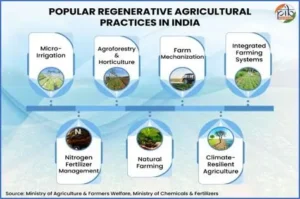
Regenerative Agriculture

Popular Practices in India

  • Microirrigation: Drip and sprinkler systems improve water efficiency and reduce wastage.
  • Natural farming: Use of biological inputs like Beejamrut, Jeevamrut, Neemastra; promotes multicropping, mulching, and livestock integration.
  • Soil health management: Green manuring, cover cropping, and mulching add organic matter, conserve moisture, and support nutrient cycling.
  • Integrated farming systems: Combining crops with livestock, fisheries, horticulture, agroforestry, and apiculture diversifies income and reduces risk.
  • Agroforestry: Planting trees alongside crops improves soil moisture, regulates temperature, stores carbon, and provides additional revenue.

Conclusion

Regenerative agriculture is not just a farming technique but a climateresilient pathway that strengthens rural livelihoods while restoring ecological balance.

CLOUD AND AI SKILLING INITIATIVE

TOPIC: (GS3) SCIENCE AND TECHNOLOGY: THE HINDU

The Government of India, in partnership with Amazon Web Services (AWS), has launched a nationwide Cloud and AI Skilling Initiative to strengthen digital capabilities among youth, particularly in Tier2 and Tier3 cities.

Key Features

  • Targets 1.5 lakh learners with foundational cloud and AI literacy through AWS digital training content.
  • Provides intensive jobready training to 10,000 participants via the AWS re/Start programme, covering cloud infrastructure, networking, security, programming, databases, and AI fundamentals.
  • Delivered online through Cultus Education, the NSDC’s selected partner.
  • Supported by the Ministry of Skill Development and Entrepreneurship (MSDE).

Focus Areas

  • Special emphasis on youth in underserved regions across all states and Union Territories.
  • Addresses challenges such as limited access to globally recognised training, weak industry connections, and lack of credentials for cloud and AI roles.
  • Designed to create social and economic impact by expanding access to highquality technology training and employment opportunities.

Additional Components

  • Includes a national hackathon, where participants will showcase projects in cloud and AI.
  • Builds pathways for learners to connect with technology employers and defence establishments.
  • Encourages innovation while strengthening India’s digital workforce ecosystem.

Conclusion

The initiative represents a strategic step toward bridging India’s digital skills gap, empowering youth with cloud and AI expertise to meet future employment demands.

INDIAN STAR TORTOISE

TOPIC: (GS3) ENVIRONMENT: THE HINDU

Recently, 216 rescued Indian Star Tortoises (Geochelone elegans) were rehabilitated in the Tadoba Andhari Tiger Reserve (TATR) after being seized from illegal trade in Mumbai and Thane.

About the Species

  • A mediumsized terrestrial tortoise, named for the starlike shell patterns that act as camouflage.
  • Found in dry areas and scrub forests, blending naturally with surroundings.
  • Distribution: Western and southeastern India (Kerala, Karnataka, Tamil Nadu), and Sri Lanka.
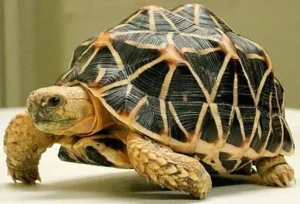
Indian Star Tortoise

Physical and Behavioural Traits

  • Grows up to 10 inches; females are larger than males.
  • Crepuscular activity – active during early mornings and late afternoons in hot weather.
  • Lifespan: 35–80 years in the wild.
  • Solitary animals; do not hibernate but remain inactive during extreme heat or cold.

Conservation Status

  • Listed as Vulnerable on the IUCN Red List.
  • Threatened by illegal wildlife trade, habitat loss, and climate stress.
  • Rehabilitation efforts like those in TATR highlight the importance of wildlife protection laws and community awareness.

Conclusion

The Indian Star Tortoise is a striking species whose survival is increasingly threatened by human activity. Conservation measures, strict enforcement against trafficking, and habitat protection are essential to safeguard this tortoise for future generations.

NILGIRI BIOSPHERE RESERVE

TOPIC: (GS3) ENVIRONMENT: THE HINDU

Researchers have recently warned that climate change is destabilising forest ecosystems in the Nilgiri Biosphere Reserve, raising concerns about biodiversity and tribal livelihoods in the Western Ghats.

Location and Establishment

  • Situated in the Nilgiri Mountains of the Western Ghats.
  • Spreads across Tamil Nadu, Kerala, and Karnataka.
  • Established in 1986 as India’s first biosphere reserve.
  • Recognised under UNESCO’s Man and the Biosphere Programme.
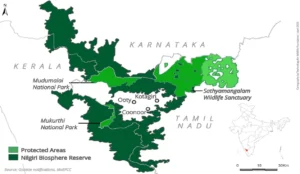
Nilgiri Biosphere Reserve

Protected Areas

  • Mudumalai Wildlife Sanctuary
  • Wayanad Wildlife Sanctuary
  • Bandipur National Park
  • Nagarhole National Park
  • Mukurthi National Park
  • Silent Valley National Park

Vegetation and Flora

  • Diverse ecosystems: tropical evergreen, montane sholas, grasslands, semievergreen, moist and dry deciduous, thorn forests.
  • Rich flora: species like Adenoon, Calacanthus, Baeolepis, Frerea, Jarodina, Wagatea, Poeciloneuron.

Fauna

  • Endangered species: Nilgiri Tahr, Liontailed macaque.
  • Largest South Indian populations of elephant, tiger, gaur, sambar, and chital.

Tribal Communities

  • Home to indigenous groups such as Todas, Kotas, Irullas, Kurumbas, Paniyas, Adiyans, Edanadan Chettis, Cholanaickens, Allar, Malayan, etc., who depend on forest resources for livelihood and cultural practices.

Conclusion

The Nilgiri Biosphere Reserve is a critical biodiversity hotspot and a living example of ecological and cultural diversity. Climate change and human pressures demand stronger conservation strategies to safeguard its fragile ecosystems.


AIRPORT PRIVATISATION

TOPIC: (GS3) ECONOMY: THE HINDU

The Public Private Partnership Appraisal Committee (PPPAC) has granted approval to the Ministry of Civil Aviation’s proposal for the third round of airport privatisation.

What is privatisation

  • Privatisation refers to the process of transferring ownership, management, or control of enterprises, assets, or services from the public sector (government) to the private sector (individuals, companies, or corporations).
  • It is a key economic reform tool often used to improve efficiency, reduce fiscal burden, and attract private investment.

Meaning

  • Involves shifting activities traditionally run by the government to private entities.
  • Can be partial (government retains some stake) or complete (full transfer to private ownership).
  • Often implemented through PublicPrivate Partnerships (PPP), disinvestment, or outright sale.

Objectives

  • Reduce government’s financial burden and fiscal deficit.
  • Improve efficiency, productivity, and competitiveness.
  • Encourage private investment and innovation.
  • Generate revenue for the government through disinvestment.

Airports Identified

  • Bundle 1: Amritsar, Kangra
  • Bundle 2: Varanasi, Gaya, Kushinagar
  • Bundle 3: Bhubaneswar, Hubballi
  • Bundle 4: Raipur, Aurangabad
  • Bundle 5: Tiruchirappalli, Tirupati

Concerns and Safeguards

  • PPPAC Chair raised concerns about oligopolistic concentration and overleveraging in the sector.
  • The Ministry of Civil Aviation assured that a cap will be introduced on the number of bundles awarded to a single bidder.
  • Modalities of this cap are being finalised and will be included in the final proposal.

Background

  • In the previous round, the Adani Group won bids for all six airports, sparking debate over bidder concentration.
  • PPPAC had earlier rejected Finance Ministry and NITI Aayog’s recommendations to limit awards to two airports per bidder and require prior airport management experience.

Conclusion

The third round of airport privatisation signals India’s continued push for PPPbased infrastructure development, but safeguards against monopolisation will be crucial to ensure fair competition and balanced growth in the aviation sector.

Write a Review

Your email address will not be published. Required fields are marked *

Seraphinite AcceleratorOptimized by Seraphinite Accelerator
Turns on site high speed to be attractive for people and search engines.