

Table of Contents
ToggleDelimitation and Lok Sabha Seats: Why 543 Should Remain 543
The debate over delimitation of Lok Sabha constituencies has gained importance as India approaches the next exercise of readjusting parliamentary representation. While delimitation aims to ensure equal representation based on population changes, concerns have emerged over its impact on federal balance, States’ representation and democratic fairness.
What Is Delimitation?
Delimitation refers to the process of redrawing boundaries of parliamentary and assembly constituencies to provide equal representation based on population changes.
Under Article 82 of the Constitution, Parliament provides for readjustment of Lok Sabha seats after each Census. However, the number of Lok Sabha seats has remained frozen at 543 due to concerns that States controlling population growth should not lose political representation.
The present freeze was extended through the 42nd Constitutional Amendment (1976) and later continued through the 84th Constitutional Amendment (2001).

Why Is the Debate About Increasing Lok Sabha Seats?
India’s population has increased significantly since the last delimitation exercise. Supporters argue that the existing number of representatives no longer reflects the size of the electorate and that increasing seats would improve representation.
However, the article argues that simply increasing seats may create new challenges. States that performed better in controlling population growth may face reduced relative influence, while high-population States could gain more seats.
Federal Concerns and Regional Balance
India’s federal structure requires balancing population-based representation with the interests of different States.
The article highlights that States with lower population growth should not be politically disadvantaged for implementing successful demographic policies. A purely population-based approach could alter the balance between States and affect cooperative federalism.
Women’s Representation and Delimitation
The article also discusses the relationship between delimitation and women’s reservation.
The Women’s Reservation Act, 2023 links implementation of reservation for women in Lok Sabha and State Assemblies with a future delimitation exercise. However, delaying delimitation creates uncertainty regarding when increased representation will actually become effective.
Need for a Balanced Approach
The solution may not lie in increasing seats alone. The article suggests preserving the existing 543-seat structure while exploring reforms that improve representation.
Possible measures include:
- Strengthening parliamentary functioning
- Improving constituency management
- Ensuring fair representation for women
- Maintaining balance between population and federal principles
Conclusion
The delimitation debate is not merely about numbers; it concerns the relationship between population, representation and federalism.
India needs an approach that improves democratic representation without penalising States that achieved population control. Any future reform should balance the principles of equal representation, constitutional fairness and cooperative federalism.
Frequently Asked Questions (FAQs)
What is delimitation in India?
Delimitation is the process of redrawing boundaries of Lok Sabha and Assembly constituencies to ensure fair representation based on population changes.
Why are Lok Sabha seats currently fixed at 543?
The number of Lok Sabha seats was frozen to prevent States that controlled population growth from losing political representation. The freeze was continued through constitutional amendments.
Why is delimitation considered a federal issue?
A population-based redistribution of seats may increase representation of high-population States while reducing the relative influence of States with lower population growth.
How is women’s reservation linked with delimitation?
The Women’s Reservation Act, 2023 provides for implementation of reserved seats for women after a future delimitation exercise.
Should India increase the number of Lok Sabha seats?
Increasing seats may improve representation due to population growth, but it must be balanced with concerns of federal fairness and equitable political representation.
Source From : The Hindu
Nepal Floods and Himalayan Disasters: Lessons for Disaster Resilience
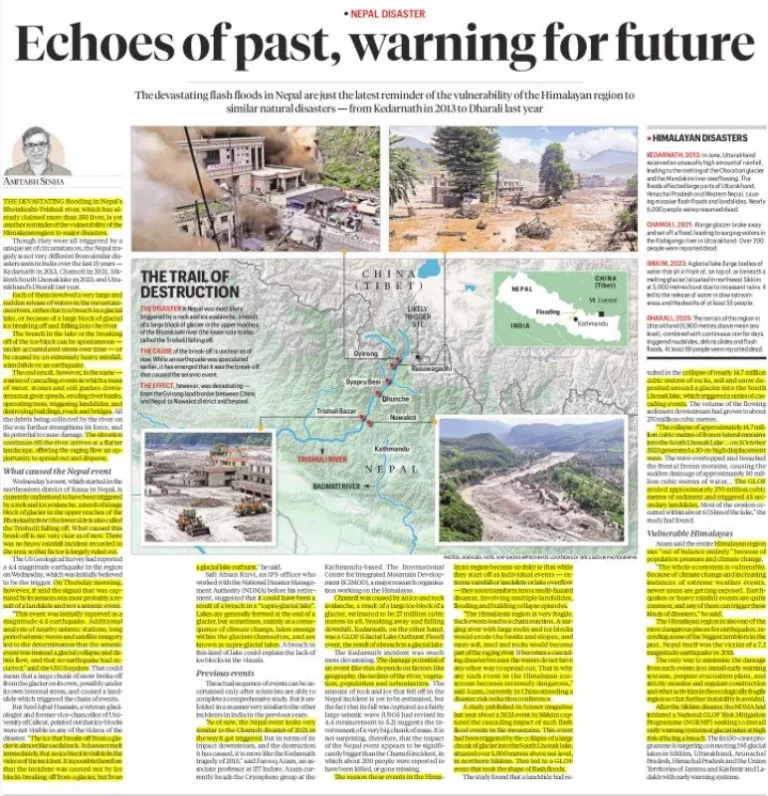
The recent devastating flash floods in Nepal have once again highlighted the growing vulnerability of the Himalayan region to natural disasters. From the Kedarnath disaster of 2013 to recent landslides and glacier-related events, the Himalayan ecosystem has witnessed repeated episodes of destruction caused by extreme weather events, fragile geology and unplanned development.
Nepal Floods: A Reminder of Himalayan Vulnerability
The recent floods in Nepal caused widespread destruction, damaging settlements, roads and infrastructure. The disaster reflects the increasing frequency of extreme rainfall events and the fragile nature of mountain environments.
The Himalayan region is highly sensitive because of its:
- Young and unstable geological structure
- Steep slopes
- Rapid erosion
- Glacial and river systems
- Increasing human pressure
These factors make the region highly vulnerable to floods, landslides and other hazards.
The Role of Climate Change in Himalayan Disasters
Climate change is intensifying risks in the Himalayan region. Rising temperatures are accelerating glacier melting, increasing the possibility of glacial lake expansion and sudden releases of water.
Changes in rainfall patterns have also increased the frequency of intense precipitation events. Short-duration heavy rainfall can trigger flash floods and landslides, especially in areas with fragile mountain terrain.
Development and Ecological Imbalance
The article highlights that disasters are not caused only by natural factors. Human interventions often increase their impact.
Unplanned construction, road expansion, deforestation, mining activities and poorly regulated tourism can weaken mountain ecosystems.
Large infrastructure projects without adequate environmental assessment may disturb natural drainage systems and increase disaster vulnerability.
Lessons from Past Himalayan Disasters
Previous events such as the Kedarnath floods (2013), Chamoli disaster (2021) and other Himalayan landslides demonstrate the need for sustainable development.
Key lessons include:
- Strengthening early warning systems
- Improving disaster preparedness
- Protecting fragile ecosystems
- Regulating construction in vulnerable zones
- Promoting climate-resilient infrastructure
Need for Regional Cooperation
The Himalayan ecosystem extends across multiple countries, including India, Nepal, Bhutan, China and Pakistan. Therefore, disaster management requires regional cooperation in areas such as:
- Weather forecasting
- Glacier monitoring
- River basin management
- Data sharing
- Climate adaptation strategies
Conclusion
The Nepal floods serve as a warning that Himalayan disasters are becoming more frequent and complex. While natural processes contribute to these events, human activities often magnify their consequences.
The future of Himalayan development must focus on ecological balance, scientific planning and disaster resilience. Protecting the mountains is not only an environmental responsibility but also essential for the safety and livelihoods of millions of people living in the Himalayan region.
Frequently Asked Questions (FAQs)
Why is the Himalayan region vulnerable to disasters?
The Himalayas are young fold mountains with unstable geology, steep slopes and active tectonic processes. These features make the region highly prone to floods, landslides and earthquakes.
How does climate change increase Himalayan disasters?
Climate change accelerates glacier melting, alters rainfall patterns and increases extreme weather events. These changes raise the risk of flash floods and glacial lake outburst floods.
What human activities increase Himalayan disaster risks?
Unplanned construction, deforestation, road cutting, mining and poorly regulated tourism can weaken mountain ecosystems and increase disaster impacts.
What lessons can India and Nepal learn from Himalayan disasters?
Both countries need stronger early warning systems, sustainable infrastructure, ecosystem protection and better disaster preparedness to reduce future risks.
Why is regional cooperation important for Himalayan disaster management?
The Himalayas cross national boundaries, and disasters often affect shared river systems. Cooperation in data sharing, forecasting and climate adaptation is essential.