

Table of Contents
ToggleNepal Disaster: A Himalayan Warning for India
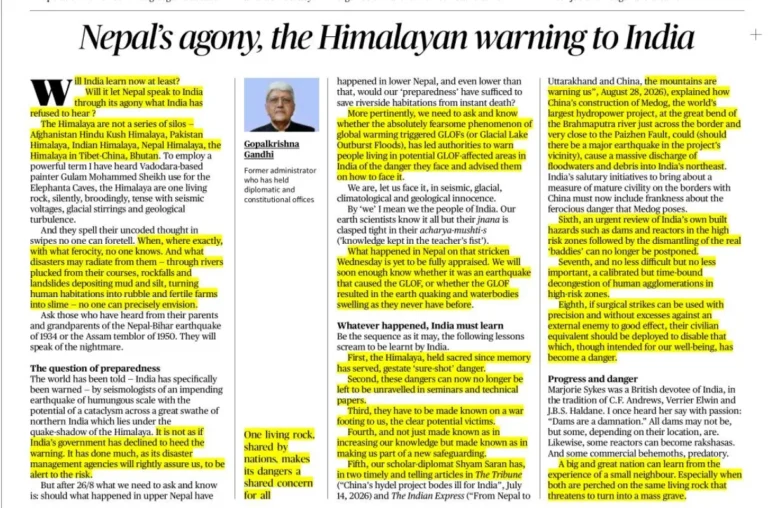
The recent Nepal disaster has once again highlighted the vulnerability of the Himalayan region to earthquakes, glacial lake outburst floods (GLOFs), landslides and other natural hazards. The interconnected Himalayan ecosystem means that a disaster in Nepal can have serious consequences for neighbouring regions of India and China.
Why Are the Himalayas Highly Vulnerable?
The Himalayas are a young and geologically active mountain system characterised by seismic activity, unstable slopes, glaciers and rapidly changing climatic conditions.
Natural hazards can trigger a chain of events. An earthquake may destabilise glaciers or slopes, leading to a Glacial Lake Outburst Flood (GLOF), landslides and sudden flooding of downstream settlements.
The unpredictability and cascading nature of these hazards make disaster preparedness particularly important.
Nepal Disaster: Lessons for India
The recent disaster in Nepal raises an important question for India: Are we sufficiently prepared for similar Himalayan hazards?
India shares the Himalayan ecosystem with Nepal, Bhutan and China. Rivers, glaciers and mountain systems cross political boundaries, meaning that disasters originating in one country can quickly create risks in another.
The experience of Nepal therefore provides important lessons for India’s disaster management and infrastructure planning.
Climate Change and Glacial Lake Outburst Floods
One of the major concerns highlighted in the article is the increasing threat from global warming and GLOFs.
Rising temperatures can accelerate glacier retreat and increase the size and instability of glacial lakes. A sudden release of water can generate powerful downstream floods, threatening settlements, roads, bridges and hydropower infrastructure.
India must therefore strengthen monitoring of Himalayan glaciers and glacial lakes and develop effective early-warning mechanisms.
Infrastructure Development in Fragile Himalayas
The article also raises concerns about large infrastructure projects in high-risk Himalayan regions.
Projects such as dams, hydropower plants, roads and tunnels can provide major developmental benefits, but their location and design must account for earthquakes, landslides, floods and other cascading hazards.
The proposed Medog hydropower project in Tibet, located close to the Brahmaputra, highlights the importance of assessing transboundary disaster risks and potential downstream consequences.
Need for Better Disaster Preparedness
India needs a comprehensive approach based on:
- Early-warning systems for GLOFs and floods
- Real-time monitoring of rivers and glaciers
- Hazard-sensitive infrastructure planning
- Scientific assessment of dams and hydropower projects
- Regulation of human settlements in high-risk zones
- Cross-border disaster information sharing
- Stronger community-level preparedness
Development and Disaster Risk Must Go Together
The article does not suggest stopping development. Instead, it calls for risk-sensitive development.
Human settlements and infrastructure must be planned according to the carrying capacity and hazard profile of the Himalayan environment. Development that ignores geological and climatic risks can eventually create greater economic and humanitarian costs.
Conclusion
The Nepal disaster is a warning for India that Himalayan hazards are interconnected, unpredictable and capable of crossing national boundaries.
India must move from a reactive disaster-response approach towards anticipatory and risk-informed disaster management. Scientific early warnings, resilient infrastructure, ecological sensitivity and regional cooperation will be essential to protect lives and livelihoods in the Himalayan region.
Frequently Asked Questions (FAQs)
Why are the Himalayas vulnerable to natural disasters?
The Himalayas are geologically young and highly active, with unstable slopes, seismic activity and extensive glaciers. Climate change and human activities can further increase disaster risks.
What is a Glacial Lake Outburst Flood (GLOF)?
A GLOF occurs when water stored in a glacial lake is suddenly released, producing a powerful flood. It can cause extensive damage to downstream settlements and infrastructure.
How can disasters in Nepal affect India?
Many Himalayan rivers and ecosystems are interconnected across borders. Floods, landslides and glacier-related disasters in Nepal can therefore create downstream risks for Indian States.
How does climate change increase Himalayan disaster risks?
Rising temperatures accelerate glacier melting and can increase the instability of glacial lakes. Changing rainfall patterns can also increase the likelihood of extreme floods and landslides.
What should India do to reduce Himalayan disaster risks?
India should strengthen early-warning systems, glacier monitoring, resilient infrastructure, hazard mapping and regional cooperation while regulating development in high-risk Himalayan areas.
Source From : The Hindu
India’s Economy: Strong Growth Amid Rising Global Risks
India’s economy continues to show resilience despite geopolitical tensions, trade uncertainty and global economic challenges. Recent GDP and inflation data indicate strong domestic fundamentals, although several risks could affect growth in the coming months.
India’s Growth Remains Strong
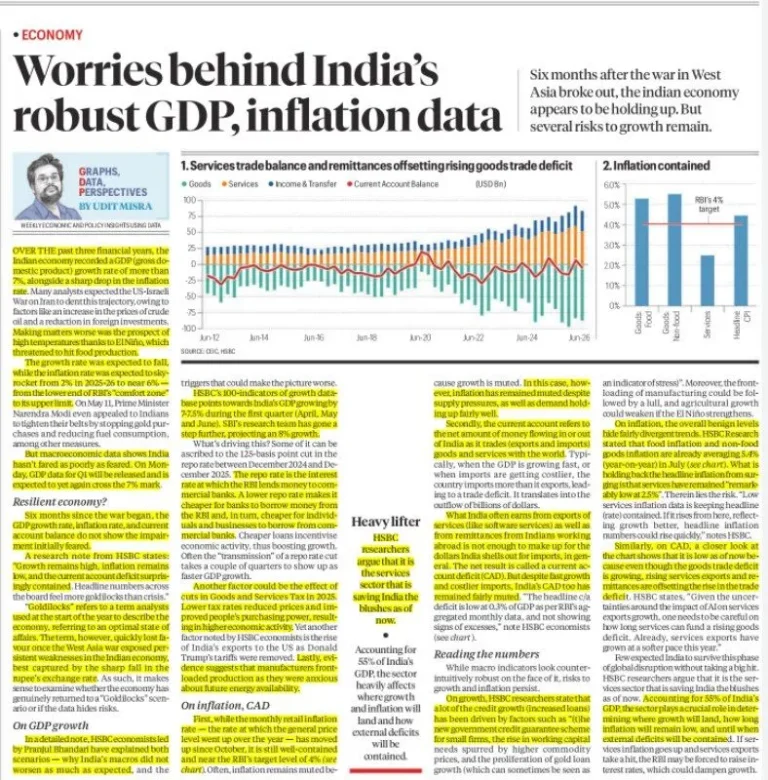
The article notes that India’s economic growth has remained robust, with GDP growth reaching around 7% despite a difficult global environment.
Strong domestic demand, improving manufacturing activity and resilient services are supporting economic momentum. The country’s relatively strong macroeconomic fundamentals have helped it withstand external shocks.
Inflation Remains Contained
India’s inflation outlook has improved significantly. Headline consumer inflation has moderated, with food inflation easing and core inflation remaining relatively contained.
The article highlights that inflation has remained close to or below the RBI’s 4% target, providing greater room for monetary policy support to economic activity.
However, risks remain from commodity prices, global disruptions and possible weather-related pressures on food prices.
Trade Deficit and Remittances
India continues to face a significant merchandise trade deficit, as imports remain higher than exports.
However, strong services exports and remittance inflows provide an important cushion. India’s large services sector, particularly IT and business services, helps offset part of the merchandise trade gap.
Remittances from Indians working abroad also remain an important source of foreign exchange.
What Are the Major Risks to Growth?
Despite strong economic indicators, the article identifies several potential risks.
These include:
- Global geopolitical tensions
- Trade restrictions and tariffs
- Weakness in global demand
- Rising commodity prices
- Oil price shocks
- Possible El Niño-related risks
- Slower manufacturing growth
A sustained rise in oil prices could particularly affect India because of its dependence on imported crude oil.
Manufacturing and Domestic Demand
India’s manufacturing sector remains an important driver of growth. Strong domestic consumption and investment can support economic expansion even when external demand is weak.
The article also points to improvements in manufacturing activity and business conditions, although the sustainability of this momentum will depend on investment, productivity and global economic developments.
Conclusion
India’s economy has demonstrated considerable resilience amid global uncertainty. Strong GDP growth, contained inflation, robust services exports and remittances provide important buffers against external shocks.
Nevertheless, policymakers must remain alert to geopolitical tensions, trade disruptions, commodity prices and global demand conditions. Sustaining growth will require strengthening domestic demand while improving manufacturing competitiveness and reducing vulnerability to external shocks.
Frequently Asked Questions (FAQs)
Why is the Indian economy considered resilient?
India’s strong domestic demand, services sector, manufacturing activity and stable macroeconomic fundamentals are helping the economy withstand global uncertainties.
How is inflation performing in India?
Inflation has moderated significantly, supported by easing food prices and contained core inflation. The article notes that inflation has remained around or below the RBI’s 4% target.
How do services exports help India’s economy?
Strong services exports, particularly in IT and business services, generate foreign exchange and help offset part of India’s merchandise trade deficit.
What are the major risks to India’s economic growth?
Key risks include geopolitical tensions, trade restrictions, oil prices, weak global demand and climate-related disruptions such as possible El Niño conditions.
Why are remittances important for India?
Remittances from Indians working abroad provide a significant source of foreign exchange. They help strengthen India’s external-sector position and partly offset the merchandise trade deficit.