
Table of Contents
ToggleA Unilateral America in a Post-Unipolar World
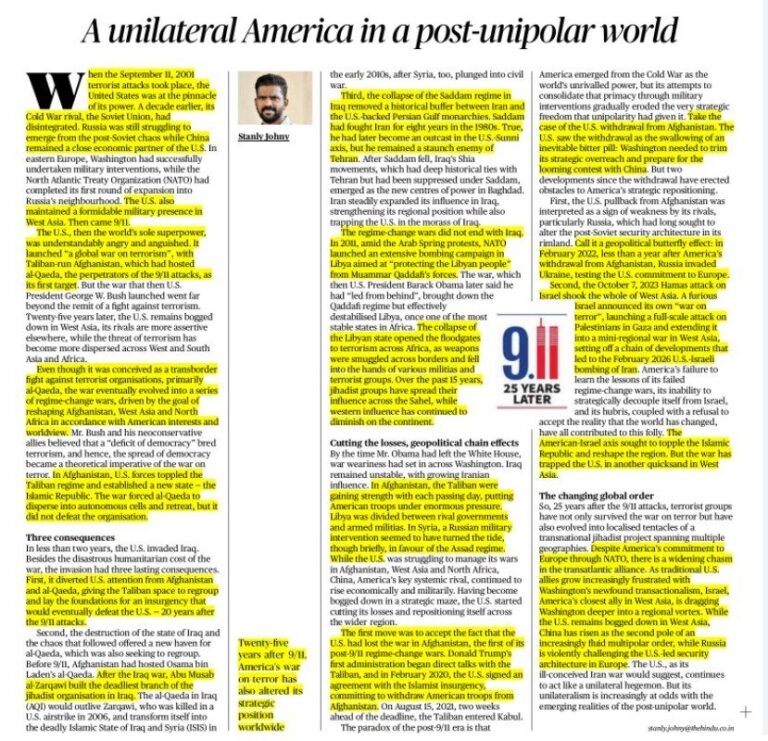
The 9/11 attacks of 2001 marked a major turning point in international relations. The United States, already the dominant global power after the Cold War, launched the War on Terror, leading to military interventions in Afghanistan and Iraq and later involvement in Libya. However, the long-term consequences of these interventions contributed to regional instability and exposed the limits of unilateral military power.
The War on Terror and US Interventions
Following 9/11, the US-led intervention in Afghanistan initially removed the Taliban from power and targeted Al-Qaeda. However, the Taliban gradually regrouped, demonstrating the difficulty of achieving lasting political stability through military intervention alone.
The Iraq War of 2003 produced wider geopolitical consequences. The collapse of Saddam Hussein’s regime weakened Iraq’s state institutions and contributed to the rise of extremist organisations. Importantly, the weakening of Iraq also increased Iran’s regional influence, altering the balance of power in West Asia.
The NATO intervention in Libya during the Arab Spring resulted in the fall of Muammar Gaddafi. The subsequent state collapse and political fragmentation created conditions for armed groups and extremist organisations to expand.
Limits of American Primacy
These interventions generated significant humanitarian, political and strategic consequences. The experience highlighted the limitations of regime-change strategies and demonstrated that military superiority does not necessarily translate into durable political outcomes.
The US withdrawal from Afghanistan further illustrated the challenges facing American influence in conflict-ridden regions.
Rise of a Multipolar World
Twenty-five years after 9/11, global politics is increasingly moving away from a purely unipolar system. China has emerged as a major economic and strategic power, while Russia has become increasingly assertive in challenging aspects of the US-led international order.
Regional powers are also gaining greater strategic autonomy, making international politics more complex and competitive.
Implications for India
For India, this changing global order reinforces the importance of strategic autonomy and multi-alignment. India must maintain productive relationships with the US, Russia, China, West Asian countries and other major partners while protecting its national interests.
India’s approach requires flexibility rather than dependence on any single power centre.
Conclusion
The post-9/11 era demonstrates the limits of unilateral power and the complexity of regime-change interventions. The international system is increasingly characterised by multipolarity, competing strategic interests and stronger regional actors. For India, maintaining strategic autonomy while engaging with multiple centres of power remains crucial in navigating this evolving global order.
Vocabulary
1. Vocabulary Unipolarity – Dominance of one major power in global affairs.
2. Regime Change – Replacement of an existing government.
3. Multipolarity – Presence of multiple centres of global power.
Prelims MCQs
MCQ 1
Consider the following statements:
1. The US invasion of Iraq removed Saddam Hussein from power.
2. Taliban returned to power after the US withdrawal from Afghanistan.
3. NATO intervention contributed to instability in Libya.
Which are correct?
A) 1 and 2 only
B) 2 and 3 only
C) 1 and 3 only
D) 1, 2 and 3
Answer: D
UPSC Mains Question
“US interventions after 9/11 have contributed to changes in the global balance of power.” Discuss.
(10 Marks)
Frequently Asked Questions (FAQs)
What is meant by a “post-unipolar world”?
A post-unipolar world refers to an international system where global power is no longer concentrated predominantly in the United States and multiple countries influence global affairs.
How did the 9/11 attacks change US foreign policy?
The 9/11 attacks led the United States to launch the War on Terror, resulting in major military interventions, particularly in Afghanistan and Iraq.
How did the Iraq War affect West Asian geopolitics?
The fall of Saddam Hussein’s regime weakened Iraq’s regional position and contributed to the expansion of Iran’s influence in West Asia.
What were the consequences of the Libya intervention?
The fall of Muammar Gaddafi was followed by state fragmentation and instability, creating space for armed groups and extremist organisations.
What does the rise of China and Russia mean for the global order?
The growing influence of China and Russia has contributed to a shift away from US-dominated unipolarity towards a more multipolar and competitive international system.
Source From : The Hindu
The Challenges for BRICS in a Changing World Order
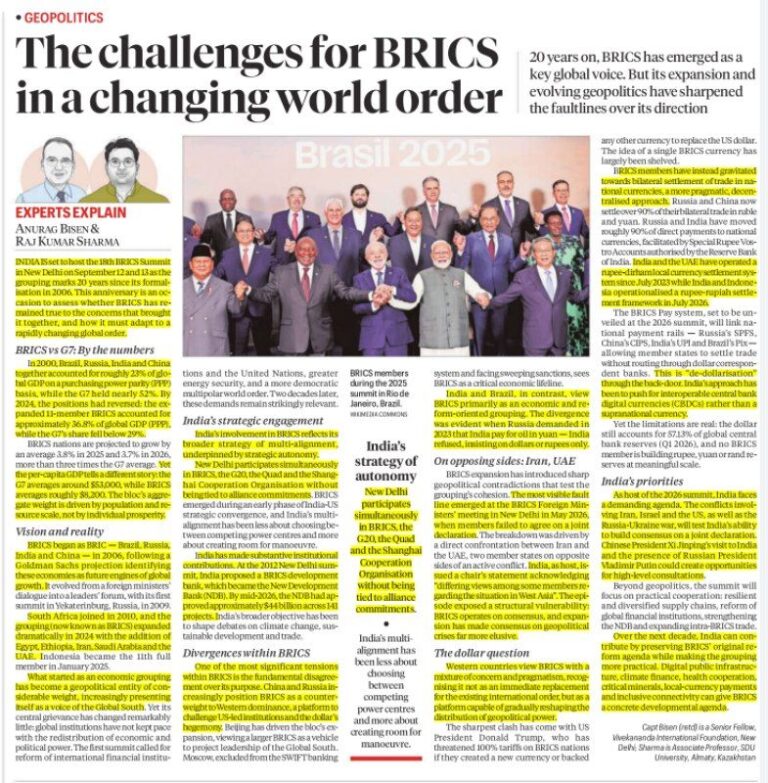
BRICS has evolved from an economic grouping into a broader geopolitical platform representing the Global South. Over the years, its growing membership and expanding agenda have increased its global influence. However, the changing international order has also exposed significant differences among its members, particularly over geopolitics, the role of China and Russia, and the future of the global financial system.
BRICS and the Global South
BRICS provides developing countries with a platform to seek greater representation in global governance. The grouping supports reforms in international institutions and promotes cooperation on economic development, finance and other shared concerns.
Its growing membership has strengthened its collective voice, but expansion also makes consensus-building more difficult because members have different economic and strategic interests.
India’s Multi-Alignment Strategy
India views BRICS as an important component of its multi-alignment strategy. At the same time, India participates actively in platforms such as the Quad, G20 and SCO.
This approach allows India to engage with different power centres without becoming part of a formal alliance system. BRICS therefore complements India’s broader pursuit of strategic autonomy.
Major Challenges for BRICS
One of the biggest challenges is the divergence in geopolitical interests among members. China–Russia influence within the grouping and differences between India and China can complicate decision-making.
Another major debate concerns de-dollarisation. BRICS members have explored greater use of local currencies in trade and financial transactions to reduce dependence on the US dollar. However, developing a common alternative financial or monetary system remains challenging.
The expansion of BRICS also creates difficulties in maintaining a common position on international political issues.
India’s Priorities
India can use BRICS to promote practical cooperation rather than allowing geopolitical differences to dominate the agenda. Key areas include:
- Development cooperation
- Economic reform
- Global South representation
- Digital infrastructure
- Trade and investment
- Financial cooperation
- Technology and connectivity
India can also use its participation to encourage consensus among diverse members.
Conclusion
BRICS has become an important institution in the emerging multipolar world order, but its future effectiveness will depend on its ability to manage internal differences. For India, BRICS is valuable as a platform for advancing Global South interests, development cooperation and strategic autonomy while maintaining partnerships across different international groupings.
Vocabulary
1. De-dollarisation – Reducing dependence on the US dollar in international trade and finance.
2. Multi-alignment – Maintaining partnerships with multiple power centres without joining formal alliances.
3. Global South – Developing countries seeking greater representation in global governance.
Prelims MCQs
MCQ 1
Consider the following statements regarding BRICS:
1. BRICS was originally formed as an economic grouping of Brazil, Russia, India and China.
2. The New Development Bank (NDB) was established by BRICS countries.
3. India is a member of both BRICS and the Quad.
Which are correct?
A) 1 and 2 only
B) 2 and 3 only
C) 1 and 3 only
D) 1, 2 and 3
Answer: D
UPSC Mains Question
“BRICS represents the aspirations of the Global South but faces challenges due to internal differences and changing geopolitics.” Discuss. (10 Marks)
Frequently Asked Questions (FAQs)
What is BRICS?
BRICS is a grouping of major emerging economies that has evolved from an economic platform into a broader forum for geopolitical cooperation and Global South interests.
Why is BRICS important for the Global South?
BRICS provides developing countries with a platform to seek greater representation in global governance, promote development cooperation and advocate reforms in international institutions.
What are the major challenges facing BRICS?
The major challenges include:
- Differences over geopolitics
- Diverging interests among members
- China–Russia influence
- India–China differences
- Debate over de-dollarisation
- Difficulties in achieving consensus after expansion
What is de-dollarisation?
De-dollarisation refers to reducing dependence on the US dollar in international trade and financial transactions, including through greater use of local currencies.
What is India’s approach towards BRICS?
India follows a multi-alignment approach, engaging simultaneously with BRICS, the Quad, G20 and SCO while maintaining its strategic autonomy.