

Table of Contents
TogglePolicing the Line Between Publicity and Justice: Media Briefings and Arrest Publicity
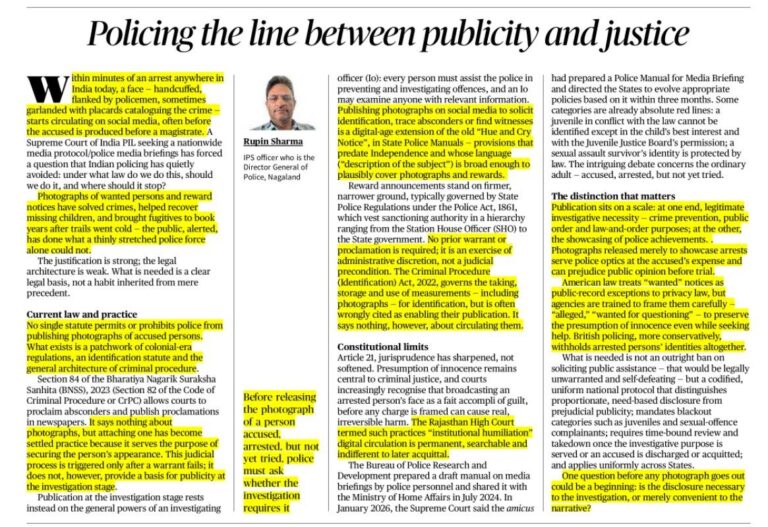
The growing practice of police publicity through photographs, media briefings and social media posts has raised important questions about the balance between crime investigation and the rights of accused persons. The article examines how police agencies can communicate with the public while protecting privacy, dignity and the presumption of innocence.
Why Police Publicity Matters
Photographs of wanted persons and public notices can assist law enforcement in locating absconders, recovering missing persons and identifying suspects. In the digital age, social media can significantly expand the reach of such information.
However, the article distinguishes between publicity that serves a genuine investigative purpose and publicity that merely showcases police action.
When an accused person is displayed publicly before trial, the consequences can extend beyond the investigation. Digital photographs may remain searchable and can affect the person’s reputation even if the person is later acquitted.
Existing Legal Framework
The article notes that there is no single statute that comprehensively governs police publication of photographs of accused persons. Instead, the practice operates through a combination of criminal procedure, police regulations and other legal provisions.
Section 84 of the Bharatiya Nagarik Suraksha Sanhita (BNSS), 2023, concerning proclamation against an absconder, permits publication of proclamations in specified circumstances. However, the article points out that this provision does not itself create a general authority for publishing photographs of accused persons.
The Criminal Procedure (Identification) Act, 2022 also provides a framework for collecting and using certain identification measurements, including photographs, but the article highlights the distinction between collecting identification information and publicly circulating it.
Constitutional Limits
Article 21 protects life and personal liberty, and judicial jurisprudence has increasingly recognised the importance of dignity and privacy in criminal proceedings.
The article refers to concerns over “digital humiliation”, noting that online circulation can be permanent and searchable. Publicly presenting an arrested person as guilty before trial can therefore create serious consequences for reputation and the presumption of innocence.
Need for Clear Guidelines
The article argues for a codified and uniform national protocol governing police publicity. Such a framework could distinguish between:
- Legitimate investigative publicity
- Public safety requirements
- Wanted-person notices
- Publicity that risks prejudicing a fair trial
Particular safeguards may also be required for juveniles and sexual-offence survivors.
Conclusion
Police communication can assist investigation and public safety, but it must remain proportionate and purpose-driven. The central question is whether disclosure is genuinely necessary for investigation or merely convenient for publicity. A clear legal framework can help balance effective policing, privacy, dignity and the presumption of innocence.
Vocabulary
1.Presumption of Innocence – Innocent until proven guilty.
2. Prejudicial Publicity – Publicity affecting a fair trial.
3. Proportionality – State action limited to what is necessary.
Prelims MCQs
MCQ 1
Consider the following statements:
1. BNSS provides for proclamation of certain absconders.
2. Presumption of innocence is central to criminal justice.
3. Police may freely publish photographs of every arrested person.
Which are correct?
A) 1 and 2 only
B) 2 and 3 only
C) 1 and 3 only
D) 1, 2 and 3
Answer: A
UPSC Mains Question
“Police publicity must balance investigative necessity with the dignity and presumption of innocence of the accused.” Discuss.
(10 Marks)
Frequently Asked Questions (FAQs)
Why is police publicity a legal concern?
Publicly displaying accused persons can affect their dignity, privacy and reputation, particularly before a court determines guilt.
Does the BNSS generally permit police to publish photographs of accused persons?
The article states that Section 84 of the BNSS deals with proclamations against absconders but does not itself establish a general power to publish photographs of accused persons.
How does Article 21 relate to police publicity?
Article 21 protects life and personal liberty, and the article connects it with concerns regarding dignity, privacy and reputational harm.
Why is social-media publication particularly significant?
Digital content can remain searchable and circulate widely, potentially causing lasting reputational consequences.
What kind of framework does the article suggest?
It calls for a codified, uniform and need-based protocol distinguishing legitimate investigative publicity from prejudicial or unnecessary disclosure.
Source From : The Hindu
Special Intensive Revision (SIR) of Electoral Rolls: Voter Rights, ECI and Electoral Integrity
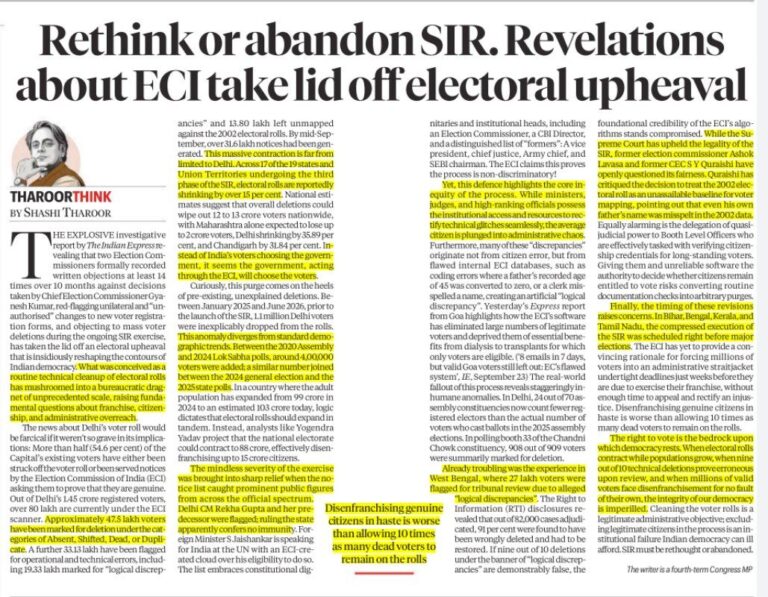
The Special Intensive Revision (SIR) of electoral rolls has generated debate over the balance between maintaining accurate voter lists and protecting eligible citizens from wrongful exclusion. The issue is significant for Indian Polity, electoral reforms and democratic governance, as electoral rolls form the foundation of meaningful participation in elections.
The Election Commission of India (ECI) has stated that electoral-roll revision is intended to ensure that eligible citizens are included and ineligible names are excluded, including entries relating to deceased, shifted or otherwise ineligible electors. The ECI invoked Article 324 of the Constitution and Section 21 of the Representation of the People Act, 1950 for the Bihar SIR.
What is Special Intensive Revision?
SIR is a detailed exercise to verify and update electoral rolls. Unlike routine revisions, an intensive revision involves more extensive verification of electors and electoral information.
The debate highlighted in the article concerns whether the verification process can unintentionally create barriers for genuine voters, particularly when documentation or database records are incomplete.
Electoral Integrity vs Voter Inclusion
A reliable electoral roll must achieve two objectives simultaneously:
- Prevent duplicate or ineligible entries
- Protect eligible voters from wrongful exclusion
The ECI’s stated objective is to maintain electoral-roll integrity while ensuring that no eligible voter is left out.
This creates an important governance challenge: How can electoral authorities improve the accuracy of voter databases without making the process excessively burdensome for citizens?
Role of Aadhaar and Documentation
The question of documentation became particularly important during the Bihar SIR. The Supreme Court clarified in September 2025 that Aadhaar is not proof of citizenship, but directed that it be accepted as a document for establishing identity in the Bihar SIR process under the relevant legal framework.
This distinction between identity and citizenship is important for understanding electoral-roll verification.
Importance of Due Process
Electoral revision requires accessible mechanisms for claims, objections and corrections. The ECI provides procedures through which voters can register, update details, search electoral rolls and raise grievances.
The article therefore raises a broader democratic question: whether verification procedures are sufficiently transparent, accessible and capable of correcting genuine errors.
Conclusion
The SIR debate highlights the importance of maintaining accurate electoral rolls while protecting universal electoral participation. Electoral integrity and voter inclusion should operate together rather than as competing objectives. Transparent verification, effective grievance redressal and accessible correction mechanisms are important for strengthening public confidence in the electoral process.
Vocabulary
1. Disenfranchisement – Loss of voting rights
2. Electoral Roll – Official list of eligible voters
3. SIR – Special Intensive Revision
Prelims MCQs
MCQ 1
Consider the following statements:
1. The Election Commission supervises preparation and revision of electoral rolls.
2. Article 326 provides for elections to the Lok Sabha and State Assemblies on the basis of adult suffrage.
3. The right to vote is a Fundamental Right.
Which are correct?
A) 1 and 2 only
B) 2 and 3 only
C) 1 and 3 only
D) 1, 2 and 3
Answer: A
UPSC Mains Question
“Electoral roll integrity requires both accuracy and protection against wrongful voter exclusion.” Discuss.
(10 Marks)
Frequently Asked Questions (FAQs)
What is Special Intensive Revision (SIR)?
SIR is an intensive process of verifying and updating electoral rolls to identify eligible voters and remove ineligible or duplicate entries.
Why is SIR important for elections?
It aims to improve the accuracy and integrity of electoral rolls, which are essential for conducting elections.
Is Aadhaar proof of citizenship?
No. The Supreme Court clarified that Aadhaar is not proof of citizenship, while directing its acceptance as an identity document for the Bihar SIR process.
What is the main concern surrounding electoral-roll revision?
The key concern is ensuring that efforts to remove ineligible entries do not inadvertently exclude eligible voters.
What constitutional provision is relevant to electoral rolls?
Article 326 provides for elections based on adult suffrage, subject to constitutional and statutory qualifications. The ECI cited Article 326 in explaining the objective of the Bihar SIR.