

Table of Contents
ToggleFrom the Brink to a Comeback: Hope for India’s Wildlife
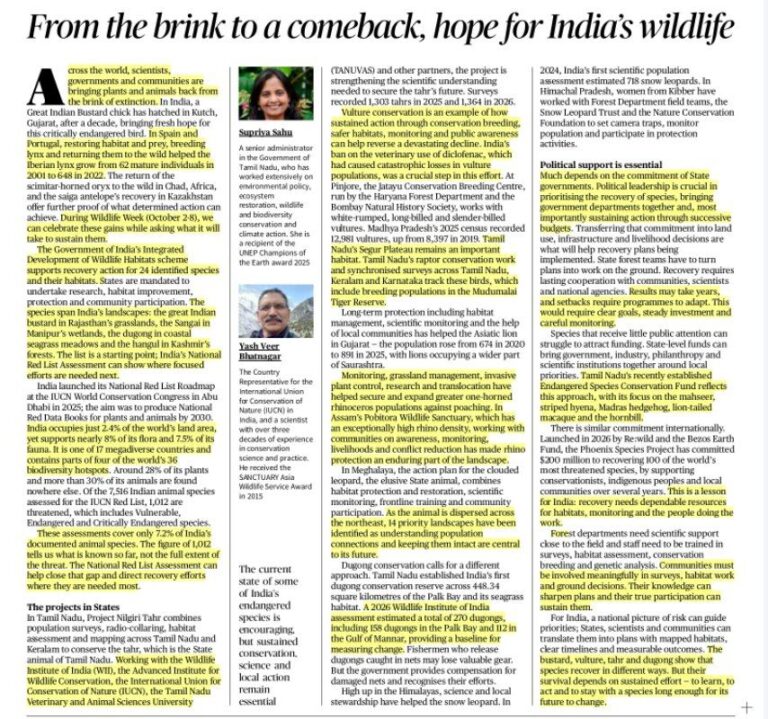
India is witnessing encouraging signs of wildlife recovery and conservation, with several threatened species showing the potential for revival through sustained scientific research, habitat protection and community participation. The experience of species such as the Great Indian Bustard, Nilgiri Tahr, Sangai, Manipur’s brow-antlered deer and rhinoceros demonstrates that coordinated conservation efforts can make a measurable difference.
India’s Wildlife Conservation Efforts
The article highlights the importance of India’s Integrated Development of Wildlife Habitats Scheme, which supports the recovery of 24 identified species through research, habitat improvement, population monitoring and community participation. Such programmes are increasingly important as habitat loss, climate change, human-wildlife conflict and other pressures threaten biodiversity.
India is also developing a National Red List Roadmap, aligned with the IUCN Red List, to improve the assessment of threatened species and identify conservation priorities. A comprehensive Red List can help governments and conservation agencies direct resources towards species and habitats requiring urgent intervention.
Species Recovery Through Science and Local Action
Tamil Nadu provides important examples of species-focused conservation. The Nilgiri Tahr recovery programme combines habitat restoration, radio-collaring, population assessment and mapping across the Nilgiri landscape. Similar approaches are being used for the Sangai in Manipur, rhinoceros in Assam and other endangered species.
In Tamil Nadu, the Jatayu Conservation Breeding Centre and other institutions are contributing to the recovery of threatened vulture populations. Scientific monitoring, breeding programmes and habitat protection can help rebuild populations while addressing threats such as poisoning and habitat degradation.
The article also stresses the importance of community participation. Conservation cannot succeed through protected areas and government action alone. Local communities need to participate in habitat management, monitoring and livelihood-related decisions.
Role of Technology and Monitoring
Modern conservation increasingly depends on technologies such as camera traps, genetic assessment, radio-collaring, satellite-based monitoring and scientific population surveys. These tools help researchers understand species distribution, population trends and emerging threats.
Conclusion
India’s wildlife recovery efforts demonstrate that conservation is not simply about protecting individual species. It requires a combination of science, habitat restoration, institutional support, political commitment and community participation. The central lesson is that endangered species can recover when conservation efforts are sustained and carefully monitored. India’s future biodiversity strategy must therefore focus not only on preventing extinction but also on rebuilding viable populations and restoring healthy ecosystems.
Vocabulary
1. Species Recovery – Restoration of declining wildlife populations.
2. Captive Breeding – Breeding endangered species under human care.
3. Red List – IUCN assessment of species’ extinction risks.
Prelims MCQs
MCQ 1
Consider the following pairs:
1. Nilgiri Tahr – Western Ghats
2. Dugong – Seagrass habitats
3. Great Indian Bustard – Grasslands
Which are correctly matched?
A) 1 and 2 only
B) 2 and 3 only
C) 1, 2 and 3
D) 1 only
Answer: C
UPSC Mains Question
“Species recovery requires more than legal protection; it demands scientific management and community participation.” Discuss. (10 Marks)
Frequently Asked Questions (FAQs)
What are the major wildlife conservation efforts in India?
India uses habitat protection, species recovery programmes, scientific monitoring, captive breeding and community participation to conserve threatened wildlife.
What is the IUCN Red List?
The IUCN Red List assesses the global conservation status of species and identifies those facing different levels of extinction risk.
Which species are highlighted in India’s wildlife recovery efforts?
The article highlights species including the Great Indian Bustard, Nilgiri Tahr, Sangai, rhinoceros and vultures.
Why is community participation important in wildlife conservation?
Local communities are closely connected with forest and wildlife landscapes, making their participation essential for habitat protection, monitoring and long-term conservation.
How does technology support wildlife conservation?
Tools such as camera traps, radio-collaring and genetic assessment help scientists monitor populations, understand threats and design targeted conservation strategies.
Source From : The Hindu
Behind the Central Bank’s Pivot: Safeguarding Price Stability
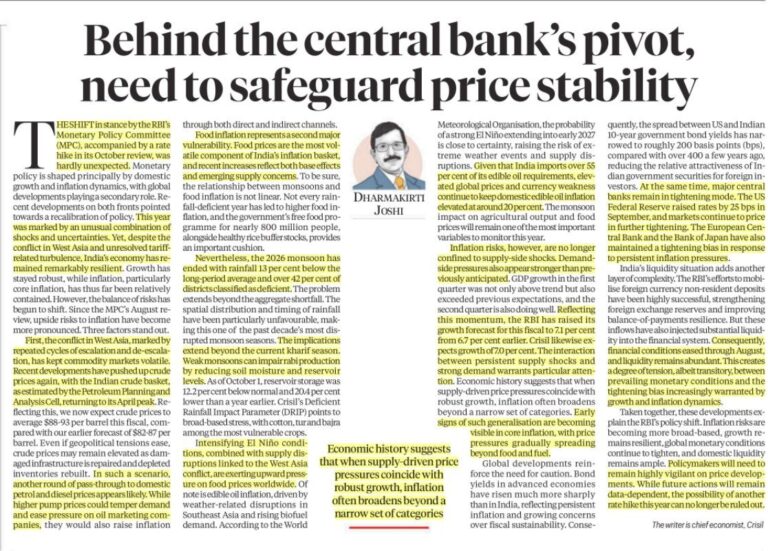
The Reserve Bank of India (RBI) has shifted its monetary policy approach amid renewed concerns over inflation, food prices, crude oil volatility and weakening monsoon conditions. The latest Monetary Policy Committee (MPC) decision reflects the growing need to balance economic growth with price stability. Although India’s economy remains resilient, emerging supply-side risks could make inflation more persistent.
Why Has the RBI Shifted Its Policy Stance?
The article identifies several factors behind the RBI’s policy pivot. The first is the renewed West Asia conflict, which has increased volatility in commodity markets and raised concerns about crude oil prices. A sustained rise in crude prices could increase transportation and production costs and eventually pass through to consumer prices.
The second major concern is food inflation. Food prices remain highly sensitive to weather conditions and supply disruptions. The article notes that food inflation had risen to around 5.95%, while core inflation was comparatively contained. A weak monsoon could further affect agricultural production and food availability.
Monsoon and El Niño Risks
India’s 2026 monsoon ended with rainfall significantly below the long-period average, while several districts were classified as deficient. Lower rainfall can affect soil moisture, reservoir levels and agricultural output, particularly for important crops.
The intensification of El Niño conditions could further complicate the inflation outlook by increasing the probability of extreme weather events and disrupting agricultural supply. These developments make food-price pressures an important consideration for monetary policy.
Growth Remains Resilient
Despite inflationary risks, India’s economic growth remains strong. The RBI has raised its GDP growth forecast, while bank credit growth remains robust. This creates a difficult policy environment because excessive monetary tightening could weaken investment and consumption, whereas delayed action could allow inflation expectations to become entrenched.
The article therefore highlights the importance of timing in monetary policy.
Conclusion
The RBI’s policy pivot reflects the changing balance between inflation risks and economic growth. Supply-side shocks from food, crude oil, weather and global conflicts require careful monitoring. Monetary policy alone cannot resolve supply-driven inflation, making coordination with agricultural, trade and supply-management policies essential. Going forward, the RBI’s challenge will be to maintain price stability without unnecessarily weakening India’s growth momentum.
Vocabulary
1. Monetary Tightening – Measures to restrict liquidity and control inflation.
2. Core Inflation – Inflation excluding food and fuel.
3. Imported Inflation – Domestic price increases caused by costlier imports.
Prelims MCQs
MCQ 1
Which factors can increase inflationary pressure in India?
1. Rising crude oil prices
2. Weak monsoon rainfall
3. Depreciation of the rupee
A) 1 and 2 only
B) 2 and 3 only
C) 1, 2 and 3
D) 1 only
Answer: C
UPSC Mains Question
“India’s monetary policy faces the challenge of controlling inflation without undermining economic growth.” Discuss.
(10 Marks)
Frequently Asked Questions (FAQs)
Why has the RBI shifted its monetary policy stance?
The shift is linked to rising inflation risks, food-price pressures, crude oil volatility, weak monsoon conditions and global uncertainties.
Why is food inflation important for India?
Food has a significant weight in household consumption, and supply disruptions caused by weather or inadequate rainfall can quickly increase consumer prices.
How can El Niño affect inflation in India?
El Niño can influence monsoon conditions and increase the risk of agricultural disruptions, potentially affecting food production and prices.
What is the RBI’s main monetary policy objective?
The RBI’s monetary policy framework places price stability at the centre while keeping growth considerations in view.
Why is the timing of monetary tightening important?
Premature tightening can affect growth and credit, while delayed action may allow inflation expectations and broader price pressures to become entrenched.