

Table of Contents
ToggleWhy Stubble Fires Keep Coming Back in India
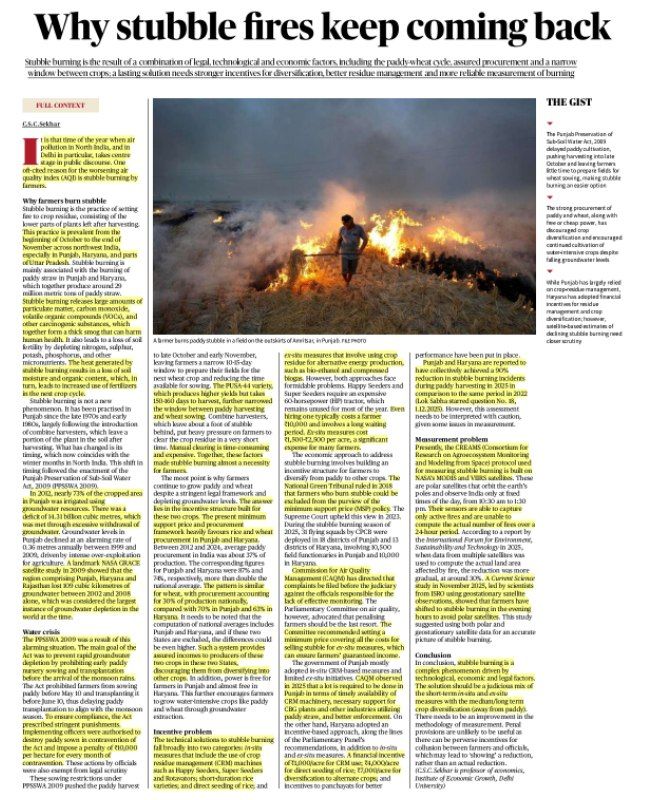
Stubble burning in India remains a major environmental and agricultural challenge, particularly in Punjab and Haryana. Every year after the paddy harvest, farmers burn crop residues to quickly clear their fields before sowing the next crop. Despite legal restrictions, technological interventions and government schemes, farm fires continue to recur. The problem is therefore not simply about farmer behaviour but is closely linked to economic incentives, cropping patterns, technology and the narrow gap between paddy harvesting and wheat sowing.
Why Do Farmers Burn Stubble?
The major reason behind stubble burning is the limited time available between the harvesting of paddy and sowing of wheat. Farmers need to clear large quantities of residue quickly and prepare their fields for the next crop.
Paddy straw also has limited economic value in many areas because of its high silica content and difficulties associated with collection, transportation and storage. As a result, burning remains a quick and relatively inexpensive option for farmers.
The article highlights that assured procurement of paddy, combined with incentives and existing cropping patterns, has contributed to the persistence of the paddy-wheat cycle. This makes crop diversification an important part of a long-term solution.
Government Measures to Control Stubble Burning
India has introduced several measures to reduce crop-residue burning. These include in-situ and ex-situ residue management, subsidised agricultural machinery, satellite-based monitoring and technologies that allow farmers to manage crop residues without burning them.
Machines such as the Happy Seeder can enable wheat sowing while retaining crop residue in the field. Other approaches include biomass utilisation, composting, bioenergy and industrial use of agricultural waste.
The article also points towards the importance of improved measurement and monitoring. Reliable identification of actual burning incidents is necessary for effective policy implementation and enforcement.
The Way Forward
A lasting solution requires more than penalties. Farmers need stronger economic incentives for crop diversification, better access to residue-management machinery and reliable markets for agricultural biomass.
Policy should also encourage the development of viable alternatives that convert crop residue into bio-CNG, compost, energy and other useful products.
Conclusion
The persistence of stubble burning in India shows that environmental problems rooted in agricultural systems require integrated solutions. Legal enforcement must be combined with economic incentives, technological support, crop diversification and better residue markets. Addressing the structural causes of the paddy-wheat cycle can help reduce air pollution while improving farm sustainability and resource efficiency.
Vocabulary
1. Stubble Burning – Burning crop residues after harvesting.
2. In-situ Management – Managing crop residue within fields.
3. Ex-situ Management – Collecting and utilising residue outside fields.
Prelims MCQs
MCQ 1
Consider the following measures:
1. Happy Seeder technology
2. Bio-CNG production
3. Crop diversification
Which can help reduce stubble burning?
A) 1 and 2 only
B) 2 and 3 only
C) 1 and 3 only
D) 1, 2 and 3
Answer: D
UPSC Mains Question
“Stubble burning is a structural agricultural challenge rather than merely an enforcement problem.” Discuss.
(10 Marks)
Frequently Asked Questions (FAQs)
Why do farmers burn stubble?
Farmers often burn stubble because it is a quick and inexpensive method of clearing fields within the short period available between paddy harvesting and wheat sowing.
Which states are mainly associated with stubble burning?
Punjab and Haryana are particularly associated with seasonal crop-residue burning because of their intensive paddy-wheat cropping systems.
How does stubble burning affect the environment?
Stubble burning releases smoke and pollutants into the atmosphere and contributes to seasonal deterioration in air quality, besides affecting soil and nutrient management.
What measures are used to control stubble burning?
Measures include residue-management machinery, in-situ and ex-situ management, satellite monitoring, biomass utilisation and incentives for alternative cropping patterns.
What is the long-term solution to stubble burning?
A sustainable solution requires crop diversification, stronger economic incentives, better residue-management technology, biomass markets and improved monitoring, rather than relying only on punitive measures.