

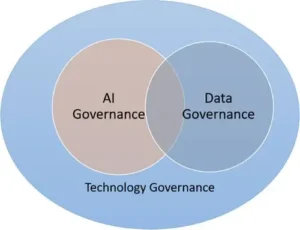
The Union Rural Development Ministry has announced an AI-enabled upgrade to the National Mobile Monitoring System (NMMS) under VB-G RAM G.
Rural Employment and Digital Monitoring
- Rural employment programmes provide wage-based livelihood support and help create village assets such as ponds, roads and water-conservation structures.
- Under MGNREGA, the NMMS application was introduced to digitally record workers’ attendance at worksites.
- The government has now proposed stronger verification under the VB-G RAM G framework to address weaknesses in attendance recording.
Major Features of the Upgraded System
- AI-based face verification: Matches workers’ faces with attendance records to establish identity.
- Liveness detection: Distinguishes a physically present worker from a photograph or other artificial image.
- Photo de-duplication: Detects repeated photographs across attendance records.
- Anti-tampering safeguards: Reduce manipulation of the application and attendance information.
- Payment verification: Suspicious records trigger temporary withholding of wage lists and Fund Transfer Orders until verification.
- Offline facility: Allows attendance recording where mobile networks are unavailable.
Why Was the Upgrade Necessary?
- Earlier systems reportedly allowed photographs of photographs to be uploaded instead of genuine worksite images.
- Differences were observed between recorded attendance and actual worker numbers.
- Repeated photographs and inconsistencies between morning and afternoon records raised concerns about misuse.
- Such irregularities can divert public funds and weaken confidence in welfare delivery.
Benefits for Rural Governance
- Financial accountability: Helps ensure wages reach genuine beneficiaries.
- Transparency: Creates stronger digital evidence for audits and inspections.
- Better implementation: Supports monitoring by district administrations and social-audit institutions.
- Public trust: Can strengthen confidence in government employment programmes.
Challenges
- Digital exclusion: Elderly workers, persons with disabilities and manual labourers may face biometric failures.
- Connectivity: Remote villages require reliable offline alternatives.
- Privacy: Facial data needs secure storage, limited access and safeguards against misuse.
- Wage delays: False fraud alerts should not unnecessarily block legitimate payments.
- Human oversight: Workers need accessible grievance redressal and manual verification options.
Conclusion
AI can improve rural employment accountability only when technological safeguards are combined with inclusion, privacy protection and timely wage payments.
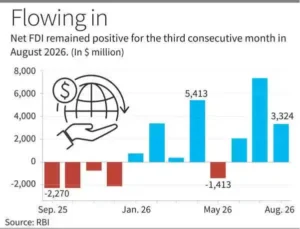
The RBI Bulletin reported positive net Foreign Direct Investment (FDI) of $3.3 billion in August 2026, marking the third consecutive month of net inflows.
What is Foreign Direct Investment
- FDI refers to long-term investment by a foreign investor in an enterprise, involving significant ownership or influence over management.
- Gross inward FDI: Total direct investment received from foreign investors.
- Net FDI: Gross inward FDI minus repatriation/disinvestment by foreign investors and outward FDI by Indian firms.
- Unlike Foreign Portfolio Investment (FPI), FDI generally involves a lasting business interest rather than merely holding financial securities.
Major Findings of the RBI Bulletin
- Net FDI: $3.3 billion in August, continuing the recent positive trend.
- Gross inflows: $11.1 billion, approximately 68% higher than a year earlier.
- Total outflows: $7.7 billion, including profit repatriation/disinvestment and overseas direct investment.
- Repatriation: $5.8 billion, indicating increased withdrawal or return of investments by foreign companies.
- Outward FDI: $1.9 billion, reflecting lower overseas investment by Indian businesses.
- Net FDI remained positive in seven of the previous eight months, reversing the negative trend recorded during August–December 2025.
Sources and Sectoral Distribution
- The United States, Singapore and Mauritius contributed approximately 72% of inward FDI.
- Communication, services and manufacturing attracted over two-thirds of foreign investment.
- Major destinations for Indian outward FDI included Singapore, the Netherlands and the United States.
- Overseas investments were concentrated in manufacturing, agriculture, mining and business-related services.
Importance for the Indian Economy
- Capital formation: Foreign investment can support factories, infrastructure and business expansion.
- Employment: New enterprises can create direct and indirect jobs.
- Technology transfer: Global companies may introduce advanced production methods and managerial practices.
- External stability: Sustained FDI can help finance the current account deficit without creating conventional debt obligations.
- Global integration: Foreign investment strengthens India’s participation in international supply chains.
Challenges
- High repatriation can reduce net inflows despite strong investment commitments.
- Concentration in a few sectors and source countries creates vulnerability.
- India should strengthen regulatory predictability, infrastructure, skills and contract enforcement.
- Initiatives such as Make in India, Production Linked Incentive schemes and PM Gati Shakti can support investment-led industrial growth.
Basis | FDI (Foreign Direct Investment) | FPI (Foreign Portfolio Investment) |
1. Meaning | Foreign investment directly in a business | Foreign investment in financial assets |
2. Purpose | Long-term business growth | Earning returns through dividends and capital gains |
3. Investment | Factories, companies and business operations | Shares, bonds and other securities |
4. Ownership | Usually 10% or more voting power in a company | Generally less than 10% equity ownership |
5. Control | May provide influence over management | Generally no direct management control |
Conclusion
Sustained FDI growth must translate into productive investment, quality employment and stronger domestic capabilities to support India’s long-term economic development.
Israel announced a major military operation in the occupied West Bank after two Israeli soldiers were killed near Hebron.
What is the West Bank?
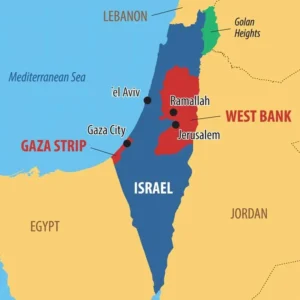
- The West Bank is a landlocked Palestinian territory located west of the Jordan River in West Asia.
- It shares borders with Israel and Jordan.
- It is one of the two main Palestinian territories, the other being the Gaza Strip.
- East Jerusalem is internationally regarded as part of the occupied Palestinian territory, although Israel claims the entire city as its capital.
Background of the West Bank Conflict
- The West Bank lies west of the Jordan River and has been under Israeli occupation since the 1967 Six-Day War.
- Under the Oslo Accords (1993–95), the Palestinian Authority (PA) received limited administrative powers in parts of the territory.
- Israeli settlements, movement restrictions and competing territorial claims remain major sources of conflict.
Recent Developments
- Palestinian gunmen attacked Israeli soldiers near Hebron, killing two and injuring three.
- Israel announced expanded military operations, including searches, movement restrictions and building demolitions.
- Hamas praised the attack but did not claim responsibility.
- Israeli political leaders demanded tougher security measures ahead of national elections.
Historical Background
- 1948 Arab–Israeli War: Jordan gained control of the West Bank.
- 1967 Six-Day War: Israel captured the West Bank from Jordan.
- 1993 Oslo Accords: Established a framework for limited Palestinian self-government.
Why is the West Bank Disputed?
- Palestinians seek it as a major part of their future independent state.
- Israel cites historical, religious and security interests.
- Israeli settlements, territorial control and restrictions on movement complicate peace negotiations.
- The International Court of Justice’s 2024 advisory opinion found Israel’s continued presence in the occupied Palestinian territory unlawful.
Conclusion
The West Bank remains central to the Israel–Palestine conflict, and its political future is crucial for achieving a lasting two-state solution.
The United Nations Environment Programme (UNEP) released the Emissions Gap Report 2026, highlighting the continued gap between global climate commitments and actual emission reductions.
- The report warned that existing efforts remain inadequate to prevent dangerous global warming.
What is the Emissions Gap Report?
- Published annually by UNEP, usually before international climate negotiations.
- Measures the difference between projected greenhouse gas (GHG) emissions and the levels required to meet the Paris Agreement’s temperature goals.
- Evaluates countries’ Nationally Determined Contributions (NDCs), which are updated every five years.
- UNEP: Established in 1972; headquartered in Nairobi, Kenya.
Major Findings of the 2026 Report
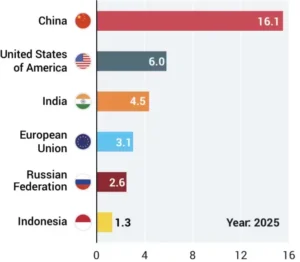
- Global emissions: Approximately 58.4 billion tonnes of CO₂ equivalent in 2025, nearly unchanged from 2024.
- Fossil fuels: Accounted for more than two-thirds of global GHG emissions.
- Emission trends: CO₂ from fossil fuels and emissions of nitrous oxide and fluorinated gases increased, while methane remained broadly stable.
- G20 contribution: Members, excluding the African Union, accounted for approximately 76% of global emissions.
- Temperature outlook: The report presents the 1.5°C goal as increasingly unattainable under present trends, with 1.8°C identified as a possible lower-warming outcome.
Emission Reduction Requirements
- Compared with 2025 levels, global emissions must decline by:
- 18% by 2030
- 45% by 2035
- 69% by 2040
- These reductions require faster clean-energy deployment, improved energy efficiency and reduced fossil-fuel dependence.
Implications for India
- India is the third-largest annual GHG emitter, but its per-capita emissions remain comparatively low.
- India has committed to achieving net-zero emissions by 2070.
- Initiatives such as the National Green Hydrogen Mission, PM Surya Ghar and International Solar Alliance support low-carbon development.
- Climate finance and technology transfer remain essential for developing countries.
Challenges
- Climate risks: Higher temperatures intensify heatwaves, floods, droughts and biodiversity loss.
- Climate justice: Developed countries must recognise historical responsibility and support vulnerable nations.
- Policy priorities: Strengthen NDCs, reduce methane emissions, protect forests and accelerate renewable energy adoption.
- Example: Solar-powered irrigation can reduce diesel consumption while supporting farmers.
Conclusion
Closing the emissions gap requires urgent global cooperation, stronger climate commitments and equitable financing to secure a sustainable future.