Table of Contents
ToggleJantar Mantar to Dilli Chalo: Protest, Power and Electoral Democracy
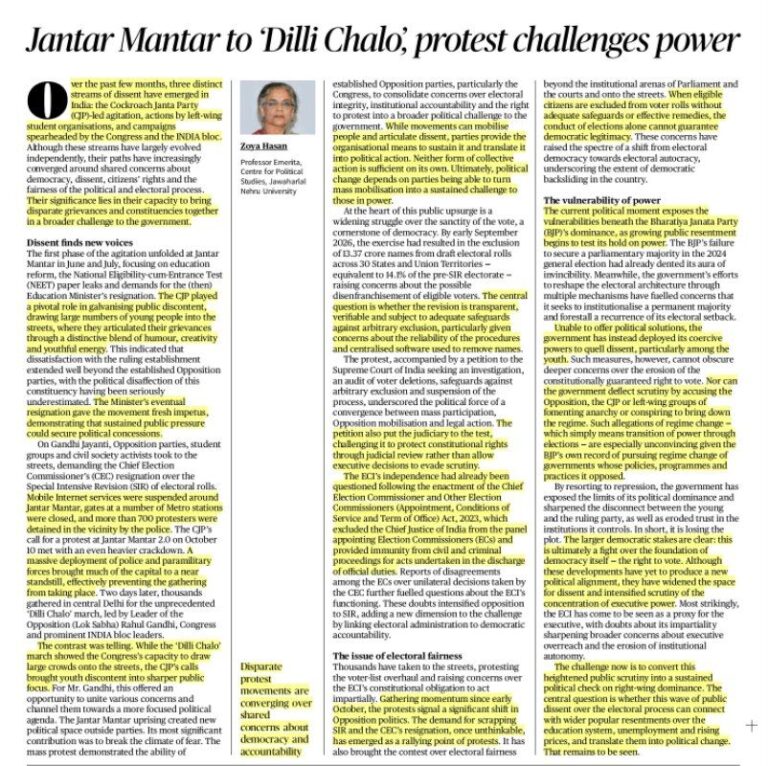
Recent protests around Jantar Mantar and the Election Commission of India (ECI) highlight growing concerns about electoral reforms, voter participation and institutional accountability. Student organisations, civil society groups and Opposition parties have raised objections relating to the Special Intensive Revision (SIR) of electoral rolls, voter-list transparency and the functioning of constitutional institutions.
New Forms of Political Dissent
The protests represent different streams of dissent. Student groups have used creative campaigns and street mobilisation, while Opposition parties and civil society organisations have focused on electoral reforms and institutional accountability.
The article highlights how such movements can expand beyond traditional political structures. Social media, public demonstrations and grassroots mobilisation have become important tools for expressing political concerns.
Electoral Rolls and Voter Participation
A major concern raised by protesters is the revision of electoral rolls. The article notes that the ECI’s constitutional mandate requires maintaining accurate electoral rolls while ensuring that genuine voters are not excluded.
The debate therefore involves balancing electoral integrity with voter inclusion. Transparent procedures, accessible information and effective grievance-redress mechanisms become important when large-scale revisions of electoral rolls are undertaken.
Protest and Democratic Accountability
Peaceful protest is an important component of democratic politics because it allows citizens to express disagreement beyond formal institutional channels. However, public mobilisation becomes politically meaningful only when it translates into sustained engagement with institutions and policy processes.
The article also highlights the role of the Opposition in converting public concerns into political pressure. At the same time, protests alone cannot replace institutional mechanisms such as Parliament, courts and constitutional bodies.
The Vulnerability of Political Power
The article argues that political dominance can become vulnerable when public dissatisfaction develops into sustained electoral mobilisation. Even a strong ruling party must respond to concerns relating to governance, electoral fairness and institutional credibility.
The challenge is therefore to convert public dissent into constructive democratic participation rather than allowing political disagreements to deepen institutional mistrust.
Conclusion
The developments surrounding Jantar Mantar, electoral-roll revisions and the ECI demonstrate the continuing importance of democratic accountability in India. Peaceful protest, electoral participation, institutional scrutiny and constitutional mechanisms must work together to maintain public confidence. Ultimately, a healthy democracy depends not only on winning elections but also on ensuring that citizens trust the electoral process and constitutional institutions.
Vocabulary
1. Disenfranchisement – Deprivation of voting rights.
2. Electoral Integrity – Fairness and transparency in elections.
3. Political Mobilisation – Organising citizens for collective political action.
Prelims MCQs
MCQ 1
Consider the following statements:
1. Article 19(1)(b) guarantees the right to assemble peacefully without arms.
2. The Election Commission derives its constitutional authority from Article 324.
3. The right to vote is a Fundamental Right under Article 19.
Which are correct?
A) 1 and 2 only
B) 2 and 3 only
C) 1 and 3 only
D) 1, 2 and 3
Answer: A
UPSC Mains Question
“Peaceful dissent and electoral accountability are essential safeguards against democratic backsliding.” Discuss the role of citizens and constitutional institutions in strengthening Indian democracy. (10 Marks)
Frequently Asked Questions (FAQs)
Why are protests being held around Jantar Mantar?
The protests discussed in the article are linked to concerns over electoral reforms, the Special Intensive Revision of electoral rolls and the functioning of the Election Commission.
What is the Special Intensive Revision (SIR)?
SIR refers to an intensive exercise for revising electoral rolls, with the objective of ensuring accurate voter lists.
Why is electoral-roll revision important?
Accurate electoral rolls are essential for ensuring electoral integrity, while transparent procedures are necessary to prevent genuine voters from being excluded.
How do protests contribute to democracy?
Peaceful protests provide citizens and political groups with a mechanism to express dissent, mobilise public opinion and demand institutional accountability.
What is the broader democratic challenge highlighted by the article?
The central challenge is maintaining public trust in electoral institutions while ensuring voter inclusion, institutional accountability and meaningful democratic participation.
Source From : The Hindu
Starlink Episode and India’s Changing Political Economy
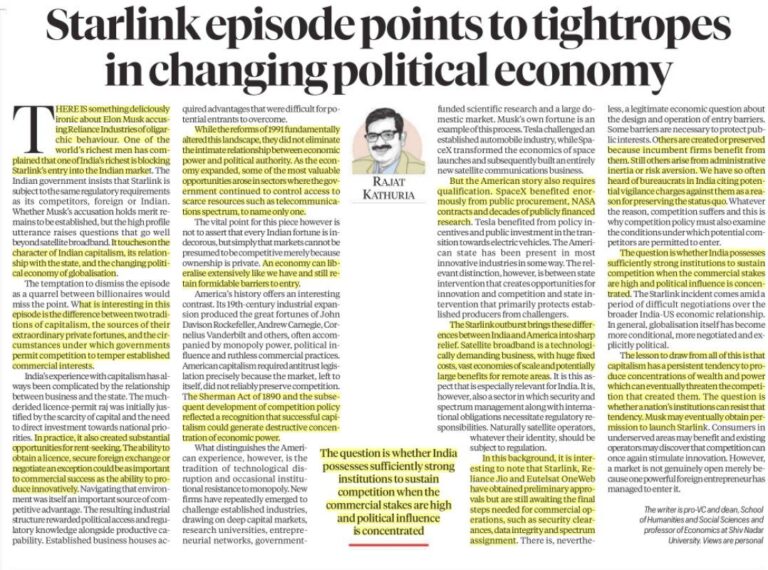
The debate surrounding Starlink’s entry into India highlights a larger question about the relationship between economic power, regulation and political influence. The episode involving Elon Musk and India’s regulatory framework illustrates how modern capitalism increasingly operates at the intersection of private wealth, technological innovation and state policy.
Starlink and India’s Regulatory Framework
Starlink, the satellite broadband service of SpaceX, has sought to enter the Indian market. The company has reportedly moved through preliminary regulatory steps, including security clearances, data-integrity requirements and spectrum-related procedures.
The debate is not simply about whether Starlink should operate in India. It raises a broader question: How should governments regulate powerful technology companies while ensuring competition and protecting public interest?
Capitalism and the Role of the State
The article argues that capitalism has historically involved a complex relationship between private enterprise and government. Industrial development has often benefited from public infrastructure, scientific research, government contracts and policy support.
The American experience also demonstrates that governments have intervened when economic concentration threatened competition. The emergence of antitrust regulation reflected concerns that excessive concentration of economic power could undermine competitive markets.
Similarly, modern technology companies may benefit from publicly supported research, infrastructure and large domestic markets while simultaneously becoming extremely powerful private entities.
Competition and Barriers to Entry
A major issue highlighted is the presence of barriers to entry. Some barriers may be legitimate because they protect public interests, such as national security, spectrum management and data protection. Others can emerge from administrative inertia, excessive regulation or preferential treatment.
The challenge for India is therefore to distinguish between necessary regulation and regulations that unintentionally restrict competition.
The Way Forward
India needs strong and independent institutions capable of maintaining a level playing field. Regulation should protect national interests while ensuring that new entrants can compete fairly.
The Starlink episode therefore provides a useful case study of India’s evolving political economy, where technology, private capital, regulation and geopolitical considerations increasingly overlap.
Conclusion
The Starlink debate is ultimately about more than satellite internet. It raises fundamental questions about competition, regulatory capacity, concentration of wealth and the role of government in a globalised economy. India’s challenge is to create institutions strong enough to regulate powerful commercial interests while preserving innovation, investment and fair competition.
Vocabulary
1. Crony Capitalism – Business advantages gained through political connections.
2. Entry Barriers – Obstacles preventing new firms from entering markets.
3. Regulatory Capture – Regulators favouring established industry interests.
Prelims MCQs
MCQ 1
Consider the following statements:
1. Satellite broadband can improve connectivity in remote areas.
2. The Competition Commission of India regulates anti-competitive practices.
3. Satellite communication services operate without spectrum allocation.
Which are correct?
A) 1 and 2 only
B) 2 and 3 only
C) 1 and 3 only
D) 1, 2 and 3
Answer: A
UPSC Mains Question
“Effective competition policy is essential to prevent crony capitalism and promote innovation.” Discuss with reference to India’s satellite broadband sector. (10 Marks)
Frequently Asked Questions (FAQs)
What is Starlink?
Starlink is a satellite broadband service developed by SpaceX that aims to provide internet connectivity using a network of satellites.
Why is Starlink’s entry into India significant?
It highlights the challenges of regulating advanced technology companies while balancing competition, national security and public interest.
What are barriers to entry?
Barriers to entry are factors that make it difficult for new firms to enter a market, including regulatory requirements, high capital costs and administrative restrictions.
Why is competition important in the technology sector?
Competition can encourage innovation, improve services and prevent excessive concentration of economic power.
What is the larger political-economy issue?
The central issue is whether institutions can effectively regulate powerful commercial interests while maintaining fair competition and protecting public interests.