
Table of Contents
ToggleIndia-Bangladesh Relations: Geography, Politics and the Road Ahead
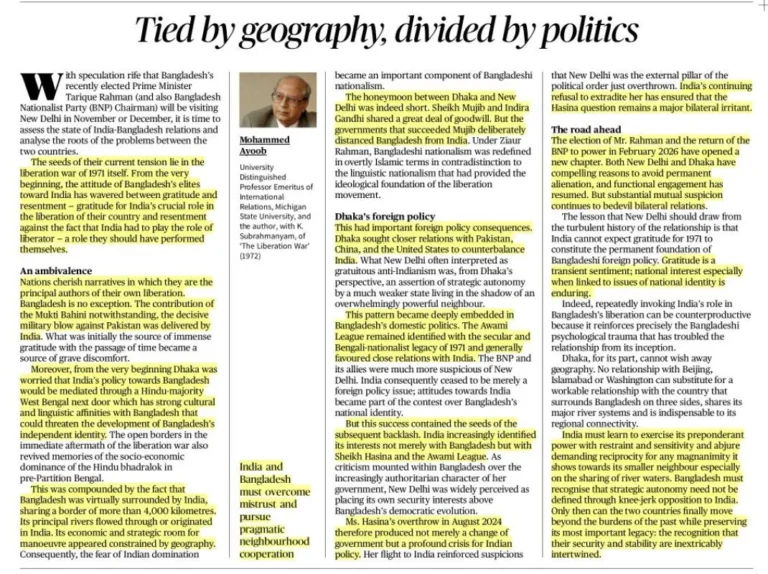
India and Bangladesh share a unique relationship shaped by geography, history, culture and strategic interests. Despite their deep economic and geographical interdependence, political differences and perceptions of Indian influence have periodically created mistrust. The possible return of Bangladesh Nationalist Party (BNP) leader Tarique Rahman to Bangladesh and the party’s potential return to power could open a new phase in India-Bangladesh relations.
Historical Roots of India-Bangladesh Relations
The foundation of Bangladesh’s independence in 1971 remains central to bilateral relations. India played a decisive military and political role in the liberation of Bangladesh. However, the initial gratitude associated with India’s role gradually gave way to concerns about Indian influence.
Bangladesh’s domestic politics increasingly shaped perceptions of India. The Awami League generally favoured closer relations with New Delhi, while the BNP and its allies have often viewed India with greater suspicion.
Geography as a Strategic Reality
Geography makes India and Bangladesh deeply interdependent. Bangladesh shares a border of more than 4,000 kilometres with India and is surrounded by Indian territory on most sides. Its major rivers also originate in or flow through India.
This geographical reality makes cooperation essential in areas such as water management, connectivity, trade, border security and economic development.
Bangladesh’s Foreign Policy and Strategic Autonomy
Bangladesh has attempted to diversify its foreign relations by strengthening ties with Pakistan, China and other countries. From Bangladesh’s perspective, this can be viewed as an effort to preserve strategic autonomy rather than simply balancing against India.
However, India’s perspective is shaped by its security concerns, regional connectivity and the importance of Bangladesh to India’s northeastern states.
The Road Ahead
The article argues that both countries need to move beyond historical grievances and develop pragmatic neighbourhood cooperation. India should avoid expecting permanent gratitude for its role in 1971, while Bangladesh should recognise the strategic importance of geography and India’s role in regional connectivity.
Issues such as river-water sharing, trade, border management, connectivity and economic cooperation require sustained dialogue and mutual sensitivity.
Conclusion
India-Bangladesh relations demonstrate how geography can create both opportunities and constraints. Historical memories, domestic politics and competing foreign-policy priorities may create friction, but neither country can afford prolonged estrangement. A relationship based on mutual respect, strategic autonomy, economic interdependence and practical cooperation can help India and Bangladesh move beyond political mistrust towards a more stable and mutually beneficial partnership.
Vocabulary
1. Strategic Autonomy – Independent foreign policy decision-making.
2. Bilateral Relations – Diplomatic ties between two countries.
3. Regional Connectivity – Cross-border transport, trade and infrastructure links.
Prelims MCQs
MCQ 1
Consider the following statements:
1. India and Bangladesh share a land border.
2. The Ganga Water Treaty concerns water sharing between India and Bangladesh.
3. Bangladesh is a member of ASEAN.
Which are correct?
A) 1 and 2 only
B) 2 and 3 only
C) 1 and 3 only
D) 1, 2 and 3
Answer: A
UPSC Mains Question
“India–Bangladesh relations are shaped by geographical interdependence and political mistrust.” Discuss the challenges and opportunities for bilateral cooperation. (10 Marks)
Frequently Asked Questions (FAQs)
Why is geography important in India-Bangladesh relations?
Bangladesh shares a long border with India and depends on several transboundary river systems, making cooperation on connectivity, water and security essential.
How did India contribute to Bangladesh’s independence?
India provided political, military and humanitarian support during the 1971 Bangladesh Liberation War.
Why does Bangladesh seek strategic autonomy?
Bangladesh seeks diversified relations with countries such as India, China and Pakistan to protect its national interests and maintain foreign-policy flexibility.
Why are river-water issues important?
Many rivers flowing through Bangladesh originate in or pass through India, making equitable and cooperative water management a major bilateral issue.
What should be the future approach to India-Bangladesh relations?
Both countries should prioritise pragmatic cooperation in water sharing, trade, connectivity, border management and economic development while respecting each other’s strategic concerns.
Source From : The Hindu
Fossil Fuel Dependence in Agriculture: India’s Food Security Challenge
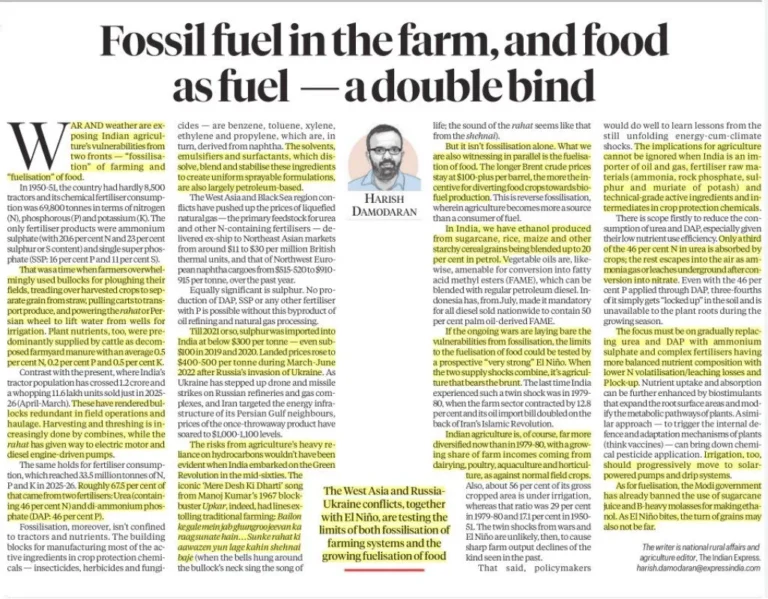
India’s agricultural sector faces a growing double bind of fossil-fuel dependence and climate vulnerability. Modern farming relies heavily on fossil fuels not only for tractors and irrigation but also for fertilisers, pesticides, transportation and food processing. At the same time, extreme weather events and geopolitical disruptions are increasing the cost and uncertainty of agricultural production.
India’s Dependence on Fertilisers
India’s dependence on fossil fuels is particularly visible in fertiliser production. Nitrogen fertilisers such as urea require significant energy inputs, while several crop-protection chemicals are derived from petroleum-based feedstocks.
The article highlights that a large share of India’s fertiliser consumption consists of nitrogen and phosphorus-based fertilisers. This dependence makes agricultural costs vulnerable to fluctuations in global energy and commodity prices.
Global Conflicts and Fertiliser Security
The Russia-Ukraine conflict and disruptions in West Asian energy markets have demonstrated how geopolitical developments can affect agricultural inputs. Higher prices of natural gas, crude oil and fertiliser feedstocks can increase production costs for farmers and put pressure on food prices.
The article also points towards the connection between fossil fuels and the wider food system. Fuel is required for farm machinery, irrigation, transportation, storage and processing, meaning that energy-price shocks can spread throughout the food supply chain.
Climate Change and Agricultural Vulnerability
Agriculture is simultaneously affected by climate change. The article highlights the role of El Niño-related weather conditions in increasing pressure on farming systems.
Extreme temperatures, changing rainfall patterns and water stress can reduce agricultural productivity. This creates a difficult situation where farmers face rising input costs while agricultural output becomes increasingly vulnerable to climatic uncertainty.
The Way Forward
India needs to gradually reduce its dependence on fossil-fuel-intensive agricultural practices. Greater use of solar-powered irrigation, balanced fertilisation, efficient water management and renewable energy can reduce both economic and environmental vulnerabilities.
The article also points towards improving nutrient-use efficiency and encouraging alternatives to conventional fertilisers where feasible. A transition towards more resource-efficient agriculture must remain affordable and accessible to farmers.
Conclusion
India’s food security cannot be separated from its energy security and climate resilience. The dependence of agriculture on fossil fuels exposes farmers and consumers to global energy shocks, while climate change adds another layer of uncertainty. India therefore needs an integrated approach combining fertiliser efficiency, renewable energy, sustainable farming practices, resilient supply chains and climate-smart agriculture. Reducing fossil-fuel dependence can simultaneously strengthen farm incomes, food security and environmental sustainability.
Vocabulary
1. Fossilisation – Dependence on fossil fuels in agriculture.
2. Fuelisation – Conversion of food crops into biofuels.
3. FAME – Fatty Acid Methyl Esters used as biodiesel.
Prelims MCQs
MCQ 1
Consider the following statements:
1. Natural gas is a major feedstock for urea production.
2. Ethanol can be produced from sugarcane and maize.
3. DAP supplies nitrogen and potassium to crops.
Which are correct?
A) 1 and 2 only
B) 2 and 3 only
C) 1 and 3 only
D) 1, 2 and 3
Answer: A
UPSC Mains Question
“Fossil fuel dependence and food-to-fuel conversion create twin vulnerabilities for Indian agriculture.” Examine their implications for food security and sustainability. (10 Marks)
Frequently Asked Questions (FAQs)
Why is Indian agriculture dependent on fossil fuels?
Fossil fuels are used directly through tractors, irrigation and transportation and indirectly through the production of fertilisers and agricultural chemicals.
How do global conflicts affect Indian agriculture?
Geopolitical disruptions can affect the availability and prices of crude oil, natural gas and fertiliser inputs, increasing agricultural production costs.
What is the link between fertilisers and fossil fuels?
The production of nitrogen fertilisers is energy-intensive and depends significantly on fossil-fuel-based feedstocks and energy.
How does El Niño affect agriculture?
El Niño can influence temperature and rainfall patterns, creating additional stress for agricultural systems through heat and water-related risks.
How can India reduce fossil-fuel dependence in agriculture?
India can promote renewable-energy-based irrigation, efficient fertiliser use, improved water management, sustainable agricultural practices and climate-resilient technologies.