Table of Contents
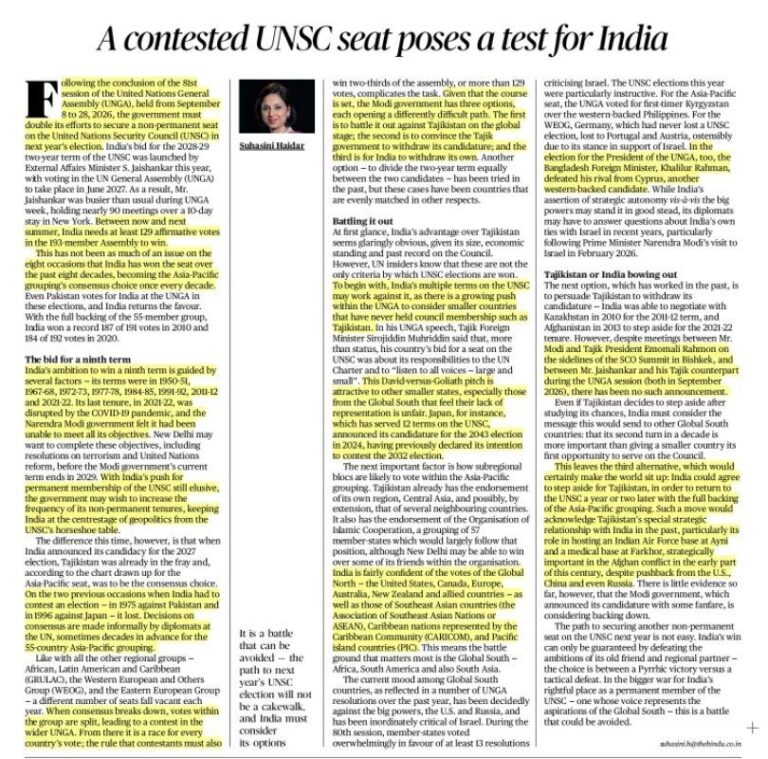
ToggleA Contested UNSC Seat Poses a Test for India
India is intensifying its diplomatic efforts to secure a non-permanent seat on the United Nations Security Council (UNSC) for the 2028–29 term. The election is expected to take place during the 80th session of the UN General Assembly in 2027. India will need the support of at least 129 of the 193 UN member states to win the required two-thirds majority.
The contest is significant because India is facing competition within the Asia-Pacific grouping, particularly from Tajikistan, making the election an important test of India’s diplomatic influence.
India’s Bid for the UNSC
India has served eight times as a non-permanent member of the UNSC. Its previous terms include:
- 1950–51
- 1967–68
- 1972–73
- 1977–78
- 1984–85
- 1991–92
- 2011–12
- 2021–22
India’s latest bid reflects its broader objective of securing a greater role in global decision-making institutions.
However, winning a non-permanent seat requires much more than regional support. A candidate must secure a two-thirds majority in the UN General Assembly.
The Asia-Pacific Challenge
The Asia-Pacific group plays a crucial role in India’s campaign. Traditionally, countries within regional groups attempt to reach an informal consensus before the General Assembly election.
However, the emergence of competing candidates can make the process more complicated.
Tajikistan has entered the contest, creating a direct challenge for India. While India’s large economy, diplomatic reach and previous UNSC experience strengthen its candidature, repeated representation on the Council could also become a disadvantage if UN members increasingly favour countries that have never served on the Council.
Why the Election Matters
The contest goes beyond obtaining a seat. The UNSC remains one of the most important institutions dealing with international peace and security.
A seat would provide India with an opportunity to:
- Influence discussions on global security.
- Promote priorities of the Global South.
- Strengthen India’s diplomatic visibility.
- Participate directly in debates on international conflicts.
- Advance India’s broader case for UN Security Council reform.
India’s campaign therefore requires extensive diplomatic outreach across different regional groups rather than relying solely on support from the Asia-Pacific region.
India vs Tajikistan
India has significant advantages in terms of economic size, diplomatic engagement and international partnerships. However, Tajikistan can appeal to countries seeking greater representation for smaller states.
The election will ultimately depend on India’s ability to build a broad coalition of support among UN members.
Conclusion
India’s campaign for the 2028–29 UNSC non-permanent seat will be an important test of its diplomatic influence and ability to build consensus across the Global South and other regional groupings. With Tajikistan also seeking the seat, India cannot rely only on its regional position or past record. A successful campaign will require sustained diplomatic engagement, coalition-building and a clear articulation of India’s role in strengthening multilateralism and global governance.
Vocabulary
1. UNSC – United Nations Security Council.
2. Regional Consensus – Agreement among countries within a regional group.
3. Strategic Autonomy – Independent foreign policy decision-making.
Prelims MCQs
MCQ 1
Consider the following statements:
1. The UNGA elects non-permanent UNSC members.
2. Non-permanent members serve two-year terms.
3. Non-permanent members possess veto power.
Which are correct?
A) 1 and 2 only
B) 2 and 3 only
C) 1 and 3 only
D) 1, 2 and 3
Answer: A
UPSC Mains Question
“India’s UNSC candidature reflects both its global aspirations and the challenges of multilateral diplomacy.” Discuss.
(10 Marks)
Frequently Asked Questions (FAQs)
How many times has India served as a non-permanent UNSC member?
According to the article, India has served eight times as a non-permanent member of the UNSC.
Which UNSC term is India currently seeking?
India is seeking a non-permanent seat for the 2028–29 term, with the election expected in 2027.
How many votes are required to win a UNSC non-permanent seat?
A candidate requires a two-thirds majority of the UN General Assembly, which means at least 129 votes out of 193 members.
Who is competing with India for the Asia-Pacific seat?
The article identifies Tajikistan as a competing candidate.
Why is a UNSC seat important for India?
It would allow India to participate directly in discussions on international peace and security, strengthen its diplomatic influence and advance its broader multilateral objectives.
Source From : The Hindu
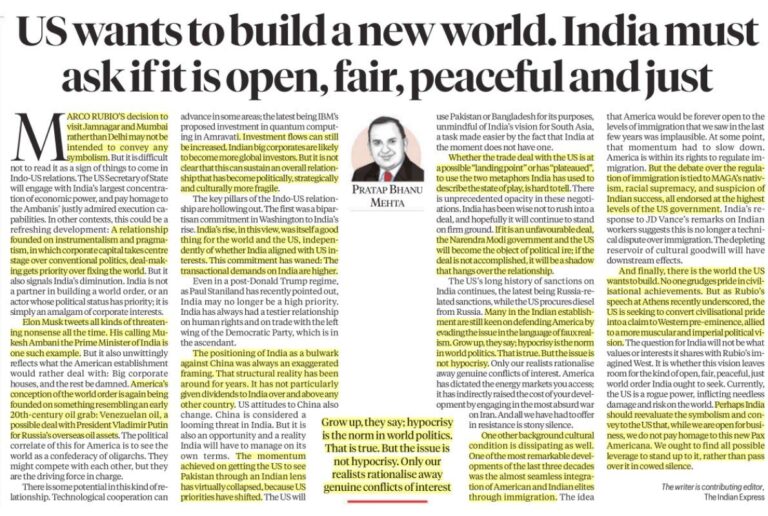
US Wants to Build a New World: India Must Ask if It Is Open, Fair, Peaceful and Just
The evolving India-US relationship is entering a more complicated phase as Washington seeks to reshape the global order. Recent developments, including U.S. trade policies, sanctions, immigration debates and its approach towards global conflicts, raise important questions for India. While India continues to engage with the United States on technology, investment and strategic cooperation, it must also evaluate whether the emerging American vision of the world is open, fair, peaceful and just.
India-US Relations: Beyond Strategic Partnership
The article highlights that the relationship between India and the United States cannot be viewed only through the lens of strategic cooperation. Economic and technological engagement continues to advance, with investments such as IBM’s proposed quantum computing facility in Amaravati indicating opportunities for deeper cooperation.
However, the relationship is also becoming more transactional. India must therefore distinguish between genuine long-term strategic convergence and short-term economic or political interests.
India's Changing Position Towards China
Washington increasingly views India as an important counterweight to China. The article argues that this positioning can sometimes exaggerate India’s role as a strategic alternative to Beijing.
India has its own interests and cannot simply become part of an American strategy aimed at containing China. At the same time, China’s growing economic and strategic influence presents India with both challenges and opportunities.
Therefore, India must maintain strategic autonomy while cooperating with the U.S. wherever its interests converge.
Trade and Sanctions Concerns
The article also highlights concerns surrounding the possibility of a trade deal between India and the U.S. It questions whether such an agreement could become a political tool if negotiations remain unresolved.
U.S. sanctions on countries such as Russia and Iran can also indirectly affect India by increasing the complexity and cost of India’s international economic engagements.
Immigration and Cultural Relations
Another important dimension is immigration. The long-standing movement of Indian professionals and communities to the United States has created significant social and cultural connections between the two countries.
Any major shift in U.S. immigration policy could therefore have consequences beyond employment, potentially affecting the reservoir of goodwill between India and America.
Conclusion
India should continue strengthening cooperation with the United States in areas such as technology, investment, trade and strategic affairs. However, partnership should not mean accepting every element of another country’s global vision. India must evaluate American policies through the principles of openness, fairness, peace, justice and national interest. A mature India-US relationship should be based on mutual respect, balanced interests and India’s ability to make independent strategic choices.
Vocabulary
1. Transactional Diplomacy – Relations driven by immediate gains.
2. Strategic Autonomy – Independent foreign policy decision-making.
3. Rules-Based Order – International system governed by agreed principles.
Prelims MCQs
MCQ 1
Consider the following statements:
1. Strategic autonomy allows independent foreign policy decisions.
2. Economic interdependence eliminates geopolitical conflicts.
3. Multilateralism promotes cooperation among nations.
Which are correct?
A) 1 and 2 only
B) 1 and 3 only
C) 2 and 3 only
D) 1, 2 and 3
Answer: B
UPSC Mains Question
(10 Marks)
Frequently Asked Questions (FAQs)
Why is the India-US relationship becoming more complex?
The relationship involves growing cooperation in technology and investment alongside disagreements over trade, sanctions, immigration and foreign policy.
How does China influence India-US relations?
The U.S. increasingly sees India as an important partner in the Indo-Pacific and a potential counterweight to China’s growing influence.
Why is strategic autonomy important for India?
Strategic autonomy allows India to cooperate with different countries while making foreign-policy decisions according to its own national interests.
How can U.S. sanctions affect India?
Sanctions on countries such as Russia and Iran can create economic and diplomatic complications for India’s trade, energy and strategic engagements.
Why is immigration important in India-US relations?
Indian professionals and communities in the U.S. have contributed significantly to the economic and cultural relationship between the two countries.