Table of Contents
ToggleArticle 33 of the Indian Constitution
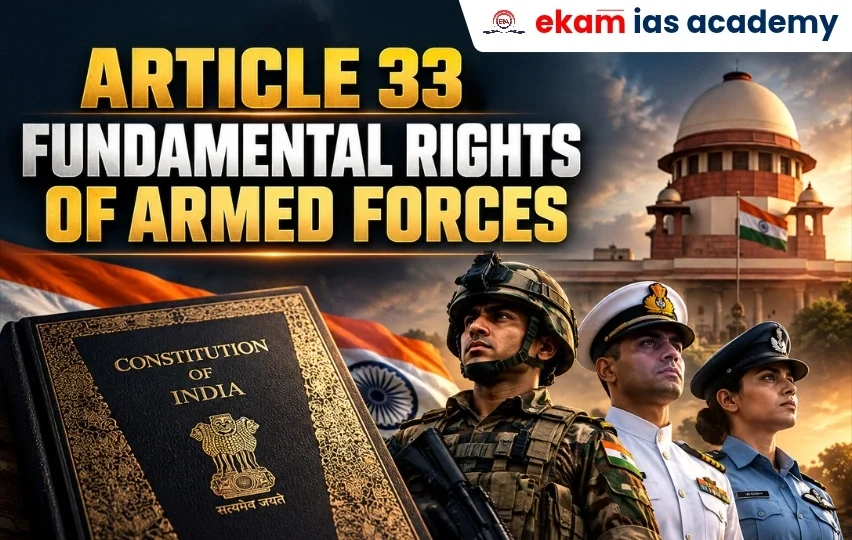
- Article 33 of the Indian Constitution is a specialized constitutional provision within Part III, designed to balance individual freedoms with national security requirements.
- Mastering Article 33 Fundamental Rights is essential for civil services candidates preparing for Indian Polity UPSC, Fundamental Rights UPSC, and Indian Constitution Articles UPSC modules.
- The article grants Parliament’s Power to Modify Fundamental Rights for specific categories of security forces to maintain institutional discipline and operational integrity.
- Studying Article 33 Explained provides candidates with key insights into the constitutional safeguards governing the Fundamental Rights of Armed Forces and intelligence agencies.
Constitutional Background of Article 33
- Foundational Objective: Framed by the Constituent Assembly to ensure that defense forces remain politically neutral, highly disciplined, and operationally resilient.
- Special Status in Part III: Serves as an explicit exception to the general doctrine of fundamental rights enforceability under Article 13.
- National Interest Anchor: Balances basic democratic liberties with the imperative of protecting sovereign territorial integrity and public order.
- Exclusive Competence: Designed purposefully to prevent state legislatures from enacting conflicting laws regarding defense personnel.
Article 33: Power of Parliament
- Exclusive Parliamentary Mandate: Grants Parliament sole constitutional authority to restrict or abrogate fundamental rights for specified forces.
- Immunity from State Laws: State legislatures are strictly barred from passing any legislation under Article 33, ensuring uniform federal standards.
- Article 13 Exemption: Parliamentary laws enacted under Article 33 cannot be declared unconstitutional or void on the grounds of violating Part III fundamental rights.
- Discretionary Flexibility: Allows Parliament to tailor restrictions according to the specific operational needs of different security arms.
Important Features of Article 33
- Targeted Application: Applies strictly to armed forces, forces charged with public order, intelligence organizations, and telecommunication personnel.
- Ancillary Staff Coverage: Encompasses non-combatant personnel attached to defense units, such as cooks, barbers, carpenters, mechanics, and medical attendants.
- Maintenance of Discipline: Primary constitutional objective is ensuring proper discharge of duties and strict adherence to military discipline.
- Statutory Authorization: Requires formal legislative acts passed by Parliament to enforce specific restrictions on rights.
Fundamental Rights That May Be Restricted
- Article 19(1)(a) Freedoms: Restrictions on freedom of speech, expression, political participation, and public press interactions.
- Article 19(1)(b) & (c) Rights: Limitations on the right to assemble peacefully without arms and the right to form trade unions or associations.
- Right to Communication: Restricting unrestricted access to media, social platforms, or public political campaigning.
- Personal Liberty Limits: Modified application of procedural safeguards under Article 22 regarding preventive detention and arrest protections.
Legislations Enacted Under Article 33
- Army Act, 1950 & Air Force Act, 1950: Restricts political activities, trade union formation, and public media statements by military personnel.
- Navy Act, 1957: Outlines statutory operational rules and disciplinary frameworks governing naval personnel.
- Police Forces (Restriction of Rights) Act, 1966: Extends constitutional restrictions to state police personnel to preserve public order.
- Border Security Force Act, 1968 & Intelligence Organizations Act, 1985: Regulates fundamental rights of paramilitary personnel and intelligence officers.
Article 33 vs Article 34
← Swipe left or right to view the full table →
| Feature / Criteria | Article 33 | Article 34 |
|---|---|---|
| Core Purpose | Enables Parliament to restrict or abrogate Fundamental Rights of specified personnel to ensure proper discharge of duties and maintenance of discipline. | Enables Parliament to provide indemnity and validate specified acts connected with maintaining or restoring order in an area where martial law was in force. |
| Target Group | Members of the Armed Forces, forces charged with maintaining public order, intelligence organisations, and specified connected telecommunications personnel. | Persons in Union or State service, and other persons, whose qualifying actions may be protected by parliamentary law. |
| Operational Timing | Can apply during peacetime and wartime, according to the law enacted by Parliament. | Relates to acts performed while martial law was in force. Parliament may provide protection subsequently. |
| Parliamentary Role | Determines by law the extent to which Fundamental Rights are restricted or abrogated for the specified personnel. | May indemnify persons for qualifying actions and validate sentences, punishments, forfeitures, or other acts done under martial law. |
Article 33 and Parliamentary Authority
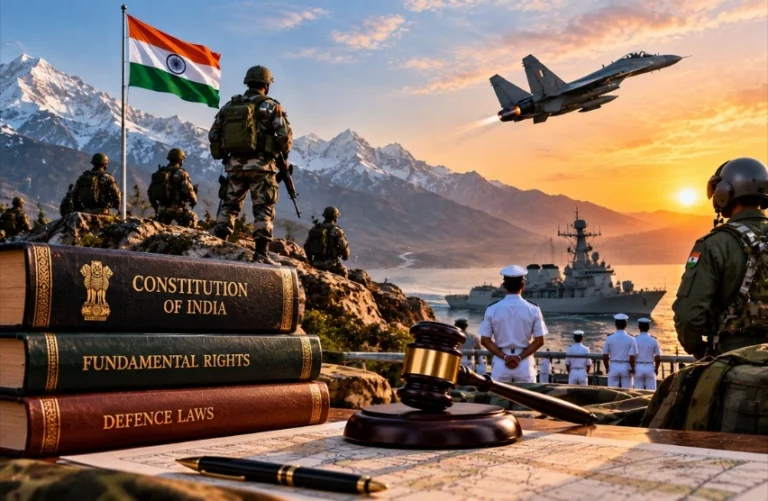
- Legislative Supremacy: Establishes sovereign parliamentary jurisdiction over military discipline and security organizational frameworks.
- Protection against Judicial Invalidation: Shields security-related statutory enactments from fundamental rights challenges under Article 13(2).
- Adaptability to Modern Threats: Enables Parliament to update statutory restrictions to address modern threats, cyber-warfare, and intelligence needs.
- National Security Integration: Connects legislative policy with broader national defense objectives.
Article 33 and National Security
- Preserving Armed Neutrality: Keeps defense forces away from political factions and partisan ideological debates.
- Operational Readiness: Ensures rapid response capabilities by prioritizing strict chain-of-command discipline over individual procedural claims.
- Preventing Mutiny: Acts as a vital constitutional safeguard against industrial unionism, strikes, or mutinous behavior within security forces.
- Safeguarding Strategic Secrets: Protects classified state intelligence and military operations from public exposure.
Judicial Interpretation and Important Case Laws
- O.K. Awasthi v. Union of India: Upheld parliamentary competence to restrict political and association rights of defense-related personnel.
- Viswanathan v. Union of India (1983): Clarified that non-combatants (such as cooks and mechanics) attached to armed forces are fully covered under Article 33.
- Lt. Col. Prithi Pal Singh Bedi v. Union of India (1982): Supreme Court emphasized that while discipline is paramount, security personnel retain basic human rights under statutory court-martial rules.
- Ram Sarup v. Union of India (1965): Confirmed that parliamentary laws under Article 33 override general Part III protections without violating the Constitution.
Conclusion
- Constitutional Keystone: Article 33 of the Indian Constitution maintains the delicate balance between individual liberties and national defense preparedness.
- Securing Democratic Stability: Ensures that Fundamental Rights and Defence Personnel regulations preserve state sovereignty and civil order.
- UPSC Core Preparation: Achieving comprehensive clarity on Article 33 and National Security enables candidates to deliver high-scoring analytical responses in General Studies Paper II.
UPSC Prelims: PYQs & Practice Questions
Previous Year Questions (Prelims)
Q: Which of the following provisions of the Constitution of India explicitly empowers Parliament to restrict or abrogate the Fundamental Rights of the members of the Armed Forces?
(a) Article 31D
(b) Article 33
(c) Article 34
(d) Article 35
Answer: (b) Article 33
Explanation:
Article 33 empowers Parliament to modify the application of Fundamental Rights to members of the Armed Forces, paramilitary forces, police forces, intelligence agencies, and telecommunication personnel to ensure the proper discharge of their duties and the maintenance of discipline among them.
Q: Consider the following statements regarding the powers of Parliament under Part III of the Constitution:
1. Only Parliament, and not the State Legislatures, has the power to make laws under Article 33 to restrict the Fundamental Rights of armed forces personnel.
2. Laws enacted by Parliament under Article 33 cannot be challenged in any court on the ground of infringement of any Fundamental Right.
Which of the statements given above is/are correct?
(a) 1 only
(b) 2 only
(c) Both 1 and 2
(d) Neither 1 nor 2
Answer: (c) Both 1 and 2
Explanation:
Statement 1 is correct: Article 33 confers the power to restrict Fundamental Rights of security personnel exclusively on Parliament to maintain uniform federal standards. State Legislatures are barred from enacting laws under Article 33.
Statement 2 is correct: Any parliamentary law made under Article 33 cannot be declared void or challenged on the ground of violating Part III Fundamental Rights (as provided under Article 13).
Practice Questions
Q: With reference to Article 33 of the Indian Constitution, consider the following statements:
1. The power to restrict Fundamental Rights under Article 33 extends to non-combatant employees attached to the armed forces, such as cooks, carpenters, and mechanics.
2. The Supreme Court has ruled that civilian employees working in police departments are completely exempt from restrictions imposed under Article 33.
3. Laws passed under Article 33 apply automatically during peacetime as well as during wartime.
Which of the statements given above are correct?
(a) 1 and 2 only
(b) 1 and 3 only
(c) 2 and 3 only
(d) 1, 2, and 3
Answer: (b) 1 and 3 only
Explanation:
Statement 1 is correct: In O.K. Awasthi and Viswanathan v. Union of India (1983), the Supreme Court clarified that non-combatants attached to armed units, such as cooks, barbers, mechanics, and medical attendants, are covered under Article 33.
Statement 2 is incorrect: Parliament enacted the Police Forces (Restriction of Rights) Act, 1966 under Article 33, which covers police personnel and administrative staff charged with maintaining public order.
Statement 3 is correct: Unlike Article 34, which applies temporarily during Martial Law, Article 33 operates continuously in both peace and wartime.
Q: Consider the following statutes enacted by the Parliament of India:
1. Army Act, 1950
2. Police Forces (Restriction of Rights) Act, 1966
3. Border Security Force Act, 1968
4. Intelligence Organizations (Restriction of Rights) Act, 1985
Which of the above legislations derive their constitutional validity directly from Article 33?
(a) 1 and 3 only
(b) 1, 2, and 3 only
(c) 2 and 4 only
(d) 1, 2, 3, and 4
Answer: (d) 1, 2, 3, and 4
Explanation:
All four Acts were enacted by Parliament under the constitutional framework of Article 33 to restrict specified Fundamental Rights of military, paramilitary, police, and intelligence personnel in the interests of discipline and proper discharge of duties.
UPSC Mains – Previous Year & Practice Questions
Mains Previous Year Questions
Question: Examine the scope of Parliament's power under Article 33 to restrict the Fundamental Rights of security personnel. How does the judiciary balance military discipline with human rights safeguards? (Mains 2021 – GS Paper II)
Question: Distinguish between the operational scope of Article 33 and Article 34 of the Indian Constitution in restricting individual freedoms. (Mains 2017 – GS Paper II)
Question: Discuss how Article 33 protects defense personnel legislation from judicial review under Article 13 of the Constitution. (Mains 2014 – GS Paper II / Law Paper)
Question: Non-combatant staff attached to armed units perform vital support roles. Comment on their coverage under Article 33 in light of judicial precedents. (Mains 2010 – GS Paper II / Law Paper)
Question: The restriction of Fundamental Rights of armed forces personnel is essential for national security. Analyze the constitutional validity of statutory military laws under Article 33. (Mains 2006 – GS Paper II / Law Paper)
Mains Practice Questions
[15 Marks | 250 Words]
Question: Article 33 provides a constitutional compromise between individual fundamental freedoms and the imperative of national defense discipline. Critically evaluate.
[15 Marks | 250 Words]
Question: Analyze the constitutional validity of restricting digital communication and social media usage for armed forces personnel under parliamentary laws backed by Article 33.
[10 Marks | 150 Words]
Question: Distinguish between the constitutional purposes of Article 33 (Armed Forces restrictions) and Article 34 (Martial Law restrictions).


Article 33 of the Indian Constitution-FAQs
What is Article 33 of the Indian Constitution?
Article 33 empowers Parliament to restrict or modify Fundamental Rights of specified security and intelligence personnel to maintain discipline and ensure proper discharge of duties.
Who can restrict Fundamental Rights under Article 33?
Only Parliament has the power to make laws under Article 33. State Legislatures cannot exercise this constitutional power.
Who comes under Article 33?
Article 33 covers the Armed Forces, forces maintaining public order, intelligence organisations, and certain telecommunication personnel connected with them.
Why was Article 33 introduced?
It was introduced to balance Fundamental Rights with national security and institutional discipline, particularly in organisations requiring strict operational control.
What is the difference between Articles 33 and 34?
Article 33 concerns restrictions on rights of specified security personnel, while Article 34 deals with Fundamental Rights during the operation of martial law.