Table of Contents
ToggleArticle 28 of the Indian Constitution
- Mastering Article 28 is an essential requirement for civil services aspirants preparing for Article 28 UPSC, Fundamental Rights UPSC, and Indian Polity UPSC examinations.
- Placed within Part III under the “Right to Freedom of Religion” (Articles 25–28), it regulates Religious Instruction in Educational Institutions across the country.
- Article 28 Indian Constitution balances individual freedom of conscience with state neutrality in public educational spaces.
- Studying Article 28 Fundamental Rights enables candidates to analyze how secularism governs classrooms and educational administration in India.
Exact Constitutional Provisions of Article 28
- Article 28(1) Indian Constitution: Mandates that no religious instruction shall be provided in any educational institution wholly maintained out of State funds.
- Article 28(2) Constitution: Exception clause stating that Article 28(1) shall not apply to an educational institution administered by the State but established under an endowment or trust requiring religious instruction.
- Article 28(3) Religious Instruction: Specifies that no person attending a State-recognized or State-aided educational institution shall be compelled to participate in religious instruction or attend religious worship without their consent (or parental consent in the case of minors).
- Constitutional Architecture: Forms a complete framework securing Freedom from Religious Instruction in public and quasi-public academic setups.
Meaning and Scope of Article 28
- Preserving Neutrality: Ensures public money is not utilized to impart sectarian, dogmatic, or denominational religious doctrines.
- Anti-Coercion Shield: Protects students from forced exposure to religious ceremonies or ideological indoctrination contrary to their personal faith.
- Moral vs Religious Instruction: Distinguishes value-based moral education from specific ritualistic or dogmatic Religious Education in India.
- Individual Autonomy: Guarantees that attendance at religious worship remains purely voluntary in State-recognized or aided institutions under Article 28 Explained.
Landmark Supreme Court Judgments on Article 28 and Religious Freedom
| Case | Year | Key Principle | UPSC Significance |
|---|---|---|---|
| D.A.V. College v. State of Punjab | 1971 | Relationship between minority educational rights and religious or cultural instruction | Helps understand minority educational rights and constitutional limits on religious instruction |
| Bijoe Emmanuel v. State of Kerala | 1986 | Freedom of conscience and religious belief in an educational setting | Illustrates Article 25 and freedom of conscience; the case was not primarily an Article 28 ruling |
| Aruna Roy v. Union of India | 2002 | Distinction between religious instruction and the academic study of religions | Relevant to Article 28 and the constitutional approach to value-based education |
| T.M.A. Pai Foundation v. State of Karnataka | 2002 | Educational autonomy and minority educational rights | Important for Articles 19(1)(g) and 30; provides broader educational-rights context |
| P.A. Inamdar v. State of Maharashtra | 2005 | Autonomy of unaided professional educational institutions and limits on State regulation of admissions | Relevant to educational autonomy and minority educational rights, rather than a direct Article 28 interpretation |
Article 28 and Secularism in India
- Positive Secularism: Upholds Indian positive secularism by keeping State-run schools strictly non-denominational while respecting diverse traditions.
- State Neutrality: Prevents the government from establishing or promoting a State-favored religion within public educational infrastructure.
- Principled Distance: Maintains a principled distance between State-funded academics and sectarian religious propagation.
- Harmonious Reading: Operates alongside Articles 25, 26, and 27 to ensure holistic secular governance under the Article 28 Constitution of India.
Article 28 and Different Types of Educational Institutions
| Institution Category | State Funding / Recognition | Freedom from Religious Instruction |
| Wholly Maintained by State | 100% State Funds | Completely Prohibited — No religious instruction allowed under Article 28(1) Indian Constitution. |
| Administered by State but Established under Trust | State Administered / Trust Established | Permitted — Allowed under Article 28(2) Constitution as per the founding trust terms. |
| Recognized by State | Recognized (Private Funds) | Voluntary — Permitted only on a voluntary basis with explicit consent under Article 28(3) Religious Instruction. |
| Receiving State Aid | Financial Aid (Private Mgmt) | Voluntary — Permitted on a voluntary basis; no student can be compelled without consent. |
Article 28 and Minority Educational Institutions
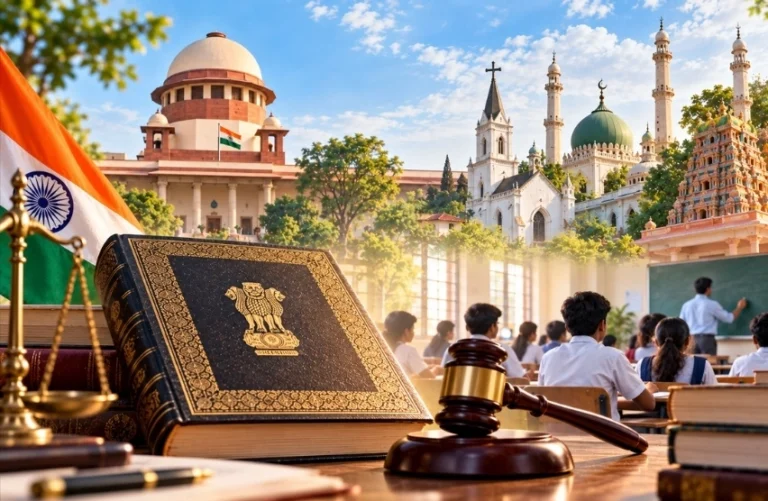
- Interplay with Article 30: Article 30 grants linguistic and religious minorities the fundamental right to establish and administer educational institutions.
- Religious Teaching Immunity: Minority-run institutions can impart religious instruction to students belonging to their community.
- Protection for Non-Minority Students: Non-minority or non-consenting students attending State-aided minority institutions cannot be compelled to join religious instruction under Article 28(3) Religious Instruction.
- Harmonious Balance: Harmonizes minority cultural rights with individual freedom of conscience for every enrolled student.
Contemporary Issues and Debates
- Value Education vs Religious Teaching: Debates surrounding the inclusion of classical texts (e.g., Gita, Vedic Mathematics) versus strict prohibition of religious instruction.
- Morning Assemblies and Prayers: Legal challenges evaluating whether compulsory non-denominational or traditional prayers violate Freedom from Religious Instruction.
- National Education Policy (NEP): Discussions on integrating Indian Knowledge Systems (IKS) while adhering to constitutional secular boundaries.
- Judicial Review: Higher courts routinely evaluate school curricula against constitutional limits established under Article 28 and Secularism.
Challenges in Implementing Article 28
- Ambiguity in Terminology: Defining the precise boundary between universal moral/cultural values and specific religious doctrine.
- Voluntary Consent Mechanics: Ensuring genuine informed consent from parents or guardians without institutional coercion or peer pressure.
- Standardizing Curricula: Aligning diverse regional educational boards with uniform secular mandates across all public schools.
- Monitoring Compliance: Lack of robust administrative oversight mechanisms to verify adherence in State-aided private schools.
Conclusion
- Academic Safeguard: Article 28 acts as a vital constitutional pillar preserving secularism and freedom of conscience within classrooms.
- Democratic Balance: Successfully protects students from coercive indoctrination while accommodating minority educational rights.
- UPSC Core Topic: Mastery over Article 28 Fundamental Rights equips civil services candidates to excel in high-scoring General Studies Paper II questions.
UPSC Prelims: PYQs & Practice Questions
Previous Year Questions (Prelims)
Q: Which of the following statements is/are correct regarding the Right to Freedom of Religion guaranteed under the Constitution of India?
1. It is subject to public order, morality, and health.
2. It empowers the State to make laws for social welfare and reform.
3. It guarantees the fundamental right to convert another person to one's own religion.
4. It includes freedom as to attendance at religious instruction or religious worship in certain educational institutions.
Select the correct answer using the code given below:
(a) 1, 2, and 3 only
(b) 1, 2, and 4 only
(c) 1 and 4 only
(d) 2 and 3 only
Answer: (b) 1, 2, and 4 only
Explanation:
Statement 1 is correct: Freedom of religion under Part III is explicitly subject to
public order, morality, and health.
Statement 2 is correct: Article 25(2)(b) empowers the State to enact progressive laws for
social welfare and reform.
Statement 3 is incorrect: In Rev. Stainislaus v. State of MP (1977), the Supreme Court held that the right to propagate does not include the right to convert another person, as forced/induced conversion violates individual freedom of conscience.
Statement 4 is correct: Article 28 specifically guarantees freedom regarding attendance at religious instruction or religious worship in educational institutions.
Q2: Which one of the following categories of Fundamental Rights incorporates protection under
Article 28 regarding religious instruction in educational institutions?
(a) Right against Exploitation
(b) Right to Freedom
(c) Right to Freedom of Religion
(d) Cultural and Educational Rights
Answer: (c) Right to Freedom of Religion
Explanation:
The Right to Freedom of Religion spans Articles 25 through 28 of Part III.
Article 28 regulates religious instruction in educational institutions,
prohibiting compulsory religious teaching in State-funded or State-recognized institutions.
Practice Questions
Q: With reference to Article 28 of the Indian Constitution, consider the following statements:
1. Religious instruction is completely prohibited in educational institutions wholly maintained out of State funds.
2. An educational institution administered by the State but established under a trust requiring religious instruction is permitted to impart religious education under Article 28(2).
3. In State-aided or State-recognized educational institutions, religious instruction can be made mandatory for students if approved by the school management.
Which of the statements given above are correct?
(a) 1 and 2 only
(b) 2 and 3 only
(c) 1 and 3 only
(d) 1, 2, and 3
Answer: (a) 1 and 2 only
Explanation:
Statement 1 is correct: Article 28(1) imposes an absolute prohibition on religious instruction in institutions
wholly maintained out of State funds.
Statement 2 is correct: Article 28(2) creates an exception for institutions administered by the State but established under an
endowment or trust requiring religious instruction.
Statement 3 is incorrect: Under Article 28(3), participation in religious instruction in State-aided or recognized institutions is
voluntary and requires explicit consent. It cannot be made compulsory by management.
Q2: Consider the following judicial precedents in the context of Article 28 and Secular Education in India:
1. D.A.V. College v. State of Punjab (1971): Clarified that academic study or research on the life and teachings of a religious leader does not constitute "religious instruction" under Article 28(1).
2. Aruna Roy v. Union of India (2002): Held that imparting non-dogmatic value-based education drawing from essential features of all religions is constitutional under Article 28.
Which of the statements given above is/are correct?
(a) 1 only
(b) 2 only
(c) Both 1 and 2
(d) Neither 1 nor 2
Answer: (c) Both 1 and 2
Explanation:
Statement 1 is correct: In D.A.V. College v. State of Punjab (1971), the Supreme Court ruled that academic study and research regarding religious philosophers, such as Guru Nanak, does not amount to sectarian religious instruction.
Statement 2 is correct: In Aruna Roy v. Union of India (2002), the Supreme Court upheld value-oriented education in the national curriculum, distinguishing general moral instruction from dogmatic religious instruction.
UPSC Mains – Previous Year & Practice Questions
Mains Previous Year Questions
Question: Indian Secularism seeks to balance state neutrality with social reform and individual conscience. Examine this statement in light of Articles 25 to 28 of the Constitution. (UPSC CSE Mains 2023 - GS Paper II)
Question: What are the constitutional safeguards provided under Part III to protect educational choices and freedom of conscience for students in India? (UPSC CSE Mains 2019 - GS Paper II)
Question: How does the Indian Constitution reconcile the state's role in public education with fundamental rights relating to freedom of religion under Articles 25–28? (UPSC CSE Mains 2018 - GS Paper II)
Question: Examine how the four-fold classification of educational institutions under Article 28 protects state neutrality while accommodating trust obligations. (UPSC CSE Mains 2014 - GS Paper II)
Question: Discuss the legal distinction between 'religious instruction' and 'value-based moral education' as interpreted by the Supreme Court of India. (UPSC CSE Mains 2011 - GS Paper II)
Mains Practice Questions
[15 Marks | 250 Words]
Question: Analyze the constitutional classification of educational institutions under Article 28. How does Article 28(3) safeguard minors from institutional coercion regarding religious assemblies and worship?
[15 Marks | 250 Words]
Question: Evaluate the interplay between Article 28 (Freedom from Religious Instruction) and Article 30 (Minority Educational Rights). How do courts resolve conflicts between denominational instruction and non-consenting student rights?
[10 Marks | 150 Words]
Question: In light of the National Education Policy (NEP) and Indian Knowledge Systems (IKS), examine how public educational curricula can integrate cultural heritage without violating Article 28(1).
Article 28 of the Indian Constitution-FAQs
What is Article 28 of the Indian Constitution?
Article 28 deals with religious instruction in educational institutions and protects freedom of conscience by regulating religious teaching and worship in State-funded and State-recognized institutions.
What does Article 28(1) provide?
Article 28(1) states that no religious instruction shall be provided in any educational institution wholly maintained out of State funds.
What is the difference between Article 28(1), 28(2) and 28(3)?
Article 28(1) prohibits religious instruction in wholly State-funded institutions. Article 28(2) provides an exception for institutions established under an endowment or trust requiring religious instruction. Article 28(3) protects students from being compelled to participate in religious instruction or worship without consent.
Does Article 28 apply to minority educational institutions?
Yes. Minority institutions enjoy rights under Article 30, but students in State-recognized or State-aided institutions cannot be compelled to participate in religious instruction or worship under Article 28(3).
How is Article 28 related to secularism in India?
Article 28 strengthens Indian secularism and freedom of conscience by preventing compulsory religious instruction in specified educational institutions while allowing constitutionally permitted religious education and voluntary participation in appropriate institutions.