
Daily Current affairs 31 October 2026

Daily Current Affairs 31 October 2026

Share this Post

SOCIAL SECURITY FOR UNORGANISED AND GIG WORKERS IN INDIA

TOPIC: (GS2) GOVERNANCE: THE HINDU

The Union Labour Ministry has constituted National Social Security Boards for unorganised workers and gig and platform workers, following the implementation of the Code on Social Security.

What is Social Security?

  • Social security refers to protection against financial hardship caused by illness, unemployment, disability, maternity, workplace injury and old age.
  • According to the International Labour Organization (ILO), it includes access to healthcare and basic income security.
  • Unorganised workers include agricultural labourers, domestic workers, street vendors and construction workers.
  • Gig workers undertake task-based employment, while platform workers obtain work through digital platforms such as ride-hailing and food-delivery applications.

Code on Social Security, 2020

  • Consolidates nine central labour laws relating to social security.
  • Recognises gig and platform workers within the social security framework.
  • Provides for schemes covering life insurance, disability, health, maternity and old-age protection.
  • Enables the creation of National Social Security Boards to recommend welfare measures.
  • Allows funding through government contributions and specified contributions from aggregators.

Significance of Social Security

  • Poverty reduction: Protects vulnerable households against sudden income losses.
  • Economic security: Reduces dependence on borrowing during illness or unemployment.
  • Worker productivity: Healthcare and income protection improve workforce stability.
  • Gender equality: Maternity support and social protection benefit women in informal employment.
  • Inclusive growth: Extends welfare beyond permanent, salaried employees.
  • Social justice: Advances the constitutional vision of dignity and decent working conditions.

Major Challenges

  • Centralised governance: Limited State participation may weaken coordination and local implementation.
  • Representation gaps: Inadequate involvement of trade unions and worker organisations reduces accountability.
  • Informal employment: Irregular earnings and frequent job changes complicate contribution-based schemes.
  • Registration barriers: Digital illiteracy and documentation difficulties exclude vulnerable workers.

Government Initiatives

  • e-Shram Portal: Creates a national database of unorganised workers.
  • Pradhan Mantri Shram Yogi Maandhan: Provides contributory pension support to eligible informal workers.
  • Ayushman Bharat PM-JAY: Offers health coverage to eligible beneficiary families.
  • Employees’ State Insurance Scheme: Provides medical and social insurance benefits to covered workers.
  • State initiatives: Rajasthan and Karnataka have introduced legislation addressing welfare arrangements for platform-based workers.

Way Forward

  • Strengthen cooperative federalism: Ensure meaningful State participation in welfare boards.
  • Improve representation: Include trade unions, women workers and gig-worker associations.
  • Ensure portability: Make benefits accessible across States and employment platforms.
  • Secure financing: Establish transparent contributions from government, employers and aggregators.
  • Improve access: Provide offline registration, multilingual support and grievance-redressal systems.
  • Measure outcomes: Track actual benefit delivery rather than registration numbers alone.

Conclusion

India’s social security reforms must move beyond registration and centralised administration towards universal, portable and adequately funded protection for every worker.

INDIA CHINA RELATIONS AND THE PATH TO PEACEFUL COEXISTENCE

TOPIC: (GS2) INTERNATIONAL RELATIONS: THE HINDU

A recent analysis has highlighted the possibility of peaceful coexistence between India and China, despite unresolved border disputes and continuing strategic mistrust.

Background of India–China Relations

  • India and China are neighbouring Asian powers with strong historical and civilisational connections.
  • 1954: Panchsheel principles promoted peaceful coexistence and mutual respect for sovereignty.
  • 1962: The border war created lasting mistrust between the countries.
  • 1988: Prime Minister Rajiv Gandhi’s visit to China helped restore political dialogue.
  • 2020: The Galwan Valley clash in Ladakh severely damaged bilateral relations.
  • Today, relations are marked by managed coexistence, involving diplomatic engagement alongside military preparedness.

Major Areas of Disagreement

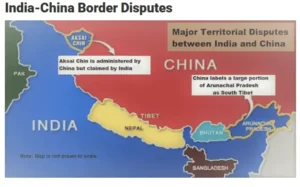
  • Boundary dispute: Different perceptions of the Line of Actual Control (LAC) create tensions in Ladakh and the eastern sector.
  • Territorial claims: China disputes India’s sovereignty over Arunachal Pradesh, while India rejects these claims.
  • Strategic competition: China’s close relationship with Pakistan raises Indian security concerns.
  • Regional influence: Both countries seek greater influence in South Asia and the Indian Ocean.
  • Global alignments: China views India’s participation in the Quad with suspicion, while India maintains its strategic autonomy.
  • Economic dependence: Trade imbalances and reliance on Chinese imports create economic vulnerabilities.

Why Peaceful Coexistence Matters

  • Border stability: Prevents accidental clashes and protects civilian communities.
  • Economic development: Reduces defence-related uncertainty and supports trade and investment.
  • Regional security: Helps maintain stability across the Himalayas and Indo-Pacific.
  • Global governance: Cooperation strengthens forums such as BRICS, SCO and G20.
  • Climate action: Both countries can collaborate on renewable energy and sustainable development.
  • Multipolar world: Constructive relations can strengthen the voice of developing countries.

Challenges to Lasting Peace

  • Trust deficit: Past conflicts and military incidents complicate negotiations.
  • Unsettled boundaries: Lack of mutually accepted border demarcation increases confrontation risks.
  • Military infrastructure: Roads, surveillance systems and troop deployments raise security concerns.
  • Power asymmetry: Differences in economic and military capabilities influence strategic calculations.
  • Nationalism: Strong domestic reactions can reduce diplomatic flexibility.
India China Relations and The Path to Peaceful Coexistence

Existing Diplomatic Mechanisms

  • 1993 and 1996 agreements: Established principles for maintaining peace and military confidence along the LAC.
  • 2005 Political Parameters Agreement: Outlined guiding principles for resolving the boundary question.
  • Special Representatives mechanism: Provides high-level dialogue on the boundary dispute.
  • Working Mechanism for Consultation and Coordination (WMCC): Addresses border-related issues through diplomatic channels.

Way Forward

  • Restore confidence: Ensure full implementation of border agreements and strengthen military communication.
  • Prevent escalation: Improve patrolling protocols and emergency contact mechanisms.
  • Sustain dialogue: Keep diplomatic engagement active despite disagreements.
  • Reduce vulnerabilities: Diversify critical imports and strengthen domestic manufacturing.
  • Expand cooperation: Identify shared interests in trade, climate negotiations and multilateral institutions.
  • Maintain strategic autonomy: Pursue independent foreign policy choices without treating conflict as inevitable.

Conclusion

Lasting India–China peace requires firm border security, sustained diplomacy and mutual respect, transforming strategic rivalry into stable and responsible coexistence.

ARTIFICIAL INTELLIGENCE IN MODERN WARFARE AND LESSONS FOR INDIA

TOPIC: (GS3) SCIENCE AND TECHNOLOGY: THE HINDU

A recent growing role of AI companies in the U.S. defence industry, shifting military innovation from traditional weapons raises questions about defence costs, cybersecurity and the future of warfare, particularly for India.

What is the Military-Industrial Complex?

  • The Military-Industrial Complex (MIC) refers to the relationship between armed forces, defence manufacturers, technology companies and government institutions.
  • Traditionally, it focused on expensive aircraft, warships, missiles and armoured vehicles.
  • Increasingly, AI, cloud computing, advanced chips and autonomous systems are becoming essential components of military capability.
  • This shift is often described as software-defined warfare, where digital systems influence the performance of physical weapons.

Why is AI Transforming Defence?

  • Changing war economics: Low-cost drones can force opponents to use expensive defensive missiles.
  • Faster innovation: Software upgrades can improve military systems without replacing entire platforms.
  • Private investment: Technology startups can develop specialised solutions through commercial research.
  • Procurement reforms: Flexible contracts may reduce delays in acquiring new capabilities.
  • Data advantage: AI can process satellite images, intelligence reports and battlefield information rapidly.

Major Applications of Military AI

  • Intelligence: Analyses surveillance footage and identifies unusual activities.
  • Autonomous systems: Supports navigation and coordination of unmanned vehicles.
  • Cybersecurity: Detects suspicious network behaviour and potential attacks.
  • Logistics: Predicts equipment failures and improves supply management.
  • Decision support: Helps commanders compare operational information.
  • Training: AI-enabled simulations support realistic military exercises.

Strategic and Economic Significance

  • Defence efficiency: Affordable unmanned systems can complement costly conventional platforms.
  • Industrial transformation: Software firms, chip manufacturers and cloud providers gain strategic importance.
  • Technological competition: Control over computing infrastructure and advanced semiconductors becomes critical.
  • Deterrence: Faster information processing may improve situational awareness.
  • Global supply chains: Countries face pressure to secure trusted technology and domestic production capabilities.

Challenges

  • Cyber vulnerabilities: Hacked software may disrupt critical military operations.
  • Algorithmic errors: Incorrect data can produce unreliable assessments.
  • Accountability: Autonomous weapons raise questions about human control and international humanitarian law.
  • Corporate dependence: Reliance on a few private technology providers creates strategic vulnerabilities.
  • Verification gaps: Frequent software updates make safety testing more difficult.
  • Escalation risks: Faster automated responses may reduce time for human judgement.

Way Forward

  • Indigenous innovation: Strengthen defence AI research through DRDO, iDEX and domestic startups.
  • Defence modernisation: Integrate AI with surveillance, logistics and unmanned systems.
  • Cyber resilience: Secure military networks, data and communication infrastructure.
  • Human oversight: Retain meaningful human control over critical decisions.
  • Skill development: Train personnel in AI, robotics and electronic warfare.
  • Institutional reform: Improve procurement, testing standards and cooperation between academia and industry.

Conclusion

India must combine indigenous AI innovation, secure digital infrastructure and responsible human oversight to remain strategically prepared for the next generation of warfare.

DIGITAL ARREST SCAMS IN INDIA AND CITIZEN PROTECTION

TOPIC: (GS2) POLITY: THE HINDU

The Supreme Court recently expressed concern over rising digital arrest scams, which have reportedly caused losses of around ₹800 crore in 2026.

What is a Digital Arrest Scam?

  • It is a form of cyber fraud where criminals impersonate police, CBI or other government officials through phone or video calls.
  • Victims are falsely accused of crimes and threatened with arrest unless they transfer money.
  • Fraudsters exploit fear, authority and psychological pressure, particularly among elderly citizens.
  • Important: Indian law does not recognise arrest through a video call as a legitimate procedure.

Why Are These Scams Increasing?

  • Digital expansion: Wider use of online banking creates more opportunities for fraud.
  • Identity manipulation: Criminals use fake documents, official-looking backgrounds and spoofed numbers.
  • Fear of authorities: Victims may comply because they fear legal action.
  • Mule accounts: Fraudsters use intermediary bank accounts to receive and transfer stolen money.
  • Cross-border networks: Some operations function from organised scam centres in Southeast Asia.

Major Impacts

  • Economic losses: Families may lose retirement savings and emergency funds.
  • Mental distress: Victims experience anxiety, shame and fear.
  • Financial exclusion: Unnecessary account freezes can disrupt small businesses and low-income households.
  • Institutional trust: Fraudulent impersonation weakens public confidence in law enforcement.
  • National security: Organised cybercrime networks may operate across international borders.

Existing Legal and Institutional Framework

  • Bharatiya Nyaya Sanhita, 2023: Contains provisions relevant to cheating and impersonation.
  • Information Technology Act, 2000: Addresses identity theft and computer-related offences.
  • RBI KYC framework: Requires banks to verify customers and monitor suspicious activity.
  • Indian Cyber Crime Coordination Centre (I4C): Supports coordinated action against cybercrime.
  • National Cyber Crime Reporting Portal: Enables citizens to report online financial fraud.
  • Helpline 1930: Facilitates rapid reporting of cyber financial fraud.

Challenges

  • Banking loopholes: Weak verification can allow fraudulent accounts to operate.
  • Compensation gaps: Victims who transfer money under coercion may not receive protection available for unauthorised transactions.
  • Privacy concerns: Excessive surveillance and automatic police reporting can affect innocent customers.
  • Disproportionate restrictions: Long account freezes may harm traders and Jan Dhan beneficiaries.
  • Jurisdictional barriers: International scam networks complicate investigation and recovery.

Way Forward

  • Strengthen bank monitoring: Use risk-based AI systems to detect suspicious transaction patterns.
  • Ensure accountability: Penalise negligent financial institutions and establish fair compensation mechanisms.
  • Protect innocent customers: Provide prompt reviews, appeals and proportionate account restrictions.
  • Improve awareness: Conduct targeted campaigns for senior citizens and first-time digital users.

Conclusion

Combating digital arrest scams requires strong cyber policing, responsible banking, international cooperation and safeguards that protect both victims and innocent account holders.

GSLV-F18 AND INDIA'S NAVIC NAVIGATION SYSTEM

TOPIC: (GS3) SCIENCE AND TECHNOLOGY: THE HINDU

ISRO successfully launched the NVS-03 navigation satellite aboard GSLV-F18 from the Satish Dhawan Space Centre, Sriharikota.

Key Features of NVS-03

  • Satellite: NVS-03, weighing approximately 2,250 kg, with a planned lifespan of 12 years.
  • Launch vehicle: Geosynchronous Satellite Launch Vehicle (GSLV-F18).
  • Orbit: Initially placed in Geosynchronous Transfer Orbit (GTO).
  • Technology: Carries an Indian-made atomic clock for accurate timing.
  • Signals: Supports L1, L5 and S-band navigation services.

What is NavIC?

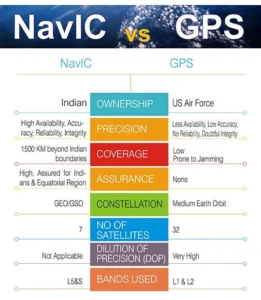
  • Navigation with Indian Constellation (NavIC) is India’s independent regional satellite navigation system.
  • Provides Position, Navigation and Timing (PNT) services across India and approximately 1,500 km beyond its boundaries.
  • Applications: Disaster response, maritime navigation, transport, defence and location-based services.
  • Reduces dependence on foreign navigation systems such as GPS.
GSLV-F18 and Indias Navic Navigation System

What is an Orbit?

  • An orbit is the curved path followed by a satellite around Earth under gravity.
  • LEO: Used mainly for Earth observation and communication.
  • Geostationary orbit: Satellite appears stationary above the equator.
  • GTO: An elliptical transfer orbit used to reach higher operational orbits.

What are Earth Observation Satellites?

  • Satellites that monitor Earth’s land, oceans and atmosphere using cameras and sensors.
  • Examples: Cartosat, Resourcesat and Oceansat.
  • Applications: Crop monitoring, flood mapping, weather observation, urban planning and environmental protection.
  • Unlike navigation satellites, they collect information about Earth’s physical conditions.

Challenges

  • Strategic autonomy: Strengthens indigenous navigation capabilities.
  • Economic benefits: Supports logistics, fisheries and digital services.
  • Challenges: Atomic clock reliability, satellite replacement and uninterrupted services.
  • Way forward: Improve indigenous components, testing and constellation maintenance.

Conclusion

A reliable NavIC constellation strengthens India’s technological self-reliance, national security and space-based public services.

INDIA'S CHANGING CRUDE OIL IMPORTS AND STRATEGIC AUTONOMY

TOPIC: (GS3) ECONOMY: THE HINDU

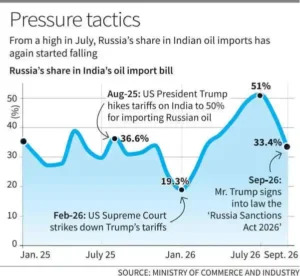
India’s crude oil imports from Russia declined sharply in September 2026, while imports from the United States reportedly fell to zero.
Indias Changing Crude Oil Imports and Strategic Autonomy

Key Developments

  • India imported 209.4 lakh tonnes of crude oil in September 2026, according to the reported government data.
  • Russia’s share declined from 51% in July to 33% in September.
  • The UAE emerged as an important alternative supplier, accounting for over one-fourth of imports.
  • Russia and the UAE together supplied approximately 60%, indicating continued import concentration.
  • The monthly oil import bill reached nearly $14.3 billion, reflecting higher crude prices.

Reasons Behind Changing Imports

  • U.S. sanctions: Possible penalties on Russian energy buyers create trade uncertainty.
  • Geopolitical tensions: West Asian conflicts threaten oil shipments through the Strait of Hormuz.
  • Price considerations: Indian refiners compare international prices, discounts and transport costs.
  • Supply diversification: Alternative suppliers help reduce dependence on individual countries.

Implications for India

  • Energy security: Concentrated imports increase vulnerability to supply disruptions.
  • Inflation: Costlier crude raises transport and production expenses.
  • Current account deficit: Higher import payments increase foreign exchange requirements.
  • Diplomacy: India must balance relations with Russia, the U.S. and Gulf countries.
  • Refining sector: Changes in sourcing affect refinery costs and profitability.

Government Measures

  • Strategic Petroleum Reserves: Provide emergency crude oil stocks.
  • Ethanol blending: Reduces dependence on petrol derived from imported crude.
  • National Green Hydrogen Mission: Promotes cleaner alternatives for selected industrial uses.
  • International Solar Alliance: Encourages renewable energy cooperation.

Way Forward

  • Diversify suppliers across West Asia, Africa and the Americas.
  • Expand strategic reserves and strengthen shipping security.
  • Negotiate stable, long-term supply agreements.
  • Promote electric mobility, public transport and energy efficiency.
  • Maintain strategic autonomy while complying with applicable international obligations.

Conclusion

India’s energy security depends on diversified oil supplies, affordable imports, resilient infrastructure and an independent foreign policy guided by national interests.

Write a Review

Your email address will not be published. Required fields are marked *