Table of Contents
ToggleCentral Secretariat in India
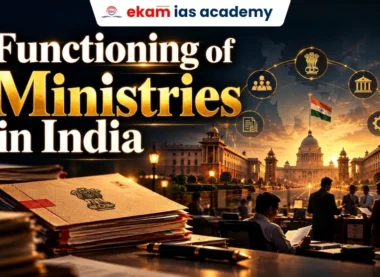
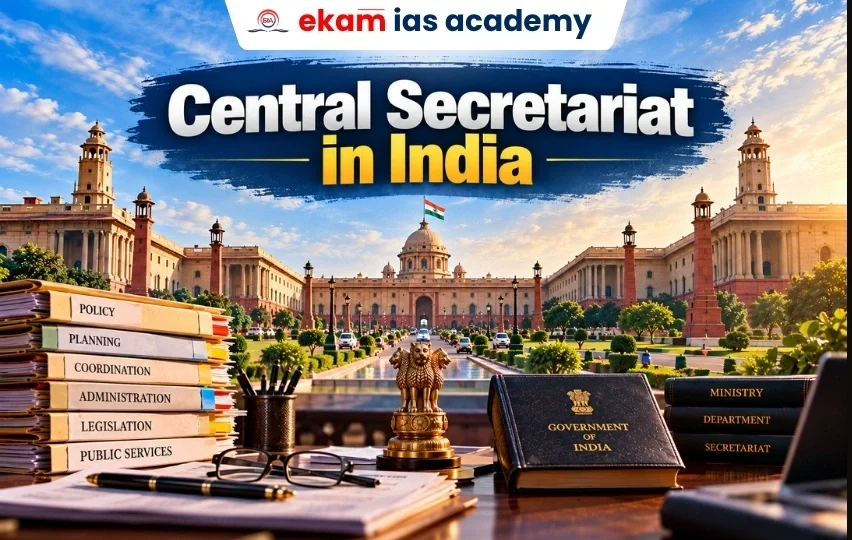
- The Central Secretariat in India serves as the administrative nerve center and institutional memory of the Union Government.
- A thorough understanding of the Central Secretariat System is essential for civil services candidates covering Indian Polity and Governance UPSC and Indian Bureaucracy UPSC modules.
- Functioning under the political executive, it aids ministers in policy formulation, administrative oversight, and legislative drafting.
- Studying the Central Secretariat Organisation provides crucial insights into the split between policy-making and policy-execution functions in Government of India Administration.
Central Secretariat
- Institutional Definition: Refers to the collective complex of all Union Ministries and Departments operating at the administrative apex in New Delhi.
- Split System Principle: Built on the fundamental administrative principle that policy-making should be separated from field-level execution.
- Collective Unit: Functions as a unified entity bound by administrative rules, mirroring the collective responsibility of the Council of Ministers.
- Evolutionary Origin: Evolved from the Imperial Secretariat during pre-independence governance into the modern Union Government Secretariat.
Organisation and Structure of the Central Secretariat
- Departmental Hierarchy: Divided systematically into Departments, Wings, Divisions, Branches, and Sections:
- Department: Headed by a Secretary to the Government of India.
- Wing: Headed by a Joint Secretary or Additional Secretary.
- Division: Headed by a Director or Deputy Secretary.
- Branch: Headed by an Under Secretary (Branch Officer).
- Section: Headed by a Section Officer (the primary operational office unit).
- Administrative Cadre: Staffed largely by officers of the Central Secretariat Service (CSS), All India Services (IAS), and Central Group ‘A’ Services.
- Tenure System: Senior policy-making posts (Deputy Secretary and above) rely on the tenure system, borrowing officers periodically from states.
Major Functions of the Central Secretariat
- Policy Formulation: Assists political ministers in analyzing data, evaluating alternatives, and drafting national policies.
- Legislative Support: Prepares legislative drafts, parliamentary bill notes, and answers to parliamentary questions.
- Financial & Budgetary Control: Assists in formulating sectoral plans, demand for grants, and expenditure monitoring.
- Inter-Agency Coordination: Serves as the primary communication link between the Union Government, State Governments, NITI Aayog, and Finance Commission.
Role of the Secretary to the Government of India
- Principal Administrative Adviser: Acts as the official head of the department and primary adviser to the Minister on policy matters.
- Chief Accounting Officer: Represents the department before the Public Accounts Committee (PAC) regarding budgetary expenditures.
- Administrative Command: Manages overall personnel management, discipline, and workflow within the department.
- Policy Continuity: Ensures institutional memory and administrative consistency across changing political regimes.
Central Secretariat and the Political Executive
- Advisory Linkage: Translates the political mandate of elected Cabinet Ministers into actionable administrative policies.
- Anonymity and Neutrality: Civil servants in the secretariat operate behind the veil of ministerial responsibility under parliamentary norms.
- Cabinet Coordination: Works closely with the Cabinet Secretariat to process proposals requiring Cabinet approval.
- Policy Refinement: Subjecting political ideas to legal, financial, and procedural feasibility checks.
Central Secretariat Rules and Administrative Framework
- Transaction of Business Rules: Governs how administrative decisions and files move across government levels under Article 77(3).
- Allocation of Business Rules: Formally distributes government departments and subjects among various ministers.
- Manual of Office Procedure: Provides standardized guidelines for note-making, drafting, file maintenance, and record management.
- Delegation of Financial Powers: Outlines financial limits and approvals required across different administrative levels.

How Does the Central Secretariat Work
- Bottom-Up File Movement: File processing typically initiates at the Section level (Section Officer/ASO) with factual notes.
- Middle-Level Examination: Under Secretaries and Deputy Secretaries scrutinize proposals, evaluate legalities, and suggest options.
- Apex Approval: Joint Secretaries, Additional Secretaries, and Secretaries finalize policy notes for Ministerial sanction.
- E-Office Integration: Modernized digital file systems now accelerate decision-making and reduce red tape.
Importance of the Central Secretariat in Governance
- Core of Policy Making: Functioning as the “think tank” of the Union Government.
- Institutional Memory: Preserves historic precedents, legislative intent, and policy data for future governance.
- National Integration: Maintains uniform administrative standards across the federation.
- Administrative Stability: Provides continuity during cabinet reshuffles, general elections, and political transitions.
Conclusion
- The Central Secretariat of India forms the backbone of the executive branch in Central Administration in India.
- Balancing political directions with bureaucratic expertise guarantees efficiency, constitutional legality, and continuity.
- Understanding the Role of Central Secretariat is critical for civil services candidates seeking a top score in Central Secretariat UPSC topics.
UPSC Prelims: PYQs & Practice Questions
Previous Year Questions (Prelims)
Q: Which of the following is/are the function/functions of the Cabinet Secretariat?
1. Preparation of agenda for Cabinet Meetings
2. Secretarial assistance to Cabinet Committees
3. Allocation of financial resources to the Ministries
Select the correct answer using the code given below:
(a) 1 only
(b) 2 and 3 only
(c) 1 and 2 only
(d) 1, 2 and 3
Answer: (c) 1 and 2 only
Explanation:
Statement 1 is correct: The Cabinet Secretariat prepares
agendas for Cabinet meetings, tracks implementation, and maintains
records of deliberations.
Statement 2 is correct: It acts as the institutional coordinator, providing secretarial assistance to all standing and ad-hoc Cabinet Committees.
Statement 3 is incorrect: Allocation of financial resources among Ministries is the statutory responsibility of the Ministry of Finance (Department of Expenditure) through the Annual Financial Statement (Budget), not the Cabinet Secretariat or Central Secretariat.
Q: With reference to the Union Government, consider the following statements:
1. The Ministries/Departments of the Government of India are created by
the Prime Minister on the advice of the Cabinet Secretary.
2. Each of the Ministries is assigned to a Minister by the President of
India on the advice of the Prime Minister.
Which of the statements given above is/are correct?
(a) 1 only
(b) 2 only
(c) Both 1 and 2
(d) Neither 1 nor 2
Answer: (b) 2 only
Explanation:
Statement 1 is incorrect: Ministries and Departments
constituting the Central Secretariat are formally
created or reorganized by the President of India under
the Government of India (Allocation of Business) Rules, 1961,
framed pursuant to Article 77(3). The Cabinet Secretary does not advise
on their creation.
Statement 2 is correct: Under Article 75(1), Ministers are appointed by the President on the advice of the Prime Minister, and portfolios across the Central Secretariat of India are formally assigned to them by the President acting on the Prime Minister's advice.
Practice Questions
Q: With reference to the Central Secretariat System in India, consider the following statements:
1. The Central Secretariat operates under the split-system principle,
separating policy-making functions from policy-execution agencies.
2. The Central Secretariat Service (CSS) provides permanent
administrative support and continuity at middle and junior management
levels in Union Ministries.
3. The tenure system in the Central Secretariat mandates that senior
policy-making officers at Deputy Secretary rank and above are drawn on
temporary deputation from states.
Which of the statements given above are correct?
(a) 1 and 2 only
(b) 2 and 3 only
(c) 1 and 3 only
(d) 1, 2, and 3
Answer: (d) 1, 2, and 3
Explanation:
Statement 1 is correct: The
Central Secretariat is organized on the split-system
model, separating the policy-making staff agency (Secretariat) from
line agencies (Attached/Subordinate offices) responsible for field
execution.
Statement 2 is correct: The Central Secretariat Service (CSS) forms the permanent bureaucratic backbone of headquarters administration, ensuring organizational memory.
Statement 3 is correct: Under the tenure system introduced during colonial governance and maintained post-independence, senior officers (Deputy Secretary, Director, Joint Secretary) are drawn from All India Services and Central Services on periodic deputations.
Q: Consider the following administrative units within a Department of the Central Secretariat Organisation:
1. Branch
2. Wing
3. Section
4. Division
Which of the following represents the correct hierarchical order from HIGHEST to LOWEST rank?
(a) Wing → Division → Branch → Section
(b) Division → Wing → Branch → Section
(c) Wing → Branch → Division → Section
(d) Division → Branch → Wing → Section
Answer: (a) Wing → Division → Branch → Section
Explanation:
The standardized internal structural hierarchy of a Department within
the Central Secretariat in India is organized as
follows:
1. Department: Headed by a Secretary to the
Government of India.
2. Wing: Headed by a Joint Secretary or Additional
Secretary.
3. Division: Headed by a Director or Deputy
Secretary.
4. Branch: Headed by an Under Secretary.
5. Section: Headed by a Section Officer (the primary
operational office unit).
UPSC Mains – Previous Year & Practice Questions
Mains Previous Year Questions
Question: The role of the Cabinet Secretariat in ensuring inter-ministerial coordination and administrative consistency is pivotal in Indian governance. Discuss. (UPSC CSE Mains 2022 - GS Paper II)
Question: Analyze the relationship between the Political Executive and Permanent Executive within the Central Secretariat in the context of policy formulation and execution. (UPSC CSE Mains 2021 - GS Paper II)
Question: How do the Allocation of Business Rules and Transaction of Business Rules framed under Article 77 streamline administrative workflows within the Union Government Secretariat? (UPSC CSE Mains 2019 - GS Paper II)
Question: Departmental silos and bureaucratic delay in the Central Secretariat hinder rapid policy execution. Critically examine the reforms required to modernize file movement and decision-making. (UPSC CSE Mains 2016 - GS Paper II)
Question: Discuss the role of the Secretary to the Government of India as the chief administrative adviser and accounting officer of a Ministry. (UPSC CSE Mains 2013 - GS Paper II)
Mains Practice Questions
[15 Marks | 250 Words]
Question: The Central Secretariat System relies on the 'Split-System' model separating policy formulation from policy execution. Assess whether modern governance challenges require merging staff and line agencies for agile public administration.
[15 Marks | 250 Words]
Question: Examine the role of the Central Secretariat Service (CSS) in preserving institutional memory and administrative continuity amid frequent political executive transitions.
[10 Marks | 150 Words]
Question: Evaluate the impact of e-Office initiatives and digital file tracking systems in reducing red tape and streamlining decision-making within the Central Secretariat of India.
Central Secretariat in India-FAQs
What is the Central Secretariat in India?
The Central Secretariat is the collective administrative complex of Union Ministries and Departments that assists the political executive in policy formulation, legislative work, coordination and administrative oversight.
What are the major functions of the Central Secretariat?
Its major functions include policy formulation, legislative support, budgetary and financial control, inter-ministerial coordination, record management and providing administrative advice to ministers.
What is the role of the Secretary in the Central Secretariat?
The Secretary is the administrative head of a department and acts as the principal adviser to the Minister on policy matters. The Secretary also ensures administrative coordination, continuity and accountability.
What is the difference between the Central Secretariat and field agencies?
The Central Secretariat primarily focuses on policy-making, coordination and administrative supervision, whereas field agencies and attached/subordinate offices are mainly responsible for implementing government policies and programmes.
Which rules govern the functioning of the Central Secretariat?
The functioning of the Central Secretariat is guided by the Transaction of Business Rules, Allocation of Business Rules, Manual of Office Procedure and Delegation of Financial Powers.