
Table of Contents
ToggleIndia’s Employment Challenge: From Falling Unemployment to Decent Work
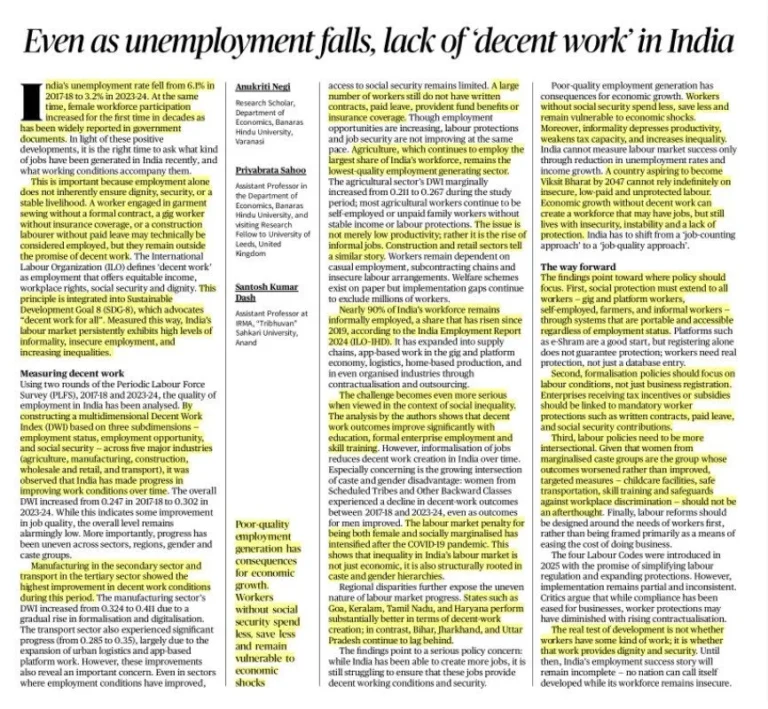
India’s unemployment rate has declined significantly, falling from 6.6% in 2017–18 to 3.2% in 2023–24. While this appears encouraging, the article highlights that lower unemployment alone does not necessarily indicate better employment conditions. The bigger challenge is ensuring “decent work” that provides adequate income, social security, workplace rights, stability and dignity.
What is Decent Work?
The International Labour Organization (ILO) defines decent work around employment opportunities that provide fair income, workplace rights, social protection and dignity.
The Sustainable Development Goal SDG 8 also promotes “decent work for all”. India’s challenge is therefore not merely creating more jobs but ensuring that employment is productive, secure and equitable.
Measuring the Quality of Employment
The article uses a Decent Work Index (DWI) constructed from indicators covering:
- Employment opportunities
- Employment security
- Adequate earnings
- Social security
- Social equality
Although the overall index improved between 2017–18 and 2023–24, progress remains uneven across sectors, regions, gender and social groups.
Key Employment Challenges
1. Informal Employment
A large proportion of workers remain in informal employment, often without adequate access to social security, paid leave, insurance and employment protection. The growth of gig and platform-based work has further complicated the employment landscape.
2. Agriculture and Low-Quality Jobs
Agriculture continues to employ a significant share of India’s workforce but generates relatively low-quality employment. The article highlights concerns over low productivity and inadequate earnings.
3. Gender and Regional Inequality
Women and workers in poorer States continue to face greater disadvantages in employment conditions. States such as Bihar, Jharkhand and Uttar Pradesh show significant challenges compared with better-performing States.
4. Need for Social Protection
Expanding social protection to gig workers, platform workers and informal workers is essential. Benefits must be portable and accessible across different forms of employment.
The Way Forward
India needs to move from a “job-counting” approach to a “job-quality” approach. Policies should focus on social security, minimum wages, worker registration, formalisation, skill development and stronger labour protections.
Conclusion
India’s declining unemployment rate is an important achievement, but employment success cannot be measured by unemployment alone. The real challenge is creating productive, secure, fairly paid and socially protected work. Strengthening decent work will be essential for inclusive growth, reducing inequality and ensuring that India’s economic transformation benefits its entire workforce.
Vocabulary
1. Decent Work – Employment ensuring dignity, fair wages and security.
2. Informalisation – Growth of jobs lacking formal protections.
3. Social Security – Protection against economic and livelihood risks.
Prelims MCQs
MCQ 1
Consider the following statements:
1. SDG 8 promotes decent work and economic growth.
2. The Periodic Labour Force Survey (PLFS) is conducted by the National Statistical Office.
3. A decline in unemployment necessarily indicates improvement in job quality.
Which are correct?
A) 1 and 2 only
B) 2 and 3 only
C) 1 and 3 only
D) 1, 2 and 3
Answer: A
UPSC Mains Question
“Declining unemployment does not necessarily ensure decent work.” Examine India’s employment challenges and suggest reforms. (10 Marks)
Frequently Asked Questions (FAQs)
What is meant by decent work?
Decent work refers to employment that provides fair income, workplace rights, social protection, security and dignity.
How has India’s unemployment rate changed?
According to the article, India’s unemployment rate declined from 6.6% in 2017–18 to 3.2% in 2023–24.
What is the Decent Work Index?
The Decent Work Index measures employment quality using indicators such as employment opportunities, security, earnings, social security and equality.
Why is informal employment a concern?
Informal workers often lack adequate social security, paid leave, insurance and other employment protections.
What should India focus on beyond reducing unemployment?
India should focus on job quality, social protection, formalisation, fair wages, worker security and productive employment.
Source From : The Hindu
Jan Vishwas Reforms: Why India Needs Better Wages, Not Just More Jobs
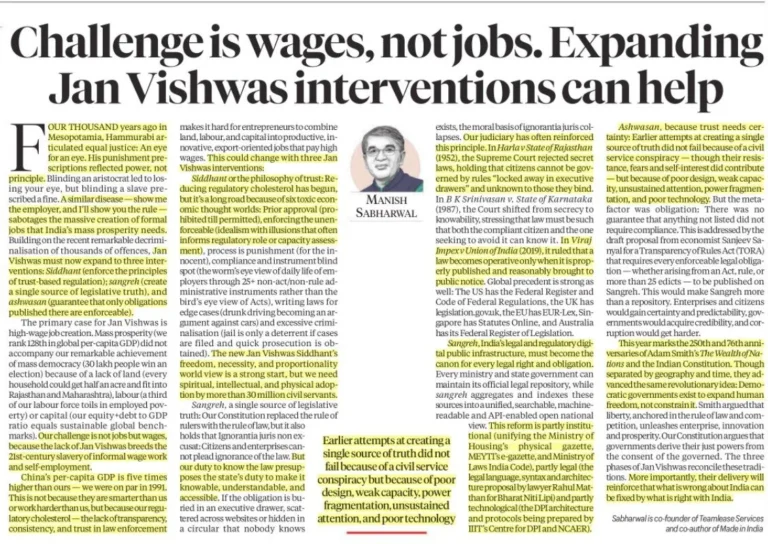
India’s employment challenge is not limited to creating more jobs; it is increasingly about ensuring better wages, formal employment and predictable regulation. The article argues that India’s prosperity has not translated adequately into high-quality employment, with a large section of workers remaining in low-paid and informal work. The Jan Vishwas framework can help address this problem by simplifying regulations, improving legal certainty and reducing unnecessary compliance burdens.
The Challenge: Wages, Not Just Jobs
India has made significant progress in economic growth, but the article highlights the persistence of low-wage and informal employment. A large workforce continues to depend on low-productivity activities, while businesses face regulatory complexity that can discourage formal job creation.
The central argument is that formal, productive and well-paid employment requires an environment where employers can invest, innovate and expand without excessive regulatory uncertainty.
Three Jan Vishwas Interventions
The article identifies three important principles:
1. Siddhant – Trust-Based Regulation
The Siddhant approach seeks to replace excessive regulatory interference with a philosophy of trust. It emphasises:
- Prior approval where necessary rather than excessive prohibition.
- Decriminalisation of minor or technical offences.
- Greater reliance on compliance and instrument-based regulation.
- Proportionality in enforcement.
The objective is to reduce unnecessary regulatory friction while maintaining essential safeguards.
2. Sangreh – Unified Legal Information
Sangreh seeks to create a single source of legislative truth. It proposes a comprehensive digital repository containing laws and regulations in an accessible, searchable and machine-readable format.
This can improve legal certainty, transparency and predictability for citizens and businesses.
3. Ashwasan – Certainty in Government Services
Ashwasan focuses on creating greater certainty in public services and government processes. The article stresses that predictable procedures, adequate capacity and better technology are essential for building trust between citizens, businesses and the State.
Why These Reforms Matter
Effective Jan Vishwas reforms can reduce compliance costs, improve the business environment and encourage formalisation. However, the article cautions that merely creating new legal mechanisms is insufficient. Implementation capacity, institutional accountability and reliable technology are equally important.
Conclusion
India’s employment challenge cannot be solved simply by increasing the number of jobs. The country needs productive employment, better wages, formalisation and greater regulatory certainty. Expanding Jan Vishwas interventions through trust-based regulation, accessible legal information and reliable public services can help create an ecosystem where businesses invest and workers benefit from better-quality employment.
Vocabulary
1. Regulatory Cholesterol – Excessive rules obstructing economic activity.
2. Decriminalisation – Removing criminal penalties for specified offences.
3. Regulatory Certainty – Predictable and transparent application of laws.
Prelims MCQs
MCQ 1
Consider the following statements:
1. The Jan Vishwas (Amendment of Provisions) Act, 2023 seeks to decriminalise certain minor offences.
2. Decriminalisation necessarily removes all civil penalties for an offence.
3. The rule of law requires that legal obligations be publicly accessible and predictable.
Which are correct?
A) 1 and 2 only
B) 1 and 3 only
C) 2 and 3 only
D) 1, 2 and 3
Answer: B
UPSC Mains Question
“Regulatory reforms are essential for creating productive, high-wage employment in India.” Discuss. (10 Marks)
Frequently Asked Questions (FAQs)
What is the Jan Vishwas approach?
Jan Vishwas seeks to improve the regulatory environment by simplifying laws, reducing unnecessary criminalisation and increasing trust and predictability.
What are the three interventions highlighted in the article?
They are Siddhant, Sangreh and Ashwasan.
What does Siddhant mean in Jan Vishwas reforms?
Siddhant represents a trust-based regulatory philosophy, including proportionality and decriminalisation of minor offences.
What is Sangreh?
Sangreh aims to create a single, accessible and searchable source of laws and regulations.
Why is regulatory certainty important for employment?
Predictable regulations can reduce compliance costs, encourage investment and help businesses create more formal and productive employment.