Table of Contents
ToggleThe ongoing disruption in Bangladesh’s Ready-Made Garment (RMG) industry, marked by labour unrest, rising production costs and factory closures, could create an opportunity for India’s textile and apparel sector. However, India must address infrastructure, scale, technology and man-made fibre gaps to convert this opportunity into long-term export growth.
What is the Current Crisis in Bangladesh’s Textile Sector?
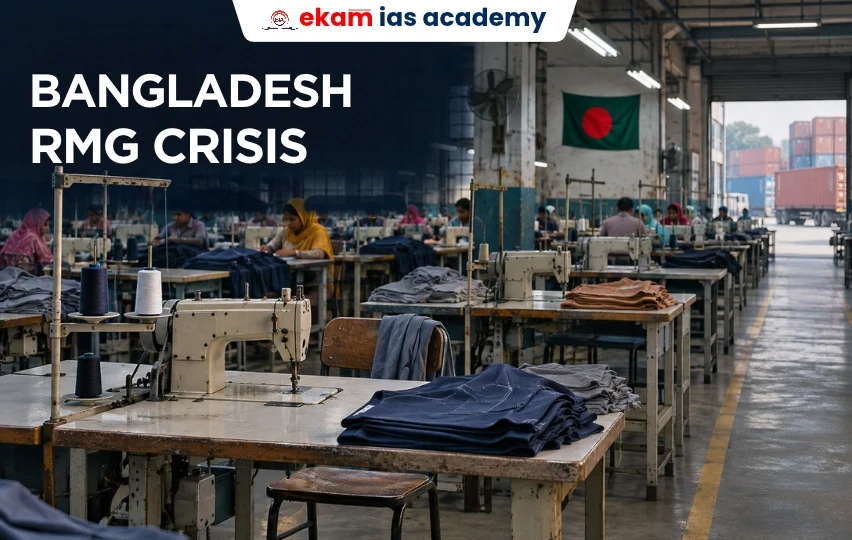
Bangladesh built a globally competitive garment industry by combining low-cost labour, export-oriented policies and preferential access to Western markets. The sector has become a major pillar of the country’s economy, employing millions and contributing a large share of export earnings.
However, the industry is facing growing pressure. Rising living costs have triggered wage demands, while expensive energy and declining orders have increased production costs. Factory closures have further disrupted supply chains and affected employment.
Causes of Current RMG Crisis in Bangladesh
The major factors include the widening gap between wages and living costs, higher energy expenses and financial stress among garment manufacturers. Factory shutdowns have added to uncertainty at a time when global apparel companies are planning their seasonal orders.
Bangladesh’s forthcoming graduation from Least Developed Country status could also reduce some of its traditional preferential trade advantages.
How Does the Bangladesh RMG Crisis Present an Opportunity for India?
Global brands seeking to diversify their sourcing could increasingly consider India under a “Bangladesh Plus One” strategy. India has several advantages, including domestic cotton production, established textile clusters and an integrated value chain covering spinning, weaving and garment manufacturing.
Major centres such as Tiruppur, Surat and Gautam Buddha Nagar can help accommodate additional demand. Government initiatives such as PM MITRA and the PLI Scheme for Textiles can further strengthen manufacturing capacity and competitiveness.
Current Status and Strategic Importance of India’s Textile Sector
India’s textile industry is a major source of employment and export earnings, particularly for women and rural communities. The country has a strong raw-material base and permits 100% FDI through the automatic route, creating opportunities for greater global investment.
What are the Associated Structural Challenges for India?
India continues to face strong competition from Vietnam, Indonesia and Cambodia. Fragmented production, longer delivery timelines, limited large-scale manufacturing and inadequate adoption of advanced technologies remain concerns.
India’s relatively weaker position in man-made fibre (MMF) garments is another challenge, especially as global fashion increasingly depends on synthetic fibres.
What Measures Can Strengthen the India RMG Sector and Become a Global Hub?
India should rapidly develop integrated textile parks, improve logistics, rationalise duties on MMF inputs and promote advanced manufacturing technologies. Skill development, particularly for women, can expand the labour pool.
Greater adoption of CAD, automation, digital production systems and Industry 4.0 technologies can improve productivity, quality and delivery timelines.
Conclusion
Bangladesh’s current RMG difficulties provide India with a valuable opening, but temporary disruption alone cannot guarantee sustained export gains. By expanding manufacturing scale, improving infrastructure, strengthening MMF capabilities and leveraging trade partnerships, India can transform this opportunity into a durable position in the global textile and apparel market.


FAQs - Bangladesh RMG crisis
What is the Bangladesh RMG crisis?
The article describes disruption in Bangladesh’s Ready-Made Garment industry caused by labour unrest, rising production costs, declining orders and factory closures.
What are the main causes of the crisis?
Key factors include wage pressures, higher living costs, expensive energy and financial stress among garment manufacturers.
How could India benefit from Bangladesh’s RMG crisis?
Global brands diversifying their sourcing could place more orders with Indian manufacturers, creating opportunities for apparel exports and employment.
What challenges could prevent India from gaining additional orders?
Fragmented production, limited manufacturing scale, logistics delays, technology gaps and weaker man-made fibre capabilities could limit India’s competitiveness.
How can India strengthen its garment industry?
India can develop integrated textile parks, improve logistics, expand MMF production, adopt modern technologies and strengthen workforce skills, supported by initiatives such as PM MITRA and the textile PLI scheme.