Table of Contents
ToggleWhat is the Indian Parliament?
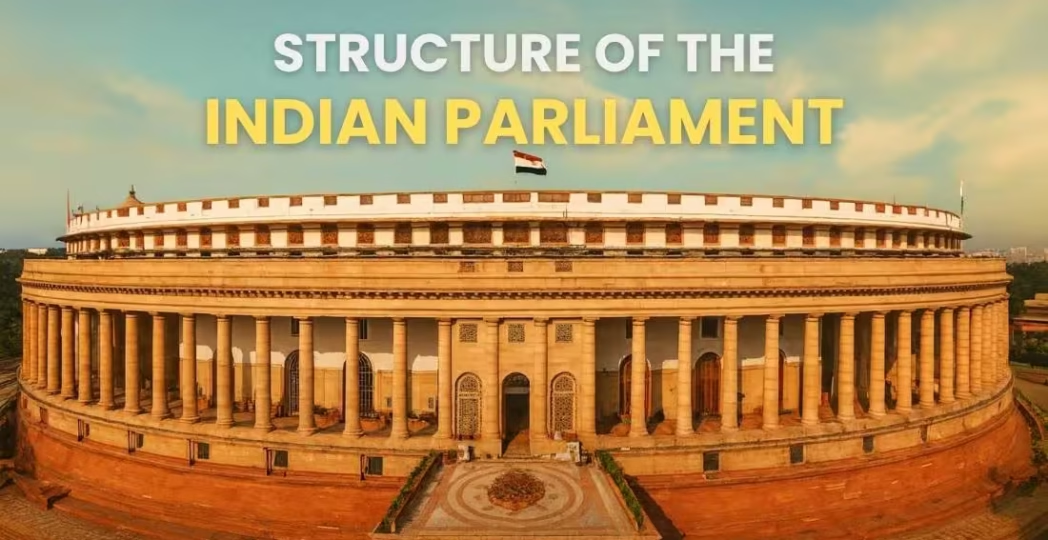
The Indian Parliament is the supreme legislative body of India at the union level. It functions as the highest law-making institution of the country. Part V of the Constitution of India (Articles 79 to 122) deals with the organization, composition, duration, officers, procedures, powers, and privileges of the Indian Parliament.
Composition of the Indian Parliament
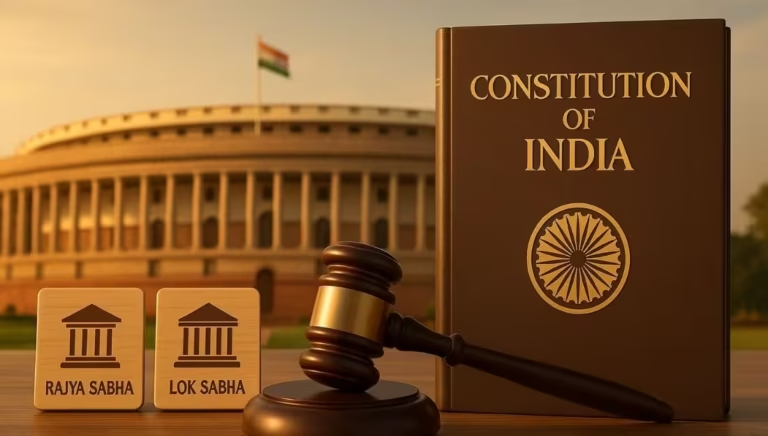
The Parliament of India consists of three parts:
- The President of India
- Council of States (Rajya Sabha)
- House of the People (Lok Sabha)
Why is the President an integral part of Parliament?
Though not a member of either house, the President plays a crucial role in the legislative process:
- Without the President’s assent, a bill passed by both houses cannot become law.
- The President has the power to summon or prorogue both houses of Parliament and can address them.
- The President addresses Parliament at the first session after a general election and at the first session of each year.
- The President can issue ordinances when Parlia.
Bicameral Legislature
India has a bicameral legislature to manage its complex diversity effectively. This divides the Parliament into:
- Lok Sabha (House of the People)
- Rajya Sabha (Council of States)
Feature | Lok Sabha | Rajya Sabha |
Composition | Article 81: Maximum 550 members (530 elected + 20 from Union Territories). 104th Amendment removed 2 Anglo-Indian seats. | Maximum 250 members: 238 elected by states/UTs, 12 nominated by President. Seats allocated as per Fourth Schedule. |
Duration & Dissolution | Article 83(2): 5 years, can be extended during emergency. Dissolution by President on PM’s advice. | Article 83(1): Permanent body; one-third members retire every 2 years. Term of member: 6 years. |
Minimum Age & Qualification | Article 84: Citizen of India, ≥25 years, voter registration, SC/ST for reserved seats. | Article 84: Citizen of India, ≥30 years, voter registration. |
Presiding Officers | Article 93: Speaker & Deputy Speaker elected by Lok Sabha members. | Article 89(1,2): Vice President = ex-officio Chairman, Deputy Chairman elected by Rajya Sabha members. |
Disqualifications of Members
Under Constitution (Article 102)
A person can be disqualified for:
- Holding office of profit (except declared by law).
- Being of unsound mind, undischarged insolvent, or not a citizen of India.
- Disqualification under any law made by Parliament.
Under Representation of People’s Act (1951)
A person can be disqualified for:
- Conviction for certain offences or imprisonment ≥2 years.
- Failure to submit election expenses.
- Interest in government contracts.
- Holding office of profit in a government-owned corporation.
- Dismissal for corruption/disloyalty.
- Promoting enmity, untouchability, dowry, or Sati practices.
Decision: Article 103 – The President decides disqualification after consulting the Election Commission.
Disqualification for Defection
Anti-Defection Act, 1985 disqualifies a member who:
- Voluntarily gives up membership of a political party.
- Votes/abstains against party directions.
- Independently elected members join a party.
- Nominated members join a party after 6 months.
Decision: Rajya Sabha → Chairman, Lok Sabha → Speaker.
Vacation of Seat
A member may vacate seat due to:
- Double membership: If elected to both houses, must choose within 10 days.
- Membership of state legislature alongside Parliament (resign within 14 days).
- Resignation: Writing to presiding officer.
- Absence: 60 days without permission.
Election declared void, expulsion, election to President/Governor.
Presiding Officers
Lok Sabha
- Speaker: Presiding officer, remains till new Speaker is elected even after dissolution.
- Deputy Speaker: Presides in absence of Speaker.
- Removal: By resolution passed by majority of all Lok Sabha members.
- Panel of Chairpersons: Up to 10 members appointed to preside in Speaker/Deputy Speaker absence.
Rajya Sabha
- Chairman: Vice President of India, ex-officio.
- Deputy Chairman: Elected by members, removal requires majority.
- Panel of Vice-Chairpersons: Nominated by Chairman to preside in absence of Chairman/Deputy Chairman.
Prelims MCQs
Q1. Which of the following statements regarding the President of India and Parliament is correct?
a) The President is a member of both Houses of Parliament.
b) The President can summon, prorogue both Houses and give assent to bills.
c) The President cannot address Parliament.
d) The President can veto a constitutional amendment.
Answer: b) The President can summon, prorogue both Houses and give assent to bills.
Q2. How many members can the Lok Sabha have according to the Constitution?
a) 545
b) 552
c) 550
d) 560
Answer: c) 550
Q3. What is the maximum strength of Rajya Sabha as per the Constitution?
a) 238
b) 245
c) 250
d) 260
Answer: c) 250
Q4. Which of the following statements about Rajya Sabha is NOT correct?
a) It is a permanent body and not subject to dissolution.
b) One-third of members retire every 2 years.
c) Members are directly elected by the people.
d) 12 members are nominated by the President.
Answer: c) Members are directly elected by the people.
Q5. Minimum age for a candidate to contest Lok Sabha elections is:
a) 18 years
b) 21 years
c) 25 years
d) 30 years
Answer: c) 25 years
Q6. The Anti-Defection Act, 1985, provides for disqualification in which of the following cases?
a) A member voluntarily gives up party membership.
b) A member votes against party directives.
c) A nominated member joins a political party after six months.
d) All of the above
Answer: d) All of the above
Q7. Who is the ex-officio Chairman of Rajya Sabha?
a) President of India
b) Prime Minister of India
c) Vice President of India
d) Deputy Chairman of Rajya Sabha
Answer: c) Vice President of India
Q8. Who decides disqualification questions arising under Anti-Defection law for Lok Sabha members?
a) President
b) Speaker of Lok Sabha
c) Election Commission
d) Prime Minister
Answer: b) Speaker of Lok Sabha
Q9. The Panel of Chairpersons in Lok Sabha can have a maximum of:
a) 5 members
b) 10 members
c) 12 members
d) 15 members
Answer: b) 10 members
Q10. Which Article deals with the term and dissolution of Lok Sabha?
a) Article 81
b) Article 83(2)
c) Article 89
d) Article 84
Answer: b) Article 83(2)
Structure of the Indian Parliament – UPSC FAQ Guide
Mains Practice Questions
Q1. Explain the composition and structure of the Indian Parliament. How does it ensure representation for both the Union and the States?
Q2. Discuss the role of the President as an integral part of the Parliament. How does it balance the powers between the executive and legislature?
Q3. What is the significance of a bicameral legislature in India? Analyze the differences between the Lok Sabha and Rajya Sabha in terms of composition, powers, and functions.
Q4. Examine the provisions related to disqualification of members under the Constitution and the Representation of People Act, 1951. Why are such provisions essential for the functioning of a healthy democracy?
Q5. Evaluate the importance of presiding officers in Parliament. Discuss the powers, responsibilities, and the functioning of the Speaker of Lok Sabha and Chairman of Rajya Sabha.
Q6. Critically analyze the Anti-Defection Act, 1985. How does it uphold the principle of party discipline and collective responsibility in the Indian parliamentary system?
Q7. Explain the procedures for vacation of seats in Parliament. How do these procedures maintain the credibility and accountability of the members of Parliament?
Q8. Discuss the mechanism of the panel of chairpersons in Lok Sabha and panel of vice-chairpersons in Rajya Sabha. How does it ensure continuity in parliamentary proceedings?
Key Notes for Quick Revision
- President – Integral part of Parliament; gives assent to bills, summons Parliament, addresses sessions, can issue ordinances.
- Rajya Sabha – Permanent House; 238 elected, 12 nominated; 6-year term; 1/3 retire every 2 years.
- Lok Sabha – People’s House; 530 elected, 20 from UTs; 5-year term; can be dissolved.
- Presiding Officers – Speaker & Deputy Speaker (Lok Sabha); Chairman & Deputy Chairman (Rajya Sabha); Panel system ensures continuity.
- Membership – Minimum age, citizenship, voter registration, and other eligibility criteria; disqualifications under Constitution and RPA 1951.
- Anti-Defection Law – Applies to both Houses; ensures party discipline and collective responsibility.
What is the structure of the Indian Parliament?
The Indian Parliament consists of three parts – the President of India, the Lok Sabha, and the Rajya Sabha. It is the supreme legislative body functioning at the Union level.
Why is the President an important part of the Indian Parliament?
The President of India is an integral part of Parliament because no bill becomes a law without the President’s assent. The President also summons, prorogues, and addresses sessions of Parliament and can issue ordinances when it is not in session.
What is the difference between the Lok Sabha and Rajya Sabha?
Lok Sabha is directly elected by the people and has a maximum strength of 550 members, with a tenure of 5 years.
Rajya Sabha is a permanent body with a maximum strength of 250 members, where one-third retire every two years.
What are the qualifications required to become a Member of Parliament in India?
For Lok Sabha, the minimum age is 25 years, while for Rajya Sabha, it is 30 years. In both cases, the person must be a citizen of India and registered as a voter.
What are the grounds for disqualification of Members of Parliament?
Members may be disqualified under Article 102, the Representation of People’s Act (1951), or the Anti-Defection Act (1985). Grounds include holding an office of profit, conviction, failure to submit election expenses, defection, or absence from Parliament without permission.