
Table of Contents
ToggleWHY FALLING UNEMPLOYMENT DOES NOT GUARANTEE QUALITY EMPLOYMENT
TOPIC: (GS3) ECONOMY: THE HINDU
According to the recent Periodic Labour Force Survey (PLFS), India’s unemployment rate has declined, reflecting an improvement in employment levels, although concerns about job quality and social security persist.
What is Decent Work?
- The International Labour Organization (ILO) defines decent work as productive employment providing fair income, workplace rights, social protection and dignity.
- It is a central objective of Sustainable Development Goal 8, which promotes inclusive growth and decent employment.
- Employment quantity measures jobs created, whereas employment quality examines their security, earnings and working conditions.
Findings of the Study
- Decent Work Index (DWI): Increased from 0.247 in 2017–18 to 0.302 in 2023–24, indicating modest improvement.
- Manufacturing: Improved through digitalisation and gradual formalisation.
- Transport: Expanded employment opportunities through logistics and platform services.
- Agriculture: Continues to provide insecure livelihoods, particularly for unpaid family workers.
- Regional inequality: Kerala, Tamil Nadu and Goa perform better than Bihar, Jharkhand and Uttar Pradesh.
- Social inequality: Women belonging to marginalised communities face greater employment disadvantages.
Challenges
- Widespread informality: Nearly 90% of workers remain informally employed, according to the ILO–IHD India Employment Report 2024.
- Insecure employment: Many workers lack written contracts, paid leave and stable wages.
- Limited social protection: Pension, health insurance and maternity benefits remain inaccessible to many.
- Gender barriers: Unpaid care responsibilities, discrimination and unsafe transport restrict women’s opportunities.
- Low productivity: Agriculture and casual construction work often provide irregular earnings.
- Skill mismatch: Education and training do not always match industry requirements.
Why Decent Work Matters
- Poverty reduction: Stable incomes improve household security.
- Economic growth: Productive workers strengthen consumption and domestic demand.
- Social justice: Fair employment reduces caste, gender and regional inequalities.
- Demographic dividend: Quality jobs help India benefit from its young workforce.
- Viksit Bharat 2047: Sustainable development requires secure livelihoods, not merely lower unemployment.
Government Initiatives
- Code on Social Security, 2020: Provides a framework for extending protection to different worker categories.
- e-Shram Portal: Registers unorganised workers for improved welfare access.
- Skill India Mission: Promotes employability through vocational training.
- PM Vishwakarma: Supports traditional artisans through training and financial assistance.
- MGNREGA: Provides a rural employment guarantee and livelihood support.
Way Forward
- Universal protection: Extend portable insurance, pensions and healthcare to informal and gig workers.
- Improve formalisation: Link industrial incentives with written contracts and worker benefits.
- Target inequalities: Expand childcare, safe transport and skill opportunities for disadvantaged women.
- Strengthen enforcement: Improve labour inspections and grievance mechanisms.
- Measure job quality: Track wages, security and working conditions alongside unemployment.
Conclusion
India’s employment success must be measured not simply by the number of people working, but by whether every worker enjoys dignity, fair wages and social security.
STRENGTHENING ISRO AND INDIA'S SPACE PROGRAMME
TOPIC: (GS3) SCIENCE AND TECHNOLOGY: THE HINDU
ISRO’s successful GSLV-F18 launch carrying the NVS-03 satellite has renewed hopes of restoring India’s NavIC navigation system after recent mission setbacks.
Background
- The Indian Space Research Organisation (ISRO) is India’s principal space agency, functioning under the Department of Space.
- Its activities include satellite launches, navigation, remote sensing, communication and scientific exploration.
- Recent setbacks have highlighted the need for stronger institutional capacity, particularly as India prepares for human spaceflight and advanced space missions.
Significance of the NVS-03 Mission
- NavIC restoration: Strengthens India’s independent regional Positioning, Navigation and Timing (PNT) services.
- Indigenous technology: Carries an Indian-developed atomic clock, reducing dependence on imported components.
- Strategic security: Supports defence operations, maritime navigation and disaster management.
- Economic applications: Benefits transport, fisheries, logistics and location-based digital services.
- Technological confidence: Demonstrates progress following recent launch and satellite-related difficulties.
Major Challenges Facing ISRO
- Launch reliability: Repeated mission failures affect schedules, costs and operational readiness.
- Component shortages: Specialised electronic parts and space-qualified materials have long procurement periods.
- Limited workforce: Complex missions require experienced scientists, engineers and technical personnel.
- Financial constraints: Growing ambitions require sustained investment in research and manufacturing.
- Satellite replacement: Delays can weaken essential services such as navigation.
- Institutional overload: Managing research, launches and operational services simultaneously can strain resources.
Government Initiatives
- Indian Space Policy, 2023: Encourages private participation across space activities.
- IN-SPACe: Facilitates and authorises non-government space activities.
- NewSpace India Limited (NSIL): Supports commercialisation of space technologies and services.
- Semiconductor Mission: Strengthens India’s domestic electronics manufacturing ecosystem.
- Gaganyaan Programme: Develops indigenous human spaceflight capabilities.
Way Forward
- Increase funding: Provide predictable allocations for launch vehicles, satellite replacement and infrastructure.
- Strengthen domestic manufacturing: Develop space-grade semiconductors, sensors and atomic clocks.
- Expand recruitment: Employ more scientists, engineers and technical specialists.
- Improve procurement: Create reliable suppliers and reduce delays in component qualification.
- Institutional reforms: Consider dedicated operational management for NavIC.
- Space legislation: Establish clear rules for private participation, liability and safety.
- Strengthen testing: Improve quality assurance, independent reviews and mission reliability.
Conclusion
India’s space ambitions can succeed only when technological innovation is supported by adequate funding, skilled manpower, reliable supply chains and strong institutions.
INDIA'S SOLAR ENERGY REVOLUTION AND VIKSIT BHARAT 2047
TOPIC: (GS3) ECONOMY: THE HINDU
India is witnessing rapid solar energy expansion through PM Surya Ghar, PM-KUSUM and domestic solar manufacturing, strengthening its clean energy transition.
Status of Solar Energy in India
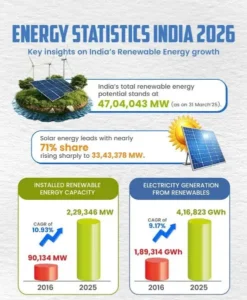
- Rapid expansion: Installed solar capacity reportedly increased from 2.8 GW in 2014 to approximately 171 GW in 2026.
- Affordable electricity: Competitive solar tariffs have fallen substantially, improving economic viability.
- Household participation: Rooftop solar enables consumers to generate electricity and reduce bills.
- National target: India aims to achieve 500 GW of non-fossil electricity capacity by 2030.
Major Government Initiatives
- PM Surya Ghar: Muft Bijli Yojana: Provides financial assistance for household rooftop solar installations.
- PM-KUSUM: Promotes solar irrigation pumps and decentralised renewable electricity for farmers.
- Production Linked Incentive (PLI) Scheme: Encourages domestic manufacturing of high-efficiency solar photovoltaic modules.
- National Green Hydrogen Mission: Targets 5 million metric tonnes of annual green hydrogen production by 2030.
- Green Energy Corridor: Strengthens electricity transmission infrastructure for renewable integration.
Significance of the Solar Revolution
- Energy security: Reduces dependence on imported fossil fuels.
- Farmer empowerment: Solar pumps lower irrigation expenses and improve energy access.
- Employment generation: Creates opportunities in installation, manufacturing, maintenance and technical services.
- Climate action: Supports India’s net-zero emissions target for 2070.
- Economic development: Encourages investment, innovation and decentralised entrepreneurship.
- Global leadership: Strengthens India’s role in clean energy cooperation through the International Solar Alliance.
Challenges
- Intermittent generation: Solar electricity depends on sunlight and weather conditions.
- Storage limitations: Batteries and pumped storage require substantial investment.
- Import dependence: Critical inputs such as wafers and polysilicon remain supply-chain concerns.
- Grid constraints: Transmission networks must expand to handle variable renewable electricity.
- Financial barriers: Households and farmers may face difficulties obtaining affordable credit.
- Environmental concerns: Land acquisition, mineral extraction and solar-panel waste require responsible management.
Way Forward
- Expand energy storage: Promote battery systems and pumped hydro projects.
- Strengthen manufacturing: Develop domestic solar cells, wafers and critical minerals supply chains.
- Improve grid infrastructure: Invest in smart grids, forecasting and transmission corridors.
- Mobilise finance: Encourage green bonds, institutional investment and affordable loans.
- Promote agrivoltaics: Combine solar electricity generation with agricultural production.
Conclusion
India’s solar revolution can transform energy security into economic prosperity by combining clean technology, domestic manufacturing, green employment and inclusive development.
EL NINO AND THE INDIAN MONSOON
TOPIC: (GS1) GEOGRAPHY: THE HINDU
India’s southwest monsoon reportedly recorded a rainfall deficit of nearly 13% in 2026, alongside strong El Niño conditions.
Understanding El Niño
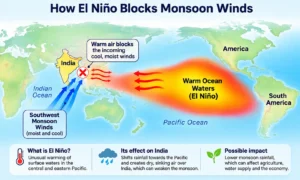
- El Niño is the abnormal warming of surface waters in the central and eastern equatorial Pacific Ocean.
- It is the warm phase of the El Niño–Southern Oscillation (ENSO).
- Normally, trade winds push warm Pacific waters towards Indonesia, encouraging cloud formation and rainfall.
- During El Niño, these winds weaken, shifting rainfall towards the eastern Pacific.
- This can increase sinking, dry air over India and weaken the southwest monsoon.
Why El Niño Does Not Always Cause Drought
- Indian Ocean Dipole (IOD): A positive IOD, with warmer western Indian Ocean waters, can support monsoon rainfall.
- 1997 example: A favourable IOD helped India receive near-normal rainfall despite a strong El Niño.
- 2015 example: A weak IOD response failed to offset El Niño, contributing to deficient rainfall.
- El Niño location: Warming concentrated in the central Pacific may affect India differently from warming near South America.
- Regional circulation: Atmospheric pressure patterns over West Asia and moisture transport from the Arabian Sea can modify rainfall.
- Southern Ocean influence: Changes in winds around Antarctica can affect IOD development.
Role of Other Climate Factors
- Madden–Julian Oscillation (MJO): An eastward-moving tropical rainfall system that influences active and weak monsoon phases.
- Monsoon depressions: Low-pressure systems over the Bay of Bengal distribute rainfall across India.
- Himalayan and land–sea heating: Temperature differences influence monsoon circulation.
- Climate change: Rising temperatures can intensify rainfall extremes and increase uncertainty.
Improvements in Monsoon Forecasting
- India Meteorological Department (IMD) issues seasonal forecasts and updates them as new observations become available.
- Since 2021, IMD has used a multi-model ensemble approach, combining several climate models.
- Ocean temperatures, atmospheric circulation and regional weather patterns are considered together.
- However, accurate all-India seasonal forecasts do not guarantee accurate regional or monthly predictions.
Significance for India
- Agriculture: Rainfall uncertainty affects sowing, crop yields and farmers’ incomes.
- Food inflation: Poor harvests can increase food prices.
- Water security: Weak rainfall reduces reservoir storage and groundwater recharge.
- Energy: Hydropower generation and electricity demand are affected.
- Disaster management: Uneven rainfall can cause droughts and floods within the same season.
Way Forward
- Improve district-level forecasts and early-warning systems.
- Expand irrigation, rainwater harvesting and watershed management.
- Promote drought-resistant crops and climate-resilient farming.
- Strengthen crop insurance and weather-based agricultural advisories.
- Invest in ocean observations, climate research and forecasting technology.
Conclusion
India’s monsoon depends on several interacting oceanic and atmospheric forces; therefore, climate resilience requires better forecasting, scientific planning and reduced dependence on rainfall.
NIPGR and CNGC13 Protein Discovery
TOPIC: (GS3) S&T: THE HINDU
National Institute of Plant Genome Research (NIPGR): Advancing Crop Improvement and Plant Biotechnology
Researchers at NIPGR recently identified a protein called CNGC13, which helps plants communicate during insect attacks.
About NIPGR
- Established: 1998.
- Location: New Delhi.
- Status: Autonomous research institution under the Biotechnology Research and Innovation Council (BRIC).
- Nodal Department: Department of Biotechnology, Ministry of Science and Technology.
- Mandate: Promote plant genomics research, scientific training and agricultural innovation.
Major Research Areas
- Plant genomics: Studies genes controlling plant growth and development.
- Molecular breeding: Develops crops with improved yield and desirable characteristics.
- Stress tolerance: Enhances resistance to drought, salinity, heat and diseases.
- Nutritional genomics: Improves the nutritional quality of crops.
- Genome editing: Uses advanced biotechnology for targeted crop improvement.
About CNGC13 Discovery
- CNGC13 helps plants transmit warning signals from insect-damaged leaves to unaffected leaves.
- This enables other parts of the plant to activate defence responses.
- Significance: Could help develop crops with stronger natural pest resistance.
About BRIC
- An apex autonomous body under the Department of Biotechnology.
- Formed by bringing together 14 DBT autonomous research institutes.
- Promotes collaborative research, indigenous biotechnology and scientific innovation.
Importance for India
- Food security: Supports resilient crop varieties.
- Sustainable agriculture: May reduce pesticide requirements.
- Atmanirbhar Bharat: Strengthens domestic biotechnology research.
- Climate resilience: Helps develop crops adapted to environmental stress.
Conclusion
NIPGR strengthens India’s agricultural future by transforming plant genome research into climate-resilient, nutritious and pest-resistant crops.
BIMSTEC MARITIME SECURITY EXERCISE
TOPIC: (GS3) SEQURITY: THE HINDU
The first BIMSTEC Maritime Security Exercise is being conducted in the Bay of Bengal. The initiative, announced by India at the 6th BIMSTEC Summit in Thailand, aims to improve maritime coordination and regional security.
About the Exercise
- Participants: Bangladesh, Bhutan, India, Myanmar, Nepal, Sri Lanka and Thailand.
- Objective: Strengthen cooperation, operational coordination and maritime security preparedness.
- Theme: Shared Seas, Shared Security and Shared Prosperity.
- Significance: Promotes collective responsibility for a peaceful, secure and inclusive maritime region.

About BIMSTEC
- Full form: Bay of Bengal Initiative for Multi-Sectoral Technical and Economic Cooperation.
- Established: 6 June 1997 through the Bangkok Declaration.
- Headquarters: Secretariat in Dhaka, Bangladesh.
- Members: Seven countries connecting South Asia and Southeast Asia.
- Objective: Promote economic, technical and regional cooperation.
Strategic Importance for India
- Maritime security: Helps address piracy, smuggling and illegal fishing.
- Disaster management: Encourages cooperation during cyclones and maritime emergencies.
- Regional connectivity: Supports trade and secure sea routes.
- Foreign policy: Strengthens India’s Neighbourhood First, Act East and MAHASAGAR approaches.
Challenges
- Challenges: Unequal maritime capabilities, political differences and limited coordination.
- Way forward: Conduct regular exercises, share maritime information, strengthen coastal surveillance and develop joint disaster-response mechanisms.
Conclusion
The BIMSTEC Maritime Security Exercise can transform regional cooperation into collective maritime security, strengthening peace, connectivity and prosperity across the Bay of Bengal.

DOPAMINE
TOPIC: (GS3) SCIENCE AND TECHNOLOGY: THE HINDU
A recent study found that excessive physical training without sufficient rest may disturb dopamine regulation in the hippocampus.
What is Dopamine?
- Dopamine is a chemical messenger (neurotransmitter) produced mainly in the brain.
- It is also a catecholamine and acts as a hormone in certain parts of the body.
- It helps nerve cells communicate and regulates several physical and mental functions.
Major Functions
- Reward and motivation: Encourages goal-oriented behaviour and learning.
- Memory and attention: Supports concentration and information processing.
- Movement: Helps coordinate voluntary muscle activity.
- Emotional regulation: Influences mood and responses to rewarding experiences.
- Body functions: Helps regulate blood pressure, kidney activity and hormone secretion.
Dopamine and Health
- Parkinson’s disease: Linked to the loss of dopamine-producing neurons.
- ADHD: Associated with differences in dopamine signalling and attention regulation.
- Addiction: Repeated substance use can alter dopamine-based reward pathways.
- Rest and recovery: Inadequate recovery after intense exercise may affect brain signalling.
Medical Importance
- Dopamine is used as an intravenous medicine in selected critical-care situations to support blood circulation.
- Medicines affecting dopamine pathways are used to manage Parkinson’s disease and certain psychiatric conditions.
Broader Significance
- Public health: Highlights the importance of sleep, exercise balance and recovery.
- Neuroscience: Improves understanding of learning, behaviour and neurological disorders.
- Sports science: Supports safer training practices and prevention of overtraining.
Conclusion
Dopamine is essential for movement, motivation and brain health, making balanced physical activity and adequate recovery important for overall well-being.