
Table of Contents
ToggleNational Board for Wildlife (NBWL): Structure, Functions, and Wildlife Clearance Framework in India
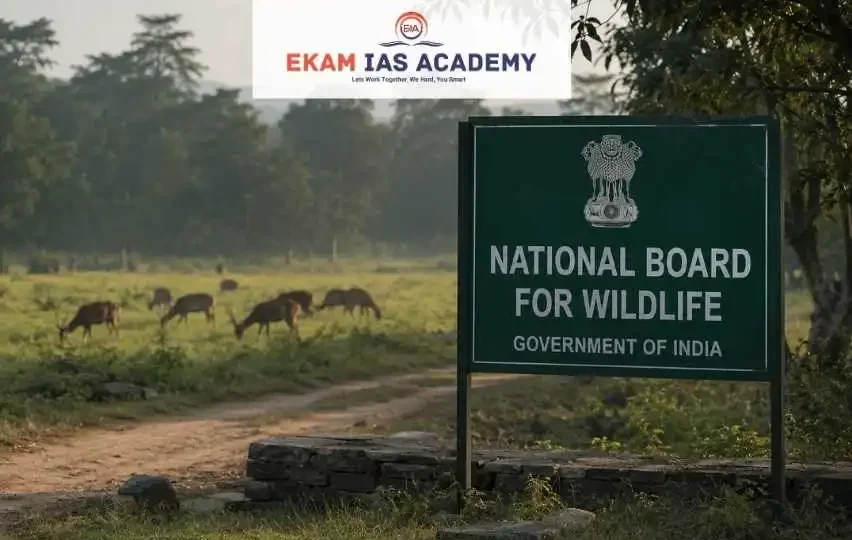
The National Board for Wildlife is the apex statutory body in India responsible for reviewing all wildlife-related matters and approving projects in and around protected areas.
Institutional Evolution:
- Precursor: The body originally existed as the Indian Board for Wildlife (IBWL), an advisory committee formed in 1952.
- Statutory Reorganization: To give the board formal enforcement powers, the central government amended the Wildlife (Protection) Act, 1972 in 2002.
- Formalization: Following this amendment, the National Wildlife Board was formally constituted in its modern statutory form in September 2003. It serves as the institutional backbone for wildlife protection in India.
Institutional Composition of NBWL
The NBWL India framework balances top political leadership with specialized scientific expertise through a large, multi-disciplinary structure:
| Component | Details |
|---|---|
| Chairman | Prime Minister of India |
| Vice-Chairperson | Minister of MoEFCC |
| Expert & Civic Sectors | 15 NGO representatives, 3 MPs, and Scientists |
The board is composed of 47 members. The NBWL Chairman is the Prime Minister of India, while the Union Minister of Environment, Forest and Climate Change (MoEFCC) serves as the Vice-Chairperson. The remainder of the board includes Members of Parliament, chief wildlife wardens of various states, independent ecological scientists, and representatives from prominent conservation NGOs.
Core Functions of the National Board for Wildlife
The baseline National Board for Wildlife functions cover macro-policy formulation and direct regulatory oversight:
- Policy Formulation: Framing national guidelines for the establishment and management of National Parks, Wildlife Sanctuaries, and Conservation Reserves.
- Clearance Mandate: Serving as the supreme clearinghouse for any commercial or infrastructure activities planned inside or within a 10 km radius of any protected area.
- Impact Assessment Review: Reviewing Environmental Impact Assessments (EIAs) for major projects that intersect critical wildlife corridors or eco-sensitive zones (ESZs).
- Periodic Reporting: Preparing and publishing the National Wildlife Action Plan to coordinate conservation targets across individual states.
The Standing Committee of NBWL
Because the full 47-member board is too large to meet frequently, the day-to-day work of processing industrial applications is handled by the Standing Committee of NBWL.
This specialized committee is chaired by the Minister of MoEFCC and consists of the Vice-Chairperson, the Member-Secretary, and up to ten members nominated by the Vice-Chairperson from the main board. This committee exercises the full statutory powers of the main board when reviewing and approving infrastructure clearances, making it the most active regulatory wing for habitat management.
NBWL and the Wildlife Protection Act, 1972
The statutory relationship between the NBWL and the Wildlife (Protection) Act, 1972 is legally binding. Under Section 35 and Section 38 of the Act, no alteration of boundaries of a National Park or a Tiger Reserve can take place without the explicit approval and recommendation of the NBWL. This legal shield ensures that state governments cannot unilaterally reduce the size of protected habitats for commercial development or mining.
Challenges
Despite its strong legal authority, the board faces key criticisms from environmental groups. A major challenge is its high approval rate for industrial projects; the Standing Committee often functions as a clearing agency rather than a conservation filter, occasionally prioritizing highways, railways, and linear transmission lines over habitat integrity.
Way Forward
To address this, the NBWL must shift toward a data-driven approach by using independent ecological impact assessments and real-time spatial mapping before granting clearances. Ensuring independent scientific experts have a stronger voice within the Standing Committee will help the board better balance industrial growth with ecological preservation.
Conclusion
Analyzing the National Board for Wildlife shows that long-term economic security requires protecting our natural ecosystems. Treating wildlife clearances as minor bureaucratic hurdles can weaken conservation safety nets and fracture critical migration corridors. By making its clearing workflows more transparent, filling independent scientist vacancies, and strictly enforcing the Wildlife (Protection) Act, 1972, India can strengthen the NBWL to protect its biodiversity and secure sustainable growth for the future.
UPSC Prelims: PYQs & Practice Questions
Previous Year Questions (Prelims)
UPSC CSE Prelims 2015
Q: Consider the following statements:
1. The National Board for Wildlife (NBWL) is chaired by the Prime Minister of India.
2. The National Ganga River Basin Authority (NGRBA) is chaired by the Prime Minister of India.
Which of the statements given above is/are correct?
A. 1 only
B. 2 only
C. Both 1 and 2
D. Neither 1 nor 2
Answer: C. Both 1 and 2
Explanation:
Both statements are correct. The National Board for Wildlife is chaired by the Prime Minister of India, reflecting the apex-level importance given to wildlife protection and environmental clearance regimes. The erstwhile National Ganga River Basin Authority, now reconstituted as the National Ganga Council, was also chaired by the Prime Minister to coordinate high-level inter-state river rejuvenation.
UPSC CSE Prelims 2012
Q: Consider the following protective governance bodies in India:
1. National Board for Wildlife
2. National Biodiversity Authority
3. Animal Welfare Board of India
Which of the above are statutory bodies established under specific environmental acts?
A. 1 and 2 only
B. 2 and 3 only
C. 1 and 3 only
D. 1, 2 and 3
Answer: D. 1, 2 and 3
Explanation:
All three are statutory bodies. The National Board for Wildlife received formal statutory backing through the 2002 amendment to the Wildlife (Protection) Act, 1972. The National Biodiversity Authority was established under the Biological Diversity Act, 2002. The Animal Welfare Board of India was created under the Prevention of Cruelty to Animals Act, 1960.
Practice Questions
Q: In the context of the operational mechanics of the National Board for Wildlife (NBWL), consider the following statements:
1. State governments can independently alter the geographic boundaries of a National Park or Sanctuary provided the resolution is passed by a two-thirds majority in the state legislative assembly.
2. The Standing Committee of the NBWL is chaired by the Union Minister of Environment, Forest and Climate Change (MoEFCC) and processes routine industrial project clearances near protected zones.
Which of the statements given above is/are correct?
A. 1 only
B. 2 only
C. Both 1 and 2
D. Neither 1 nor 2
Answer: B. 2 only
Explanation:
Statement 1 is incorrect because under the Wildlife Protection Act, 1972, state legislative majorities are insufficient. No boundary alteration of a National Park or Sanctuary can be executed without the explicit recommendation of the NBWL.
Statement 2 is correct. Since the full 47-member board meets infrequently, its specialized Standing Committee, led by the MoEFCC Minister, exercises regulatory powers to process infrastructure applications near protected areas.
Q: The statutory mandate of the National Board for Wildlife (NBWL) requires it to review and approve developmental projects planned within what baseline radius around a notified Eco-Sensitive Zone (ESZ) or Protected Area?
A. 2 kilometers
B. 10 kilometers
C. 50 kilometers
D. 100 kilometers
Answer: B. 10 kilometers
Explanation:
To prevent industrial encroachment from damaging sensitive ecosystems, the Supreme Court and NBWL guidelines require that any project needing environmental clearance within a 10-kilometer radius of a National Park or Wildlife Sanctuary must obtain specific wildlife clearance from the NBWL Standing Committee.
UPSC Mains – Previous Year & Practice Questions
Mains Previous Year Questions
Mains 2023
Question: Dam construction inside ecologically sensitive mountainous terrain introduces structural vulnerabilities. Discuss the role of statutory clearance bodies in balancing infrastructure demands with hazard mitigation.
(Requires assessing NBWL's clearance filter for hydro projects inside wildlife corridors)
Mains 2020
Question: How does the draft Environment Impact Assessment (EIA) Notification differ from the existing EIA Notification, 2006?
(Can connect to how EIA requirements trigger mandatory referrals to the NBWL for projects near sanctuaries)
Mains 2019
Question: Public Interest Litigation (PIL) has been both a boon and a bane for environmental governance in India. Discuss.
(Can evaluate how courts have stepped in to scrutinize or overturn quick clearances issued by the NBWL)
Mains 2014
Question: Enumerate the national targets set for expanding protected areas under the National Action Plan on Climate Change (NAPCC).
Mains 2013
Question: Critically evaluate the institutional efficiency of apex statutory boards in protecting endangered species against illegal poaching and habitat fragmentation.
Mains Practice Questions
[15 Marks | 250 Words]
Question: The Standing Committee of the NBWL is frequently criticized for functioning as a rubber-stamping clearance agency rather than an ecological conservation filter. Critically evaluate this statement in light of recent linear infrastructure approvals in pristine habitats.
[10 Marks | 150 Words]
Question: Analyze how the statutory veto power of the National Board for Wildlife over boundary alterations creates institutional friction between central ecological mandates and state-level economic aspirations.
[15 Marks | 250 Words]
Question: Linear infrastructure projects like highways, railways, and transmission lines present the greatest threat to wildlife conservation in India via habitat fragmentation. Discuss how the NBWL can utilize smart-green infrastructure models to mitigate these impacts.



National Board for Wildlife-FAQs
What is the National Board for Wildlife?
The National Board for Wildlife is India’s apex statutory body responsible for reviewing wildlife-related matters and approving projects in and around protected areas.
Who is the chairman of the National Board for Wildlife?
The Prime Minister of India is the Chairman of the National Board for Wildlife, while the Union Minister of Environment, Forest and Climate Change serves as the Vice-Chairperson.
What are the main functions of the National Board for Wildlife?
The main functions of NBWL include wildlife policy formulation, approval of projects in protected areas, review of environmental impact assessments, and preparation of the National Wildlife Action Plan.
What is the Standing Committee of NBWL?
The Standing Committee of NBWL is a smaller committee chaired by the Union Environment Minister. It handles regular project approvals, wildlife clearances, and protected-area related decisions on behalf of the full board.
Why is NBWL important for UPSC?
NBWL is important for UPSC because it connects with wildlife conservation, protected areas, Wildlife Protection Act 1972, environmental clearances, biodiversity governance, National Parks, Wildlife Sanctuaries and sustainable development.