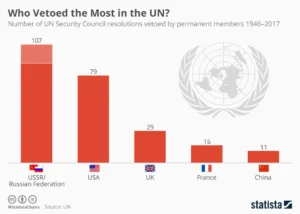
France and Mexico proposed voluntary restraint on UNSC veto use during genocide, crimes against humanity and other mass atrocities. The initiative gained wider support in 2026, with 128 countries backing the declaration, including the United Kingdom.
What is the UNSC Veto?
- The UN Security Council has 15 members:
- 5 permanent members (P5): China, France, Russia, UK and USA.
- 10 non-permanent members, elected for two-year terms.
- Under Article 27, substantive decisions require nine affirmative votes, including the concurring votes of the permanent members.
- A negative vote by any P5 member can block a substantive resolution.
- The veto emerged from the post-World War II structure, where major powers were given a special role in maintaining international peace and security.
Why is Veto Reform Being Demanded?
- Changing global realities: The present Council reflects the power structure of 1945 more than today’s geopolitical and economic realities.
- Under-representation: Africa, Latin America and major developing countries remain inadequately represented in permanent decision-making.
- Council paralysis: Rival positions among P5 members can prevent collective action during major conflicts and humanitarian crises.
- Accountability concerns: Critics argue that a single permanent member can block action even when large-scale civilian suffering is involved.
French-Mexican Initiative
- France and Mexico proposed in 2015 that P5 members should voluntarily refrain from using vetoes in cases involving: Genocide, Crimes against humanity, Large-scale war crimes
- This is voluntary political restraint, not abolition of the veto or a change to the UN Charter.
- France has supported the initiative since 2013, while the UK joined it in 2026, becoming the second P5 member alongside France.
Other Accountability Mechanism
Liechtenstein Veto Initiative
- In 2022, UNGA Resolution 76/262 established a standing mandate for the General Assembly to debate a situation within 10 working days after a UNSC veto.
- This does not remove the veto but increases political accountability and transparency.
Should the Veto Be Abolished?
Arguments for abolition/restriction
- Can reduce institutional paralysis.
- Can improve the Council’s ability to respond to humanitarian emergencies.
- Would strengthen the principle of sovereign equality among UN members.
- Could make global governance more representative.
Arguments against abolition
- Major powers may be unwilling to accept decisions threatening their core interests.
- Removing veto could reduce P5 participation or cooperation.
- Formal abolition requires UN Charter amendment, making it extremely difficult.
- Under Article 108, amendments require two-thirds UNGA approval and ratification by two-thirds of UN members, including all P5 members.
India’s Perspective
- India supports comprehensive UNSC reform, including expansion of permanent and non-permanent membership.
- India, along with G4 partners — Brazil, Germany and Japan, seeks greater representation for developing and emerging powers.
- For India, reform should address both representation and effectiveness, rather than focusing only on the veto.
Conclusion
A more representative and accountable UNSC can preserve great-power cooperation while making collective security more responsive to contemporary global challenges.
As Make in India completes 12 years on September 25, 2026, its impact on manufacturing growth, investment, employment and exports is being assessed.
Make in India
- Launched in 2014, the initiative aimed to make India a global hub for manufacturing, innovation and investment.
- Make in India 2.0 now covers 27 sectors, including 15 manufacturing sectors.
- Major supporting measures include PLI schemes, PM GatiShakti, National Single Window System, FDI reforms, industrial corridors and logistics reforms.
Performance
- Manufacturing Growth: Revised national accounts show manufacturing GVA grew at 10.88% annually from 2022-23 to 2025-26 period.
- Investment: PLI schemes attracted more than ₹2.40 lakh crore investment by March 2026, supporting manufacturing capacity expansion.
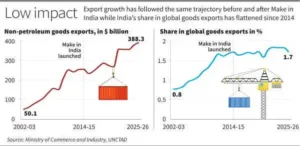
- Exports: Non-petroleum goods exports have expanded considerably since 2014, but India’s merchandise export share remains modest.
- Employment: Manufacturing can generate large-scale semi-skilled and skilled employment, but remains an underdeveloped employment engine nationally.
Sectoral Success of PLI
- PLI has produced visible gains in electronics, pharmaceuticals, automobiles, solar modules and specialty steel.
- By March 2026, PLI-supported sectors reported over ₹22.66 lakh crore production/sales and ₹15.20 lakh crore exports.
- Electronics illustrates the transformation: mobile-phone production has expanded sharply, while domestic manufacturing now meets most domestic demand.
- However, benefits remain concentrated in selected industries rather than spreading uniformly across the manufacturing ecosystem.
Challenges
- Low manufacturing intensity: Manufacturing has not yet achieved the scale required to become a dominant growth and employment driver.
- Investment gap: Weak private investment in new productive capacity can restrict long-term industrial expansion.
- MSME constraints: Smaller firms face difficulties related to finance, technology, infrastructure and market access.
- Global competition: India competes with established manufacturing hubs on cost, logistics, skills and supply-chain efficiency.
Way Forward
- Shift from incentive-led manufacturing towards productivity, innovation and technology-intensive production.
- Integrate MSMEs with large firms and global supply chains through technology, credit and quality-support programmes.
- Improve logistics, industrial infrastructure, power reliability and ease of doing business.
- Encourage deeper domestic value addition in electronics, semiconductors, machinery, chemicals and green technologies.
Conclusion:
Make in India has created important manufacturing capabilities, but sustained private investment, employment and global value-chain integration are essential for converting sectoral gains into broad-based industrial transformation.
Importance
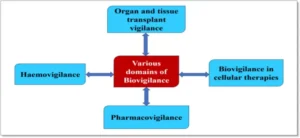
- Patient safety: Early detection of adverse reactions can reduce complications and improve transplant outcomes.
- Evidence-based regulation: Systematic reporting can generate safety data for better regulatory decisions.
- Public confidence: Strong monitoring mechanisms can improve trust in transplantation and related medical procedures.
- Integrated health surveillance: It expands India’s pharmacovigilance framework to cover specialised transplantation-related risks.
Complementary Programmes
- Pharmacovigilance Programme of India (PvPI): Monitors adverse drug reactions and medicine-related safety concerns.
- Materiovigilance Programme of India (MvPI): Monitors adverse events associated with medical devices.
- Biovigilance Programme: Adds focused surveillance of medicines and biological products used in organ and tissue transplantation.
Way Forward
- Promote standardised reporting across transplant centres.
- Train healthcare professionals to identify and report adverse events promptly.
- Use digital databases and data analytics for early safety signals.
- Strengthen coordination among transplant hospitals, regulators and public-health institutions.
Conclusion:
Biovigilance can strengthen India’s transplantation ecosystem by combining patient safety, scientific evidence and responsive health regulation.
The Arunachal Pradesh Cabinet has approved an Empowered High-Level Committee to coordinate the pre-feasibility survey of the Siang Upper Multipurpose Project (SUMP).
About the Project
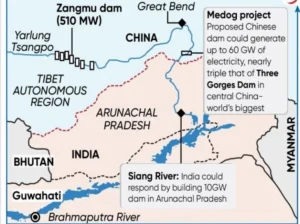
- SUMP is a proposed 11,000 MW multipurpose hydropower project in Arunachal Pradesh.
- It has three designated sites, with two located in Siang district and one in Upper Siang district.
- The Union government accorded it National Project status in 2008, recognising its strategic importance.
- Besides electricity generation, such a project can potentially support water management, flood moderation and regional infrastructure development.
Siang River
- The Siang originates in Tibet, where it is known as the Yarlung Tsangpo.
- It flows eastward for more than 1,000 km before making a major turn around Namcha Barwa.
- After entering Arunachal Pradesh, it is known as the Siang.
- In Assam, it joins the Dibang and Lohit, forming the Brahmaputra.
Significance
- Energy security: Adds substantial renewable electricity generation capacity.
- Regional development: Can improve roads, connectivity, employment and supporting infrastructure.
- Strategic importance: Strengthens infrastructure in a sensitive border region.
- Water management: Reservoir-based regulation could contribute to downstream water management.
Concerns
- Large dams may affect biodiversity, forests, river ecology and local livelihoods.
- Seismic risks, landslides and downstream flood impacts require careful assessment.
- Rehabilitation and resettlement must adequately address affected communities.
Conclusion:
SUMP can strengthen India’s energy and border infrastructure, but sustainable development requires rigorous environmental, geological and social assessments.
The Ministry of Defence has signed a contract with Bharat Dynamics Limited (BDL) for 160 SAT-SAAW systems. The procurement will strengthen the Indian Air Force’s precision-strike and stand-off attack capabilities.
About SAT-SAAW
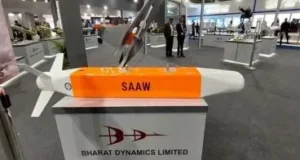
- Satellite Smart Anti-Airfield Weapon (SAT-SAAW) is an air-to-ground precision-guided glide weapon designed to attack enemy airfield infrastructure from a stand-off distance.
- It has been designed and developed by DRDO, with around 60% indigenous content.
- It can be launched from platforms including Jaguar, Hawk and Su-30MKI aircraft.
- Deliveries are scheduled during 2027–28 and 2028–29.
Key Features and Significance
- Stand-off capability: Enables aircraft to engage targets without entering the immediate range of hostile air-defence systems.
- Precision strike: Guided targeting improves accuracy against designated military infrastructure.
- Operational flexibility: Compatibility with multiple aircraft platforms expands its potential deployment options.
- Indigenisation: Domestic development reduces dependence on foreign weapon systems and strengthens India’s defence-industrial base.
- Deterrence: Improved precision-strike capabilities can strengthen India’s ability to respond to threats while supporting credible defence preparedness.
Development Journey
- The indigenous SAAW programme was approved in 2013.
- Flight testing was conducted between 2016 and 2021.
- The weapon was inducted into the Indian Air Force in 2021.
- The latest procurement represents a further step towards large-scale domestic production.
Conclusion:
SAT-SAAW reflects India’s shift towards indigenous, precision-based and network-enabled defence capabilities under Atmanirbhar Bharat.