
Table of Contents
ToggleHow AI Training Models Could Compromise Privacy
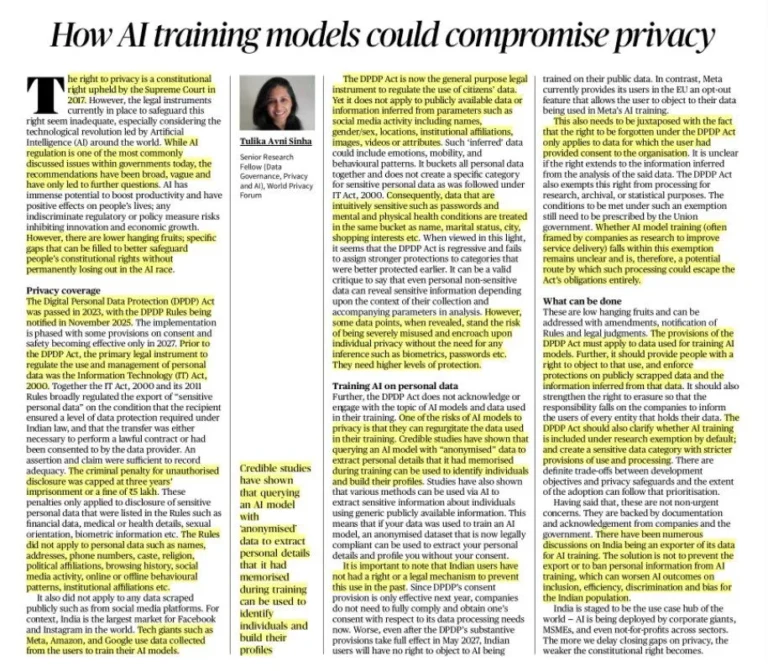
Artificial Intelligence (AI) is transforming productivity, research and digital services, but the use of personal data to train AI models raises serious concerns about privacy and data protection. In India, the constitutional right to privacy was recognised by the Supreme Court in 2017. However, the rapid development of AI has created new challenges that existing privacy safeguards may not fully address.
Privacy Concerns in AI Training
India’s Digital Personal Data Protection (DPDP) Act, 2023 is the primary legal framework governing the processing of digital personal data. The article highlights concerns about whether the existing framework adequately addresses AI-specific risks.
AI models can be trained using large datasets that may contain personal information. Studies have also indicated that AI models can sometimes extract or reproduce information that they encountered during training.
This creates risks such as
- Unauthorised extraction of personal information.
- Re-identification of individuals from supposedly anonymised data.
- Profiling based on sensitive or inferred information.
- Use of personal data without meaningful consent.
- Difficulty for individuals in knowing whether their information was used for AI training.
The Challenge of Inferred Data
The article highlights an important distinction between directly collected personal information and “inferred” data.
AI systems can generate information about individuals based on patterns in existing datasets. Such information may include sensitive characteristics or behavioural patterns.
This raises a key question: Should information inferred by AI receive the same privacy protection as information directly provided by an individual?
The article argues that the DPDP framework may need stronger safeguards for such categories of data.
AI Training and the Right to Object
Another concern is whether individuals should have a meaningful right to object to the use of their personal data for AI training.
The article also highlights uncertainty regarding the application of exemptions for research, archival and statistical purposes when AI models are trained using personal data.
What Can Be Done?
The article suggests several measures:
- Clear provisions regulating AI training using personal data.
- Stronger rights for individuals to object to AI-based processing.
- Greater transparency regarding the sources of training data.
- Clearer rules for anonymised and inferred data.
- Stronger protection for sensitive personal information.
- Greater accountability for companies developing and deploying AI systems.
Conclusion
AI innovation should not come at the cost of the constitutional right to privacy. India needs a regulatory framework that balances technological innovation with individual rights. As AI increasingly becomes embedded in governance, business and everyday life, stronger transparency, consent, accountability and data-protection mechanisms will be essential to ensure that technological progress remains rights-respecting.
Vocabulary
1. Data Inference – Deriving personal information from existing data.
2. Data Scraping – Automated collection of information from digital platforms.
3. Right to Erasure – Right to seek deletion of personal data under applicable law.
Prelims MCQs
MCQ 1
Consider the following statements:
1. The Supreme Court recognised privacy as a Fundamental Right in K.S. Puttaswamy (2017).
2. The DPDP Act, 2023, applies exclusively to government-held personal data.
3. AI models can potentially reconstruct personal information from training datasets.
Which are correct?
A) 1 and 2 only
B) 1 and 3 only
C) 2 and 3 only
D) 1, 2 and 3
Answer: B
UPSC Mains Question
“AI-driven innovation raises significant data privacy concerns.” Examine India’s regulatory challenges and suggest safeguards. (10 Marks)
Frequently Asked Questions (FAQs)
Why can AI training create privacy risks?
AI models may be trained on large datasets containing personal information, creating risks of unauthorised extraction, profiling or re-identification.
What is the DPDP Act?
The Digital Personal Data Protection Act, 2023 provides India’s legal framework for regulating the processing of digital personal data.
What is inferred data?
Inferred data is information generated about an individual by analysing existing data, rather than information directly provided by that individual.
Why is anonymised data not always risk-free?
The article highlights that AI models may sometimes extract information from datasets considered anonymised, potentially allowing individuals to be identified or profiled.
How can India balance AI innovation and privacy?
India can strengthen transparency, consent, individual rights, accountability and safeguards governing the use of personal data for AI training.