Table of Contents
ToggleYouth Discontent and the Changing Face of Protest
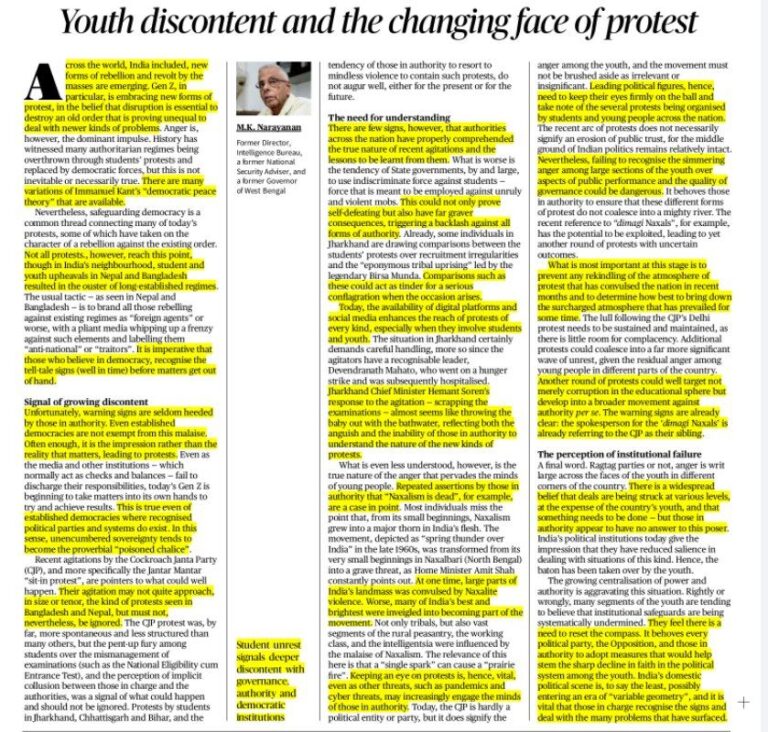
Across the world, youth and student protests are emerging as an important expression of public dissatisfaction. The changing nature of protests reflects concerns related to governance, unemployment, institutional credibility and the responsiveness of democratic systems. The spread of digital platforms has also transformed how young people organise, communicate and mobilise.
Rising Youth Discontent
The article highlights growing concerns among young people over the functioning of democratic institutions. Issues such as unemployment, governance and institutional accountability can contribute to dissatisfaction when citizens feel that their concerns are not being adequately addressed.
Student and youth protests have increasingly become visible across different regions. These movements demonstrate that young citizens are willing to participate directly in public affairs when they believe established mechanisms are not sufficiently responsive.
Changing Nature of Protests
Contemporary protests differ from many traditional movements in their organisation and speed.
Digital platforms and social media allow young people to:
- Mobilise participants rapidly
- Share information widely
- Coordinate demonstrations
- Draw national attention to local grievances
- Build support across geographical boundaries
However, the article also highlights that protests can become difficult to manage when grievances escalate and authorities respond primarily through coercive measures.
Need for Understanding and Dialogue
A key concern is the tendency to treat public mobilisation only as a law-and-order issue. Excessive use of force can potentially deepen dissatisfaction and increase confrontation.
Democratic governance requires authorities to understand the underlying grievances behind protests and create mechanisms for meaningful dialogue.
Timely grievance redressal, institutional accountability and communication can help address legitimate concerns before they develop into larger conflicts.
Institutional Credibility
The credibility of democratic institutions depends not only on elections but also on their ability to respond to citizens between elections.
Institutions need to demonstrate:
- Transparency
- Accountability
- Responsiveness
- Accessible grievance mechanisms
- Respect for peaceful participation
For young citizens in particular, meaningful participation can strengthen their confidence in democratic institutions.
Way Forward
The article points towards a need for sustained engagement with youth. Governments and institutions can strengthen democratic participation by improving education and employment opportunities, responding to grievances and maintaining channels for peaceful dialogue.
Authorities must also distinguish between legitimate peaceful protest and activities involving violence or serious disruption.
Conclusion
The changing face of youth protest reflects broader questions about governance, democratic participation and institutional credibility. Digital platforms have made mobilisation faster and more widespread, while unresolved grievances can intensify public dissatisfaction. A responsive democratic system therefore needs dialogue, accountability and effective grievance redressal to maintain public trust.
Vocabulary
1. Discontent – Dissatisfaction with existing conditions
2. Dissent – Expression of disagreement with authority
3. Institutional Credibility – Public trust in institutions
Prelims MCQs
MCQ 1
Consider the following statements:
1. Article 19 protects the right to assemble peacefully and without arms.
2. The right to protest is absolute and cannot be reasonably restricted.
3. Freedom of speech and expression is protected under Article 19.
Which are correct?
A) 1 and 3 only
B) 2 only
C) 1 and 2 only
D) 1, 2 and 3
Answer: A
UPSC Mains Question
“Youth protests can serve as indicators of deeper governance and institutional challenges.”
Discuss. (10 Marks)
Frequently Asked Questions (FAQs)
Why are youth and student protests increasing?
Youth protests can reflect concerns over governance, unemployment, institutional credibility and unresolved grievances. The article highlights growing dissatisfaction when young people feel that democratic institutions are not responding adequately to their concerns.
How has social media changed youth protests?
Digital platforms have made protests faster and easier to organise. They enable young people to:
- Mobilise participants quickly
- Share information widely
- Coordinate activities
- Draw attention to local issues at a wider level
Why is dialogue important in managing protests?
The article emphasises understanding the underlying grievances behind protests. Dialogue can provide an avenue for addressing concerns and preventing dissatisfaction from escalating into larger conflicts.
Can excessive use of force increase public unrest?
The article argues that excessive reliance on coercive measures can intensify dissatisfaction and confrontation. A democratic response should combine public order measures with dialogue and grievance redressal.
What is the role of democratic institutions in addressing youth discontent?
Democratic institutions need to demonstrate responsiveness, accountability and transparency. Accessible grievance-redressal mechanisms can help citizens raise concerns through institutional channels.
Source From : The Hindu
Great-Power Rivalry and the Changing Global Order
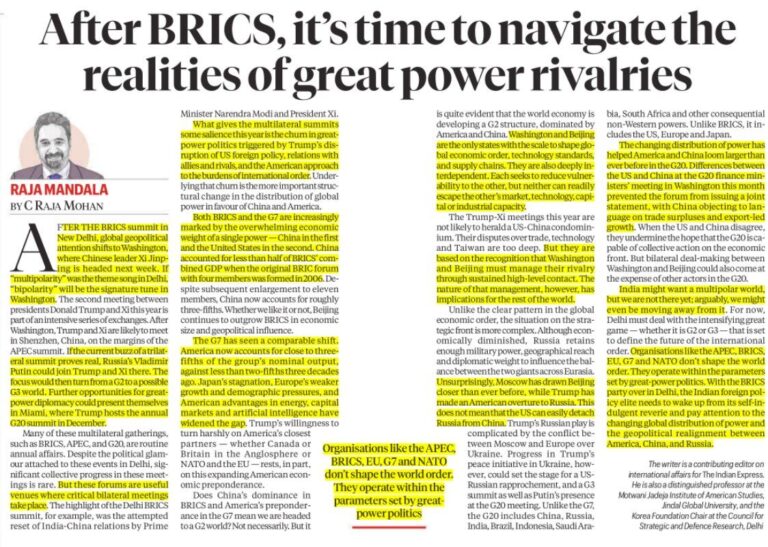
The international system is undergoing a significant transformation as great-power rivalry, particularly between the United States and China, increasingly shapes global politics and economics. While platforms such as BRICS, G20, G7 and APEC provide spaces for dialogue and cooperation, their functioning remains influenced by broader competition among major powers.
Rise of U.S.–China Competition
The U.S.–China relationship has become a central factor in the changing global order. The two countries possess significant economic and technological capabilities and are deeply interconnected through trade and supply chains.
Their competition extends beyond economics to areas such as:
- Technology and industrial capacity
- Global economic standards
- Supply-chain resilience
- Strategic influence
- Regional security
Managing this rivalry has implications for the wider international system.
Changing Balance of Global Power
The article highlights the growing economic weight of China within BRICS, while the United States remains highly influential within the G7. This reflects the emergence of different concentrations of power across international groupings.
At the same time, countries such as Russia, India, Brazil and South Africa bring distinct interests to these platforms. Consequently, multilateral organisations must navigate differences among their members while attempting to achieve collective outcomes.
Role of Multilateral Platforms
Institutions such as BRICS, G20, G7, APEC and NATO operate within the broader framework of great-power politics.
These platforms can facilitate:
- Diplomatic engagement
- Economic cooperation
- Crisis management
- Discussion of global challenges
- Coordination among member states
However, geopolitical competition can also make consensus difficult, particularly when major powers have conflicting strategic interests.
India’s Strategic Challenge
For India, the changing distribution of global power creates both opportunities and challenges. India participates in multiple platforms, including BRICS, G20 and other international groupings, while maintaining engagement with different power centres.
The central challenge is to preserve strategic autonomy while responding to the evolving relationship between the US, China and Russia.
India must therefore navigate great-power competition without allowing its foreign-policy choices to become excessively dependent on any single power centre.
Conclusion
The emerging global order is characterised by great-power rivalry, shifting economic weight and multiple centres of influence. U.S.–China competition will remain an important factor shaping international relations, while multilateral platforms will continue to provide avenues for dialogue.
For India, maintaining strategic autonomy and flexible engagement with multiple power centres will remain important as the distribution of global power continues to change.
Vocabulary
1. Great-Power Rivalry – Competition among major global powers
2. Strategic Autonomy – Independent pursuit of national interests
3. Multipolarity – Distribution of power among several major powers
Prelims MCQs
MCQ 1
Consider the following statements:
1. India is a member of both BRICS and G20.
2. India is a member of the G7.
3. BRICS and G20 are intergovernmental groupings rather than treaty-based military alliances.
Which are correct?
A) 1 and 3 only
B) 1 and 2 only
C) 2 and 3 only
D) 1, 2 and 3
Answer: A
UPSC Mains Question
Frequently Asked Questions (FAQs)
What is great-power rivalry?
Great-power rivalry refers to strategic, economic and geopolitical competition among major powers seeking to protect and expand their influence in the international system.
Why is U.S.–China competition important for the global order?
The United States and China have significant economic, technological and strategic influence. Their competition affects global trade, technology standards, supply chains and international economic governance.
What role do BRICS, G20, G7 and APEC play?
These platforms provide avenues for diplomatic engagement, economic cooperation and discussion of global issues. However, their functioning is also influenced by broader great-power competition.
How is the global balance of power changing?
The global system is witnessing a shift towards multiple centres of power. China has gained greater economic weight, while the US continues to exercise substantial influence through institutions and alliances such as the G7 and NATO.
What is the significance of BRICS in the changing global order?
BRICS provides a platform for emerging economies to cooperate and promote greater representation in global governance. Its growing economic and geopolitical importance also reflects the broader movement towards a multipolar international system.