Table of Contents
ToggleUntouchability and the Constitutional Idea of ‘Purity’
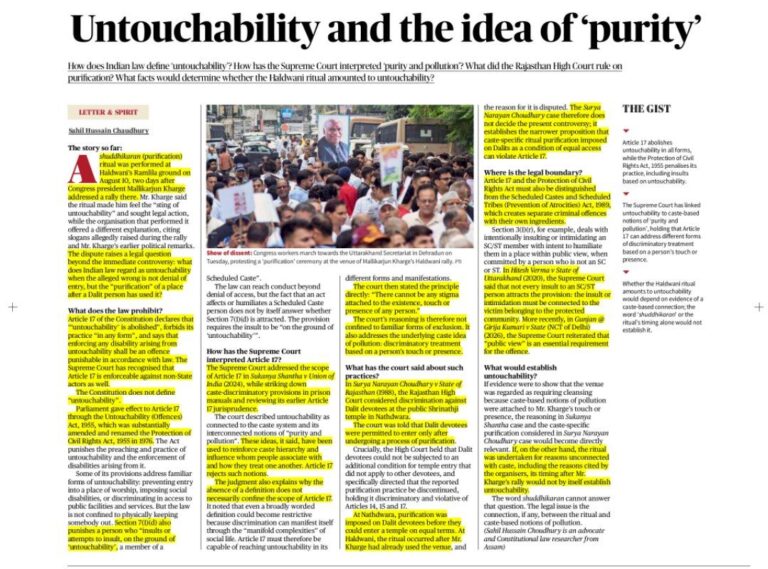
The recent controversy over a “shuddhikaran” (purification) ritual in Haldwani raises an important constitutional question: can an act amount to untouchability even when there is no direct denial of entry or access? The issue requires examining Article 17, the Protection of Civil Rights Act, and the Supreme Court’s interpretation of caste-based notions of purity and pollution.
What Does Article 17 Prohibit?
Article 17 of the Constitution abolishes untouchability and prohibits its practice in any form. Unlike several other Fundamental Rights, Article 17 operates against both State and non-State actors.
The Constitution does not specifically define “untouchability”. Its legal meaning has therefore developed through legislation and judicial interpretation.
The Protection of Civil Rights Act, 1955 penalises the enforcement of disabilities arising from untouchability and covers practices connected with social exclusion and caste-based discrimination.
How Has the Supreme Court Interpreted Untouchability?
In Sukanya Shanthi v. Union of India (2024), the Supreme Court examined caste-discriminatory practices in prisons and recognised that notions of purity and pollution can contribute to caste-based discrimination.
The Court stressed that Article 17 is concerned with discriminatory practices connected to a person’s caste identity and should not be narrowly understood only in terms of physical exclusion.
What About Purification Rituals?
The Haldwani incident raises a different but related question: if a place is “purified” after being used by a person belonging to a particular caste, does the act communicate that the person has polluted the space?
The answer would depend on the facts and context.
Relevant considerations could include:
- Whether the ritual was specifically linked to the person’s caste
- Whether notions of caste-based purity or pollution motivated the act
- Whether the act was intended to impose a social disability
- Whether the person was treated differently because of caste
- Whether the venue was treated as requiring purification because of their presence
Rajasthan High Court and the Purification Question
The article refers to State of Rajasthan v. State of Rajasthan (1988), concerning discrimination against Dalit devotees at a public temple.
It highlights the importance of examining whether purification practices are directed specifically at Dalit presence and whether they create discriminatory disabilities.
At the same time, the article notes that the Surya Narayan Choudhary case does not by itself conclusively determine the Haldwani controversy.
Article 17 and Other Laws
Article 17 must also be distinguished from laws dealing with other forms of discrimination.
The Scheduled Castes and Scheduled Tribes (Prevention of Atrocities) Act, 1989 addresses specific caste-based offences, while the Protection of Civil Rights Act deals with disabilities arising from untouchability.
Thus, the legal characterisation of an incident depends on the precise conduct, intention, caste connection and surrounding circumstances.
Conclusion
The Haldwani controversy highlights that untouchability is not merely about denying physical entry. Caste-based notions of purity, pollution and social exclusion can also raise serious constitutional concerns.
However, whether a particular purification ritual legally amounts to untouchability cannot be determined from the ritual alone. The purpose, caste-based connection, manner of performance and resulting social disability would be crucial in applying Article 17.
Vocabulary
1. Untouchability – Caste-based exclusion or stigma
2. Purity–Pollution – Caste notion of ritual superiority/inferiority
3. Civil Rights – Rights guaranteed against discriminatory disabilities
4. Caste Discrimination – Unequal treatment based on caste
5. Social Stigma – Negative social marking of a group
Prelims MCQs
MCQ 1
With reference to Article 17 of the Indian Constitution, consider the following statements:
- It abolishes untouchability.
- It prohibits its practice in any form.
- It applies only to discrimination by the State.
Which of the statements given above is/are correct?
A) 1 and 2 only
B) 2 only
C) 1 and 3 only
D) 1, 2 and 3
Answer: A) 1 and 2 only
MCQ 2
Consider the following pairs:
| Provision/Law | Subject |
|---|---|
| Article 17 | Abolition of untouchability |
| Protection of Civil Rights Act, 1955 | Disabilities arising from untouchability |
| SC/ST (Prevention of Atrocities) Act, 1989 | Specific caste-based offences |
Which of the pairs given above are correctly matched?
A) 1 only
B) 1 and 2 only
C) 2 and 3 only
D) 1, 2 and 3
Answer: D) 1, 2 and 3
UPSC Mains Question
“Article 17 cannot be understood merely as a prohibition on physical exclusion; caste-based notions of purity, pollution and social disability may also raise constitutional concerns.” Discuss.
Key points to cover:
- Article 17 — abolition of untouchability
- Constitution does not define “untouchability”
- Protection of Civil Rights Act, 1955
- Caste-based notions of purity and pollution
- Supreme Court interpretation
- Distinction between Article 17 and SC/ST (Prevention of Atrocities) Act, 1989
- Haldwani purification controversy — importance of facts, context and caste connection
- Constitutional values of equality, dignity and social justice
Frequently Asked Questions (FAQs)
What does Article 17 of the Constitution prohibit?
Article 17 abolishes untouchability and its practice in any form. It makes enforcement of disabilities arising from untouchability punishable under law.
Does the Constitution define “untouchability”?
No. The Constitution does not provide a specific definition. Its scope has developed through legislation and judicial interpretation.
Can a purification ritual amount to untouchability?
It may raise an Article 17 issue if the ritual is specifically based on caste-related notions of purity or pollution. The facts and circumstances would determine its legal character.
What is the Protection of Civil Rights Act, 1955?
The Act gives effect to Article 17 by penalising the enforcement of disabilities arising from untouchability. It addresses various forms of caste-based social exclusion.
What facts would determine whether the Haldwani ritual amounted to untouchability?
Important factors include the caste identity of the person, reason for the purification, whether caste-based pollution was alleged, and whether any disability or discriminatory treatment resulted.
Source From : The Hindu
Indian Economy: Resilient Growth Amid Rising Risks
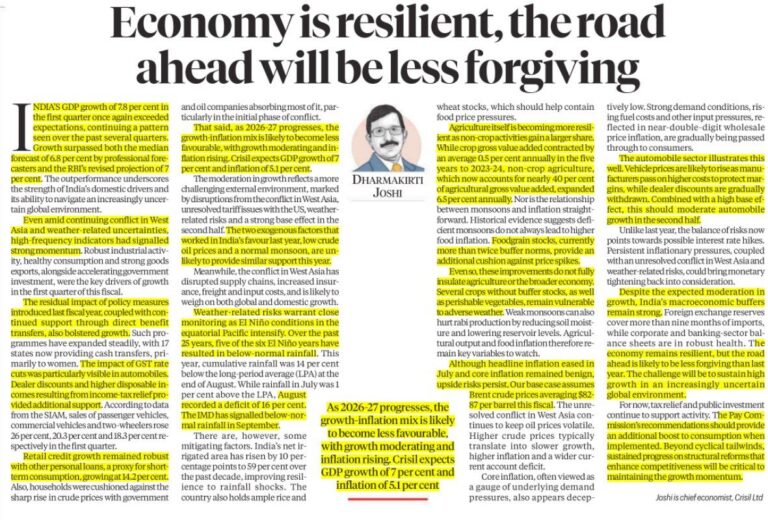
India’s economy has continued to demonstrate resilience despite geopolitical tensions, weather-related uncertainties and global economic disruptions. GDP growth has remained strong, but the road ahead could become more challenging as inflationary pressures and external risks increase.
Strong GDP Growth Supports the Economy
India’s GDP growth reached 7.8% in the first quarter, exceeding market expectations and continuing a strong growth trend.
The article highlights that domestic drivers remain important, particularly:
- Robust industrial activity
- Healthy consumption
- Strong goods exports
- Government investment
- Expanding retail credit
Retail credit growth has remained strong, supporting household consumption and economic activity.
Fiscal Measures and Public Investment
Recent fiscal measures have continued to support economic momentum. Income-tax relief, higher transfers and government spending have helped sustain domestic demand.
Public investment and government programmes have also supported economic activity, providing a cushion against weaker external conditions.
Growth-Inflation Outlook
The article expects the growth-inflation mix to become less favourable in 2026-27, with growth moderating while inflation rises.
It cites expectations of around 7% GDP growth and 5.1% inflation.
Higher crude oil prices, supply disruptions and geopolitical tensions could create additional inflationary pressures.
Monsoon and Agricultural Risks
Weather conditions remain an important factor for India’s economy. The article highlights concerns surrounding El Niño conditions and rainfall variability.
Agriculture is becoming more resilient, with non-crop activities accounting for a larger share of agricultural Gross Value Added. However, weak monsoons can still affect crop production, reservoir levels and food inflation.
West Asia Conflict and Oil Prices
The continuing conflict in West Asia poses risks through higher crude oil prices, shipping disruptions and increased insurance and freight costs.
Since India is a major importer of crude oil, sustained increases in oil prices could widen the current account deficit and increase domestic inflation.
External Sector Remains Strong
Despite global uncertainties, India’s foreign exchange reserves remain comfortable, covering more than nine months of imports.
The banking and corporate sectors also remain relatively healthy, providing important macroeconomic buffers against external shocks.
What Lies Ahead?
The article suggests that India’s strong buffers may not be sufficient if global risks intensify.
Sustaining growth will require continued public investment, stronger domestic demand and structural reforms that improve competitiveness and productivity.
Conclusion
India’s economy remains resilient, supported by strong domestic demand, government investment, healthy financial conditions and comfortable foreign exchange reserves.
However, the outlook is becoming less forgiving. Inflation, crude oil prices, geopolitical tensions, weather risks and global trade disruptions could challenge growth in 2026-27. India must therefore combine short-term economic support with structural reforms to maintain sustainable growth.
Vocabulary
1. GDP Growth – Expansion of economic output
2. Core Inflation – Inflation excluding volatile items
3. Macroeconomic Buffer – Cushion against economic shocks
4. El Niño – Pacific warming affecting monsoon
5. Structural Reforms – Long-term economic policy changes
Prelims MCQs
MCQ 1
With reference to the Indian economy, consider the following statements:
- India’s GDP growth reached 7.8% in Q1.
- Strong domestic demand has supported economic growth.
- Retail credit growth has contributed to household consumption.
Which of the statements given above is/are correct?
A) 1 only
B) 1 and 2 only
C) 2 and 3 only
D) 1, 2 and 3
Answer: D) 1, 2 and 3
MCQ 2
Which of the following factors can pose risks to India’s economic growth according to the article?
- Geopolitical tensions
- Crude oil price shocks
- Weather-related risks
- Global trade uncertainty
Select the correct answer using the code below:
A) 1 and 2 only
B) 1, 2 and 3 only
C) 2, 3 and 4 only
D) 1, 2, 3 and 4
Answer: D) 1, 2, 3 and 4
UPSC Mains Question
“India’s economy has demonstrated resilience despite global uncertainties, but sustaining high growth will require managing both domestic and external risks.” Discuss.
Key points to cover:
- 7.8% GDP growth highlighted in the article
- Strong domestic consumption and industrial activity
- Government investment and fiscal support
- Robust retail credit growth
- Contained inflation but emerging price pressures
- West Asia conflict and crude oil risks
- Weather and El Niño-related uncertainties
- Merchandise trade deficit
- Cushion from services exports and remittances
- Comfortable foreign exchange reserves
- Need for structural reforms and productivity enhancement
- Balance between growth, inflation and macroeconomic stability
Frequently Asked Questions (FAQs)
What is driving India’s economic growth?
Strong domestic demand, industrial activity, consumption, exports, government investment and retail credit are important drivers of India’s current economic momentum.
What is the expected growth-inflation outlook for 2026-27?
The article expects growth to moderate towards 7%, while inflation could rise to around 5.1%, creating a less favourable growth-inflation combination.
How can West Asia tensions affect India’s economy?
Higher crude oil prices, shipping costs and supply disruptions can increase inflation and widen India’s external-sector pressures.
Why is the monsoon important for the Indian economy?
The monsoon influences agricultural production, food prices, rural demand and reservoir levels. Weak rainfall can therefore create both economic and inflationary risks.
What can help sustain India’s economic growth?
Continued public investment, strong domestic demand and structural reforms to improve competitiveness and productivity can help maintain India’s growth momentum.