Table of Contents
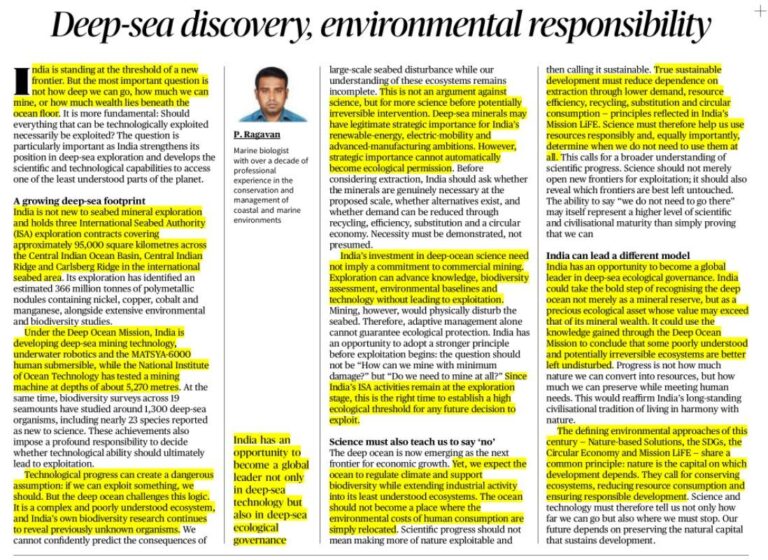
ToggleDeep-Sea Discovery and Environmental Responsibility: India’s Path to Sustainable Ocean Governance
India is entering a new phase of deep-sea exploration, driven by scientific research, seabed mineral exploration and advanced underwater technologies. However, the growing ability to access the deep ocean also raises an important question: Does technological capability automatically justify exploitation? The article highlights the need to balance scientific progress with ecological responsibility.
India’s Growing Deep-Sea Footprint
India has undertaken exploration activities through International Seabed Authority (ISA) contracts covering approximately 95,000 square kilometres in the Central Indian Ocean Basin, Central Indian Ridge and Carlsberg Ridge. These areas contain polymetallic nodules with minerals such as nickel, copper, cobalt and manganese.
Under the Deep Ocean Mission, India is developing deep-sea mining technologies, underwater robotics and the MATSYA-6000 human submersible. NIOT has also tested mining technology at significant ocean depths.
At the same time, biodiversity research has identified numerous deep-sea organisms, highlighting how much remains unknown about these ecosystems.
Environmental Concerns
Deep-sea mining can physically disturb the seabed and potentially affect poorly understood ecosystems. Since the consequences of large-scale seabed disturbance remain uncertain, ecological impacts cannot simply be assumed to be manageable.
The article therefore argues for precaution, adaptive management and scientific assessment before large-scale extraction.
Mineral demand for renewable energy, electric mobility and advanced manufacturing may increase the strategic importance of seabed resources. However, strategic importance alone should not become an ecological justification for exploitation.
Sustainable Development and Circular Economy
The article connects deep-sea resource use with broader principles of sustainable development and circular economy. Greater recycling, resource efficiency and substitution can reduce dependence on extraction.
India’s Mission LiFE is also highlighted as an approach encouraging responsible resource consumption.
India as a Leader in Deep-Sea Governance
India has an opportunity to become a global leader not only in deep-sea technology but also in deep-sea ecological governance. Scientific research can help determine where extraction may be appropriate and where ecosystems should remain undisturbed.
The central principle is that progress should be measured not only by how much humanity can extract, but also by how effectively nature can be preserved.
Conclusion
India’s deep-sea ambitions offer significant scientific and economic opportunities, but they also carry ecological responsibilities. A balanced approach based on scientific evidence, biodiversity protection, circular economy principles and precautionary decision-making can help ensure that deep-ocean development remains sustainable.
Vocabulary
1. Polymetallic Nodules – Seabed deposits containing multiple valuable metals
2. Natural Capital – Natural resources and ecosystems that support human well-being
3. Circular Economy – Reducing resource extraction through reuse, recycling and efficiency
Prelims MCQs
MCQ 1
Consider the following statements:
1. Polymetallic nodules may contain nickel, cobalt, copper and manganese.
2. India undertakes seabed exploration in areas regulated by the International Seabed Authority.
3. Deep-sea mining has no potential impact on marine ecosystems.
Which are correct?
A) 1 and 2 only
B) 1 and 3 only
C) 2 and 3 only
D) 1, 2 and 3
Answer: A
UPSC Mains Question
“India’s deep-sea ambitions must balance strategic mineral requirements with the protection of fragile marine ecosystems.” Discuss. (10 Marks)
Frequently Asked Questions (FAQs)
What is India’s Deep Ocean Mission?
It is an initiative focused on deep-sea technologies, underwater exploration, biodiversity research, seabed resources and related ocean science.
What are polymetallic nodules?
They are mineral-rich deposits found on the deep seabed containing resources such as nickel, copper, cobalt and manganese.
Why is deep-sea mining an environmental concern?
Mining can physically disturb the seabed and affect ecosystems whose biodiversity and ecological processes are still not fully understood.
What is the precautionary approach to deep-sea exploration?
It emphasises scientific assessment and ecological safeguards before undertaking activities whose environmental consequences may be difficult to reverse.
How can India balance resource needs and conservation?
Through recycling, resource efficiency, substitution, scientific monitoring, biodiversity assessment and responsible extraction where necessary.
Source From : The Hindu
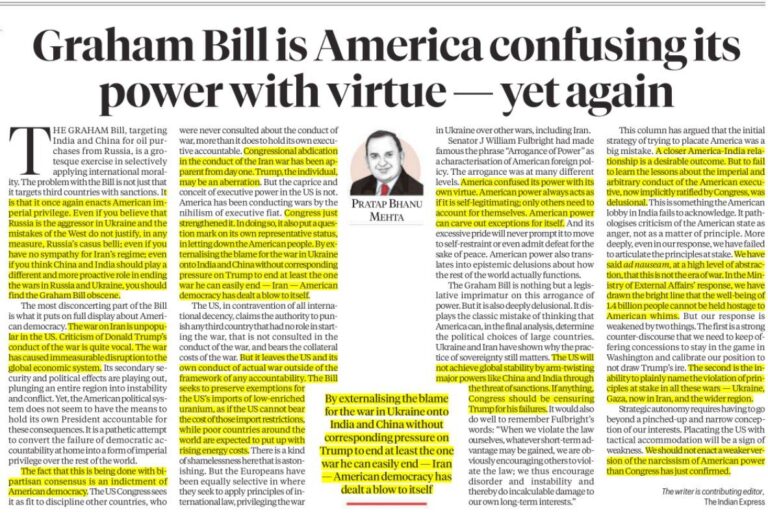
Graham Bill: U.S. Sanctions, Tariff Powers and India’s Strategic Autonomy
The Lindsey O. Graham Sanctioning Russia and Iran Act of 2026 has significant implications for India’s foreign policy, energy security and trade relations with the United States. The legislation was passed by both chambers of the U.S. Congress and signed into law by President Donald Trump on September 18, 2026. It targets Russia’s energy and defence sectors and gives the U.S. President expanded authority to impose tariffs on major purchasers of Russian energy.
What Does the Graham Bill Mean for India?
India has remained a major purchaser of Russian crude oil. The new legislation therefore creates a potential conflict between India’s energy-security requirements and U.S. efforts to increase economic pressure on Russia.
The law authorises tariffs of up to 100% on imports from countries among the largest buyers of Russian oil or gas and countries involved in sanctions evasion. India and China are among the countries potentially affected.
India’s Energy Security Challenge
India is heavily dependent on imported crude oil. Russian supplies became increasingly important after 2022 because discounted Russian crude provided refiners with an additional source of energy.
A sharp reduction in Russian imports could affect energy costs, domestic inflation and trade flows. At the same time, continuing Russian purchases could expose Indian exports to possible U.S. tariff pressure.
This creates a complex policy challenge involving energy security, trade interests and diplomatic relations.
Implications for India–U.S. Relations
The legislation could add pressure to already sensitive India–U.S. trade negotiations. India has warned that such tariffs could affect bilateral relations and has emphasised its need to protect national energy security.
The issue also highlights the increasing use of economic instruments as tools of foreign policy, where tariffs and sanctions can influence the strategic choices of other countries.
Strategic Autonomy and the Way Forward
For India, the situation reinforces the importance of strategic autonomy. India can reduce vulnerability by diversifying energy suppliers and export markets while strengthening domestic economic resilience.
At the same time, sustained diplomatic engagement with Washington, Moscow and other partners can help India manage competing interests.
Conclusion
The Graham Bill illustrates how sanctions and tariffs can extend beyond bilateral economic relations and influence broader geopolitical choices. For India, the challenge lies in balancing energy security, economic interests, strategic autonomy and major-power relationships in an increasingly contested international environment.
Prelims MCQs
MCQ 1
Consider the following statements regarding the Graham Bill:
- It targets Russia’s energy and defence sectors.
- It provides authority for tariffs of up to 100% against qualifying countries.
- Its provisions can have implications for countries importing Russian energy.
Which of the statements given above are correct?
A) 1 and 2 only
B) 2 and 3 only
C) 1 and 3 only
D) 1, 2 and 3
Answer: D
UPSC Mains Question
“The increasing use of sanctions and tariffs as instruments of foreign policy presents new challenges for India’s strategic autonomy.” Discuss with reference to the U.S. sanctions framework targeting Russian energy trade.
Frequently Asked Questions (FAQs)
What is the Graham Bill?
The Lindsey O. Graham Sanctioning Russia and Iran Act of 2026 strengthens sanctions against Russia and Iran and expands U.S. presidential authority over tariffs targeting major purchasers of Russian energy.
Why is the Graham Bill important for India?
India is a major importer of Russian crude, so potential U.S. tariffs could affect India’s energy security, exports and bilateral trade relations.
What is the maximum tariff authority under the law?
The legislation authorises tariffs of up to 100% on qualifying imports from countries targeted under its provisions.
How could India respond to such tariff risks?
Possible policy responses include energy diversification, export-market diversification, domestic reforms and diplomatic engagement with major trading partners.