Table of Contents
ToggleMarathas and Mughals in Deccan UPSC
The geopolitical struggle between the Marathas and the Deccan during the late 17th century redefined the trajectory of South Asian history. Following the demise of Chhatrapati Shivaji Maharaj and the subsequent annexation of the Deccani kingdoms, the Deccan theater became the graveyard of Mughal imperial ambitions. For candidates preparing for Medieval Indian History UPSC, analyzing Maratha Power in Deccan and the prolonged Maratha–Mughal Conflict in Deccan (1687–1707) provides essential insights into asymmetric warfare, imperial overstretch, and state survival.
Deccan Before 1687
- Characterized by a tri-polar power struggle involving the imperial Mughals, the Deccani Sultanates, and the rising Maratha state.
- Saw Marathas and Deccan Sultanates engage in shifting alliances to counter relentless expansionist pressure from Delhi.
- Witnessed the strategic consolidation of Shivaji and Deccan powers, which laid the foundation for long-term regional autonomy.
Mughal Conquest of the Deccan Sultanates
- Executed directly by Emperor Aurangzeb, resulting in the fall of Marathas and Bijapur (1686) and Marathas and Golconda (1687).
- Removed the traditional regional buffer states that had historically absorbed northern imperial pressure.
- Created massive political instability by liquidating native Deccani administrative structures and disbanding local armies.
Why Did Aurangzeb Turn Toward the Marathas
- Aimed to eliminate the primary ideological and military challenge to total imperial hegemony in Southern India.
- Sought to capture strategic hill fortresses across the Western Ghats to secure newly annexed provincial territories.
- Intended to crush the Rise of Marathas in Deccan after Prince Akbar sought political refuge with the Maratha court.
Sambhaji and the Marathas
- Led fierce resistance against imperial armies for nine years following the death of Shivaji Maharaj.
- Maintained military pressure on Mughal frontiers while conducting naval operations along the Konkan coast.
- Captured and executed in 1689 at Sangameshwar, which unexpectedly transformed a dynastic conflict into a popular war of independence.
Rajaram and the Shift of Maratha Resistance
- Shifted the seat of Maratha government to the distant southern fortress of Jinji (Tamil Nadu) to evade imperial capture.
- Decentralized political authority by empowering regional military commanders (Sardars) to raise independent troops.
- Initiated a multi-front campaign that forced Mughal forces to divide their resources across vast distances during Maratha Expansion in Deccan.
Maratha Resistance Under Rajaram
- Sustained an eight-year siege at Jinji (1690–1698), tying down top Mughal generals like Zulfiqar Khan.
- Coordinated widespread guerrilla operations across Maharashtra while keeping the core imperial army trapped in the south.
- Demonstrated remarkable organizational resilience under severe financial and territorial constraints in Deccan History UPSC.
Role of Maratha Commanders
- Led by legendary military strategists like Santaji Ghorpade and Dhanaji Jadhav, who perfected mobile warfare.
- Executed rapid, surprise cavalry attacks on imperial supply columns, baggage trains, and isolated outposts.
- Neutralized heavy Mughal artillery and siege engines through swift ambushes and rapid retreats across the Sahyadris.
Tarabai and the Continuation of Maratha Resistance
- Assumed supreme leadership following Rajaram’s death in 1700, guiding the state on behalf of her young son, Shivaji II.
- Displayed civil and military leadership by personally directing fort defenses and field strategies.
- Launched aggressive counter-offensives into Mughal provinces like Malwa and Khandesh, expanding the Maratha Empire in Deccan.
Mughal Military Strategy in the Deccan
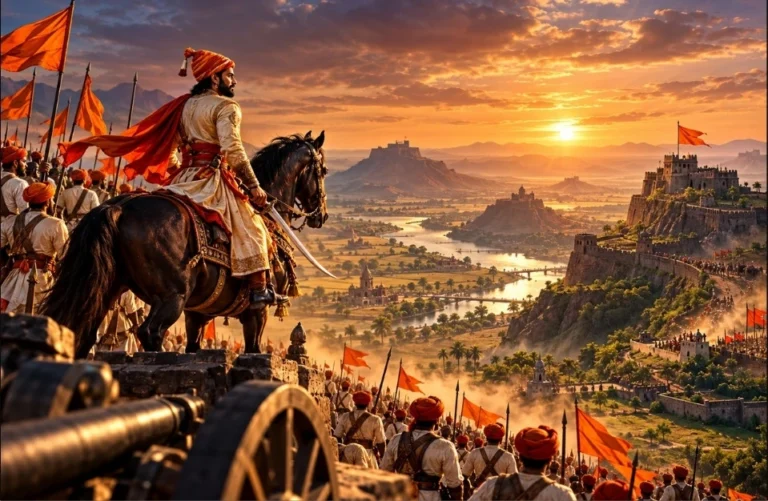
- Relied heavily on slow-moving, massive imperial encampments (Fath-i-Lashkar) and heavy siege artillery.
- Focused on capturing individual Maratha hill forts through prolonged, expensive sieges lasting months.
- Drained imperial treasuries while failing to secure permanent territorial control, as lost forts were quickly retaken by Marathas.
Maratha Military Strategy
- Utilized light, highly mobile cavalry (Bargirs) capable of striking deep into imperial supply lines without warning.
- Employed Ganimi Kava (guerrilla tactics) to avoid pitched battles against superior Mughal numerical strength.
- Turned captured forts into temporary defensive positions before abandoning them to fight elsewhere when pressed.
Mughal Administrative Problems in the Deccan
- Widespread alienation among local Deccani nobility (Nobles) following the annexation of Bijapur and Golconda.
- Severe disruption of agriculture and trade, causing widespread famine, financial deficits, and unpaid troop mutonies.
- Rampant corruption and exhaustion among senior imperial commanders in Maratha History UPSC modules.
Significance of the Period 1687–1707
- Marked the breakdown of imperial authority and financial bankruptcy of the late Mughal state under Aurangzeb.
- Paved the way for 18th-century Maratha expansion across Central and Northern India.
- Highlighted the triumph of regional political identity over centralized imperial governance covered under Shivaji Maharaj UPSC.
Conclusion
The twenty-year war between the Marathas in the Deccan and the Mughal Empire exposed the limits of imperial overreach. By transitioning from a centralized state to a resilient, decentralized movement under leaders like Rajaram and Tarabai, the Marathas successfully eroded Mughal military power. Mastering this critical period provides civil services aspirants with an essential foundation for understanding 18th-century political transformations in Maratha History UPSC.
UPSC Prelims: PYQs & Practice Questions
Previous Year Questions (Prelims)
Q: Which one of the following statements correctly explains the main cause for the shifting of the Maratha resistance base to Jinji (Chingee) in the late 17th century?
(a) To establish a naval monopoly over the Coromandel trade routes.
(b) The execution of Chhatrapati Sambhaji and the capture of Raigad by Mughal forces under Zulfiqar Khan forced Rajaram to retreat to the Carnatic region.
(c) To form a joint political alliance with the European East India Companies against the Portuguese.
(d) The invitation of the Nayakas of Madurai to liberate Southern India from the Bijapur Sultanate.
Answer: (b)
Explanation:
Following the capture and execution of Chhatrapati Sambhaji in 1689 and the fall of the capital Raigad, Chhatrapati Rajaram escaped through the Western Ghats to the southern fortress of Jinji in modern Tamil Nadu.
Jinji served as the strategic seat of the Maratha court-in-exile from 1690 to 1698. This forced Emperor Aurangzeb to divide his grand army between Maharashtra and the Carnatic, prolonging the war and draining Mughal resources.
Q: Consider the following statements regarding the Mughal–Maratha conflict in the Deccan during the reign of Aurangzeb:
1. The annexation of Bijapur (1686) and Golconda (1687) by Aurangzeb eliminated the regional buffer states and brought the Mughals into direct conflict with the Marathas.
2. During the period 1700–1707, Maharani Tarabai led the Maratha resistance and directed offensive campaigns into Mughal provinces like Malwa and Gujarat.
Which of the statements given above is/are correct?
(a) 1 only
(b) 2 only
(c) Both 1 and 2
(d) Neither 1 nor 2
Answer: (c) Both 1 and 2
Explanation:
Statement 1 is correct: The annexation of Bijapur (1686) and Golconda (1687) destroyed the native Deccani Sultanates that historically absorbed northern imperial pressure. Their dissolution released thousands of soldiers who joined Maratha ranks.
Statement 2 is correct: After Rajaram's death in 1700, his widow Maharani Tarabai assumed supreme leadership of the Maratha state on behalf of her young son Shivaji II. She shifted Maratha military doctrine from passive defense to offensive raids into central Mughal Subahs like Malwa and Gujarat.
Practice Questions
Q: With reference to the operational warfare in the Deccan between 1689 and 1707, consider the following statements:
1. Mulkgiri refers to the systematic Mughal strategy of besieging individual hill fortresses using heavy artillery.
2. Ganimi Kava was the traditional asymmetric guerrilla tactic of swift, unexpected Maratha cavalry ambushes.
Which of the statements given above is/are correct?
(a) 1 only
(b) 2 only
(c) Both 1 and 2
(d) Neither 1 nor 2
Answer: (b) 2 only
Explanation:
Statement 1 is incorrect: Mulkgiri (or Mulkgiri raids) refers to wide-ranging predatory military expeditions for collecting revenue and plundering enemy territory. The systematic Mughal practice of besieging hill forts one after another was historically termed Qila'giri.
Statement 2 is correct: Ganimi Kava was the Maratha guerrilla doctrine characterized by mobility, avoiding pitched battles against superior enemy forces, cutting off supply lines, and launching surprise attacks.
Q2. Who among the following Maratha military commanders played a legendary role during Chhatrapati Rajaram's reign by executing swift cavalry attacks that repeatedly disrupted Mughal supply lines in the Deccan?
(a) Kanhoji Angre and Baji Rao I
(b) Santaji Ghorpade and Dhanaji Jadhav
(c) Murar Baji and Tanaji Malusare
(d) Chimaji Appa and Sadashivrao Bhau
Answer: (b) Santaji Ghorpade and Dhanaji Jadhav
Explanation:
Santaji Ghorpade (Senapati) and Dhanaji Jadhav were the principal Maratha generals who spearheaded decentralized resistance during the siege of Jinji (1689–1698). Their coordinated hit-and-run tactics terrorized imperial camps and immobilized large Mughal armies.
UPSC Mains – Previous Year & Practice Questions
Mains Previous Year Questions
Question: "The extinction of the Deccani Sultanates of Bijapur and Golconda by Aurangzeb was a strategic blunder that accelerated the fall of the Mughal Empire." Critically analyze. (UPSC CSE Mains 2021)
Question: "Aurangzeb's 25-year military campaign in the Deccan proved to be his political and financial 'Spanish Ulcer'." Discuss. (UPSC CSE Mains 2017)
Question: Examine the role played by Maharani Tarabai in organizing Maratha resistance against the Mughals following the death of Chhatrapati Rajaram. (UPSC CSE Mains 2012)
Question: "The transformation of the Maratha struggle from a dynastic conflict into a popular war of regional independence after 1689 broke the back of imperial administration." Elucidate. (UPSC CSE Mains 2006)
Question: Evaluate the socio-economic impact of the prolonged Mughal–Maratha wars (1687–1707) on the agrarian landscape of the Deccan region. (UPSC CSE Mains 1999)
Mains Practice Questions
[15 Marks | 250 Words]
Question: The geography of the Sahyadris acted as an equalizer between the massive imperial army of the Mughals and the agile, light cavalry of the Marathas. Evaluate the role of terrain and logistics during the 1687–1707 war.
[10 Marks | 150 Words]
Question: How did the Jagirdari crisis and agrarian stagnation within the Mughal Empire compound Aurangzeb’s failure to subjugate the Marathas in the Deccan?
[15 Marks | 250 Words]
Question: "Decentralization of military command was both the savior of the Maratha state under Rajaram and the seed of 18th-century Maratha feudal fragmentation." Discuss.
Marathas and Mughals in Deccan UPSC-FAQs
Why did Aurangzeb focus on the Deccan after 1687?
After annexing Bijapur and Golconda, Aurangzeb sought to eliminate the Marathas and consolidate Mughal control over the Deccan. The campaign aimed to secure the newly conquered territories and strategic forts.
How did Rajaram contribute to Maratha resistance?
Rajaram shifted the centre of resistance to Jinji and decentralized military operations among Maratha commanders. This forced the Mughals to fight on multiple fronts over a vast geographical area.
What role did Santaji Ghorpade and Dhanaji Jadhav play?
They employed highly mobile cavalry warfare, attacking Mughal supply lines, baggage trains and isolated forces. Their tactics exploited the difficult terrain of the Deccan and weakened Mughal military operations.
Why did the Mughals struggle to defeat the Marathas?
The decentralized nature of Maratha resistance meant that capturing forts or individual leaders could not end the conflict. Prolonged warfare also exhausted Mughal finances, manpower and logistical capacity.
What was the significance of the Maratha–Mughal War of 1687–1707?
The prolonged conflict severely weakened Mughal imperial power and contributed to the political fragmentation of the empire. It also created conditions for the expansion of Maratha power across India during the 18th century.