Table of Contents
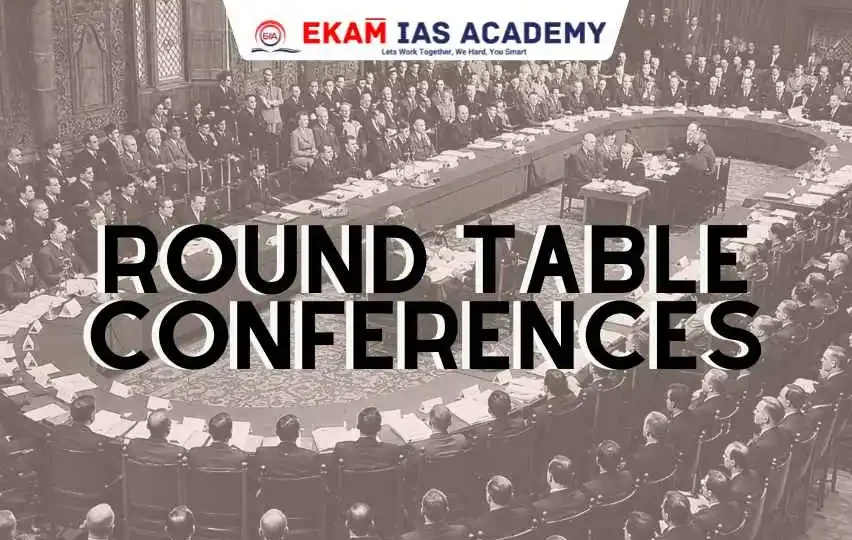
ToggleThe Round Table Conference series held between 1930 and 1932 in London represents a critical chapter in Modern Indian History UPSC preparation. These historical conferences were organized by the British Government to deliberate on constitutional reforms and address the growing demands of the Indian National Movement.
Background of the Round Table Conferences
Following the rejection of the Simon Commission recommendations and the subsequent rejection of the Nehru Report, political turmoil escalated across India. The launch of the Civil Disobedience Movement forced the imperial administration to invite Indian leaders to equal-table negotiations in London.
First Round Table Conference (1930–1931)
Opened in November 1930, the First Round Table Conference included Round Table Conference participants representing Princely States, Liberals, the Muslim League, and Depressed Classes. However, it proved ineffective because the Indian National Congress boycotted the session due to the ongoing freedom struggle.
Gandhi-Irwin Pact and the Second Round Table Conference
To ensure Congress participation, the Gandhi Irwin Pact was signed in March 1931. Congress suspended civil disobedience, enabling Gandhi and Round Table Conference talks to materialize.
Second Round Table Conference (1931)
The Second Round Table Conference (September–December 1931) saw Mahatma Gandhi attend as the sole representative of the Congress (Gandhi Second Round Table Conference). Negotiations stalled due to deadlocks over minority representation and communal claims.
Third Round Table Conference (1932)
The Third Round Table Conference (November–December 1932) was short and poorly attended. Congress boycotted the proceedings once again, and major British opposition leaders also stayed away.
Major Issues Discussed in the Round Table Conferences
Key themes included:
- Structural setup of an All-India Federation.
- Provincial autonomy and executive accountability.
- Safeguards and communal representation for minorities.
Communal Award, 1932
Following the deadlock in London, British Prime Minister Ramsay MacDonald announced the Communal Award 1932, granting separate electorates for depressed classes. This led to Gandhi’s fast and the subsequent Poona Pact 1932 signed with Dr. B.R. Ambedkar.
Outcomes of the Round Table Conferences
The primary Round Table Conference outcomes were published in a White Paper in 1933, which formed the constitutional foundation for enacting the landmark Government of India Act 1935.
Significance of the Round Table Conferences
These meetings recognized Indians as equal status participants in constitutional drafting for the first time on an international platform.
Limitations and Reasons for Failure
- Absence of Congress in the first and third sessions.
- Imperial divide-and-rule tactics surrounding minority seats.
- Uncompromising stances among communal delegate factions.
First vs Second vs Third Round Table Conference
| Round Table Conference | Year | Key Points |
|---|---|---|
| First | 1930 | Boycotted by Congress; discussed federal framework. |
| Second | 1931 | Attended by Gandhi; collapsed over communal deadlock. |
| Third | 1932 | Minor event; drafted final recommendations without Congress. |
Timeline of Important Events
- November 1930: Round Table Conference 1930 (First session).
- March 1931: Signing of the Gandhi-Irwin Pact.
- September 1931: Round Table Conference 1931 (Second session).
- August–September 1932: Announcement of Communal Award and signing of Poona Pact.
- November 1932: Round Table Conference 1932 (Third session).
Conclusion
Understanding the Round Table Conferences UPSC syllabus details is essential for completing your UPSC History Notes. They directly shaped the constitutional blueprint leading to the Government of India Act 1935.
UPSC Prelims: PYQs & Practice Questions
Previous Year Questions (Prelims)
Q: Who among the following attended all the three Round Table Conferences?
1. B.R. Ambedkar
2. Mahatma Gandhi
3. Tej Bahadur Sapru
4. Jawaharlal Nehru
Select the correct answer using the code given below:
(a) 1 and 2 only
(b) 1 and 3 only
(c) 2 and 4 only
(d) 1, 2 and 3
Answer: (b) 1 and 3 only
Explanation:
Dr. B.R. Ambedkar, representing the Depressed Classes, and
Tej Bahadur Sapru, representing the Liberals, attended
all three Round Table Conferences held in 1930, 1931 and 1932.
Mahatma Gandhi attended only the
Second Round Table Conference in 1931 as the representative of the Indian National Congress.
Jawaharlal Nehru did not attend any of the three Round Table Conferences.
Q: The Indian National Congress agreed to participate in the Second Round Table Conference as a result of which of the following pacts?
(a) Poona Pact
(b) Gandhi-Irwin Pact
(c) Lucknow Pact
(d) Shimla Pact
Answer: (b) Gandhi-Irwin Pact
Explanation:
The
Gandhi-Irwin Pact, also known as the
Delhi Pact, was signed on
5 March 1931 between Mahatma Gandhi and Viceroy Lord Irwin.
Under the agreement, the Indian National Congress agreed to
suspend the Civil Disobedience Movement and participate in the
Second Round Table Conference.
Mahatma Gandhi subsequently attended the conference in London as the
sole representative of the Indian National Congress.
Practice Questions
Q: With reference to the First Round Table Conference (1930–1931), consider the following statements:
1. It was the first conference where Indians and the British met as equal participants to discuss constitutional reforms.
2. It was officially presided over by British Prime Minister Ramsay MacDonald.
3. The Indian National Congress sent a delegation led by Sardar Vallabhbhai Patel.
Which of the statements given above are correct?
(a) 1 and 2 only
(b) 2 and 3 only
(c) 1 and 3 only
(d) 1, 2 and 3
Answer: (a) 1 and 2 only
Explanation:
Statements 1 and 2 are correct. The
First Round Table Conference was inaugurated by
King George V and presided over by
British Prime Minister Ramsay MacDonald in November 1930.
It marked an important constitutional development as Indian representatives and British officials participated in discussions on India's future constitutional framework.
Statement 3 is incorrect. The
Indian National Congress boycotted the First Round Table Conference because the Civil Disobedience Movement was underway and many Congress leaders were imprisoned.
Q: Which of the following women delegates attended the Second Round Table Conference in London in 1931?
1. Sarojini Naidu
2. Begum Jahanara Shahnawaz
3. Radhabai Subbarayan
Select the correct answer using the code given below:
(a) 1 only
(b) 1 and 2 only
(c) 2 and 3 only
(d) 1, 2 and 3
Answer: (d) 1, 2 and 3
Explanation:
All three were women delegates associated with the Second Round Table Conference.
Sarojini Naidu attended the conference and represented Indian women alongside the wider nationalist delegation.
Begum Jahanara Shahnawaz and
Radhabai Subbarayan also participated as representatives of Indian women.
UPSC Mains – Previous Year & Practice Questions
Mains Previous Year Questions
[10 Marks | 150 Words]
Question: Analyse the causes behind the failure of the Second Round Table Conference. How far was the issue of minority representation responsible for the deadlock? (UPSC CSE Mains 2014)
[10 Marks | 150 Words]
Question: Evaluate the circumstances under which the Gandhi-Irwin Pact was signed. To what extent did it fulfil the nationalist expectations of the Indian National Congress? (UPSC CSE Mains 2008)
[10 Marks | 150 Words]
Question: Discuss the role of Dr. B.R. Ambedkar at the Round Table Conferences with particular reference to his demand for political safeguards for the Depressed Classes. (UPSC CSE Mains 2001)
[15 Marks | 250 Words]
Question: Trace the evolution of British constitutional policy towards India from the Simon Commission to the enactment of the Government of India Act, 1935. (UPSC CSE Mains 1996)
[10 Marks | 150 Words]
Question: Why did the First Round Table Conference fail to produce any lasting constitutional settlement for British India? (UPSC CSE Mains 1989)
Mains Practice Questions
[15 Marks | 250 Words]
Question: “The Round Table Conferences highlighted the inherent contradictions between British imperial design and Indian nationalist aspirations.” Critically analyse.
[15 Marks | 250 Words]
Question: Assess Mahatma Gandhi’s strategy and stance during the Second Round Table Conference. Why did he return empty-handed to India?
[10 Marks | 150 Words]
Question: Discuss how the deliberations of the three Round Table Conferences directly contributed to the framing of the Government of India Act, 1935.
Round Table Conferences-FAQs
What were the Round Table Conferences?
The Round Table Conferences were three conferences held in London between 1930 and 1932 to discuss constitutional reforms for India.
Why did Congress boycott the First Round Table Conference?
Congress boycotted the First Round Table Conference because the Civil Disobedience Movement was ongoing and major Congress leaders were not participating in British-led negotiations.
Which Round Table Conference did Gandhi attend?
Mahatma Gandhi attended the Second Round Table Conference in 1931 as the sole representative of the Indian National Congress.
What was the main reason for the failure of the Second Round Table Conference?
The Second Round Table Conference failed mainly due to deadlock over minority representation and communal claims.
Why are the Round Table Conferences important for UPSC?
They are important because they connect Civil Disobedience Movement, Gandhi-Irwin Pact, Communal Award, Poona Pact and the Government of India Act 1935.