Table of Contents
ToggleSAREX-2026 Latest News
The Indian Coast Guard conducted the 12th National Maritime Search and Rescue Exercise (SAREX-2026) off the coast of Paradip, Odisha. The SAREX 2026 India exercise focused on strengthening coordination, technological preparedness and operational capabilities for maritime emergencies, making it significant for Maritime Safety in India and Maritime Emergency Response India.
About SAREX-2026
SAREX 2026 is a multi-agency maritime search and rescue exercise conducted by the Indian Coast Guard. The National Maritime Search and Rescue Exercise 2026 supports India’s maritime safety objectives and is aligned with the SAGAR and Mahasagar visions.
The theme of the exercise was “Leveraging Technology to Strengthen SAR Preparedness and Maritime Safety.”
The exercise also had an international dimension, with 32 observers from 30 countries participating. Their involvement promoted the exchange of operational practices and strengthened international interoperability in maritime Search and Rescue (SAR), highlighting the importance of Maritime Search and Rescue India.
Participating Forces and Assets
The exercise brought together assets from multiple agencies. These included:
- 15 Indian Coast Guard ships
- Three Dornier aircraft
- Three Advanced Light Helicopters
- One Chetak helicopter
- IAF C-130J and Mi-17 aircraft
- Two Indian Navy ships
- Civil and State resources
- Shore-based support units
The participation of different agencies demonstrated the importance of coordinated responses during large-scale maritime emergencies and strengthened Search and Rescue Operations at Sea.
Activities Involved
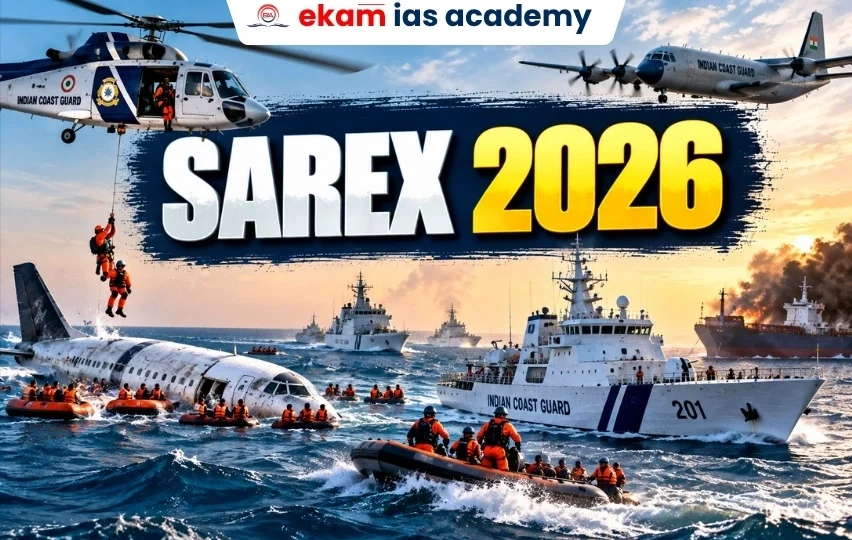
The main sea drill simulated a Mass Rescue Operation following simultaneous aeronautical and maritime distress situations.
The scenario involved a passenger aircraft carrying 228 people ditching at sea near Paradip Port. The aircraft’s fuselage subsequently struck the container vessel MV Zumba, causing structural damage and a fire.
The response involved activation of an Incident Command Post, firefighting operations and coordinated evacuation of survivors, demonstrating the capabilities of Indian Coast Guard SAREX and Maritime Emergency Response India.
Rescue Operations Demonstrated
The exercise showcased several maritime rescue techniques, including helicopter evacuation, life rafts, air-droppable life rafts, Jason Cradle and Gemini recovery systems, rescue basket operations and scramble-net procedures.
A demonstration of Remotely Operated Vehicle (ROV) capability was also conducted, highlighting the growing role of technology in underwater search and rescue and strengthening Search and Rescue Exercise India capabilities.
Significance of SAREX-2026
SAREX 2026 India strengthens India’s ability to respond to complex maritime disasters while improving coordination among defence, civil and state agencies. International participation further reinforces India’s role as a reliable maritime Search and Rescue partner in the region and contributes to Indian Maritime Security. The exercise is important for understanding Indian Coast Guard Exercises, Maritime Security UPSC, Indian Coast Guard UPSC, Defence Exercises in India 2026 and Defence Current Affairs UPSC.


SAREX-2026-FAQs Answered
What is SAREX-2026?
SAREX-2026 is the 12th National Maritime Search and Rescue Exercise conducted by the Indian Coast Guard to strengthen maritime safety, rescue coordination and emergency response capabilities.
Where was SAREX-2026 conducted?
The exercise was conducted off the coast of Paradip, Odisha, involving multiple defence, civil and state agencies.
What was the theme of SAREX-2026?
The theme was “Leveraging Technology to Strengthen SAR Preparedness and Maritime Safety.”
Which agencies participated in SAREX-2026?
The exercise involved the Indian Coast Guard, Indian Navy, Indian Air Force, civil and State resources, along with shore-based support units. 32 observers from 30 countries also participated.
Why is SAREX-2026 important for India?
SAREX-2026 strengthens India’s ability to conduct large-scale maritime Search and Rescue operations, improves inter-agency coordination and enhances international interoperability in maritime emergencies.