Table of Contents
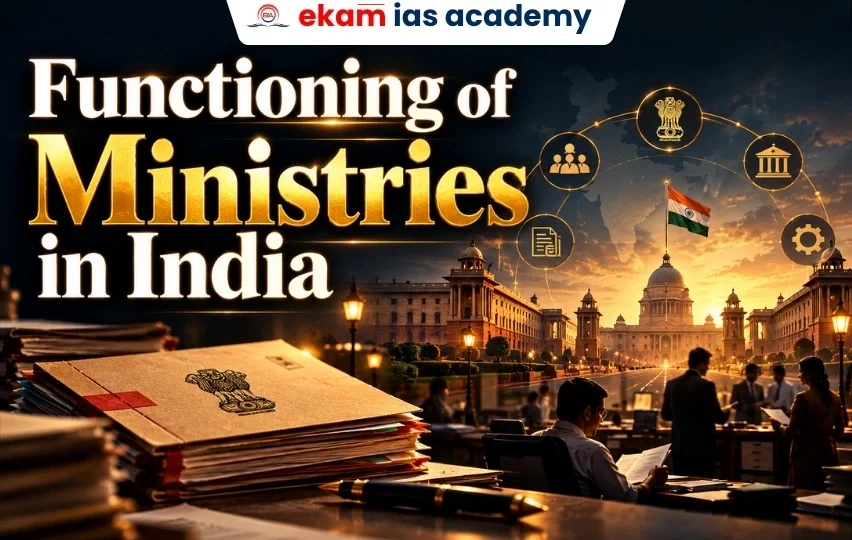
ToggleFunctioning of Ministries in India
- Understanding the Functioning of Ministries in India is a fundamental requirement for civil services aspirants preparing for Indian Governance UPSC, Union Executive UPSC, and Indian Polity UPSC examinations.
- As the administrative engine of the State, Union Ministries of India translate statutory laws enacted by Parliament into actionable governance programs and social welfare schemes.
- Studying Indian Ministries and Departments provides crucial insights into administrative law, policy formulation, public administration, and democratic accountability.
- Mastering the Role of Union Ministries enables candidates to analyze how public resource allocation, executive rulemaking, and administrative machinery operate under the Constitution.
Structure of Ministries in India
- Three-Tier Political Pyramid: Comprises Cabinet Ministers and Ministries, Ministers of State (Independent Charge), Ministers of State (MoS), and Deputy Ministers.
- Internal Administrative Hierarchy: Each administrative ministry is divided into Indian Ministries and Departments, which are further sub-divided into Wings, Divisions, Branches, and Sections.
- Administrative Bureaucracy: A senior civil servant (Secretary to the Government of India) serves as the administrative head of a Ministry of Government of India.
- Rules of Business: Governed by the Allocation of Business Rules, 1961 and Transaction of Business Rules, 1961 framed under Article 77 of the Constitution.
Role of the Prime Minister and Council of Ministers
- Constitutional Core: Article 74 establishes the Council of Ministers India headed by the Prime Minister to aid and advise the President of India.
- Collective Responsibility: Under Article 75(3), the entire council remains collectively responsible to the Lok Sabha for all decision-making across Central Government Ministries.
- Prime Ministerial Primacy: The Prime Minister allocates portfolios, directs policy agendas, and coordinates administrative functions across Cabinet Ministers and Ministries.
- Strategic Apex: The Union Cabinet serves as the chief policy-formulating body driving high-level Government Decision Making in India.
How Do Ministries Function — Step-by-Step Process
- Policy Conceptualization: Formulated based on legislative mandates, cabinet decisions, electoral promises, or international treaty obligations.
- Drafting and Inter-Ministerial Consultation: Prepared by departmental officers and circulated among allied ministries, the Law Ministry, and Finance Ministry.
- Cabinet Note Submission: Submitted to the Cabinet Secretariat for formal approval by the Union Cabinet or relevant Cabinet Committees.
- Parliamentary Enactment & Executive Notification: Tabled in Parliament as a Bill, followed by presidential assent and gazette notification to commence implementation.
Role of the Political Executive and Permanent Executive
- Political Executive: Comprises elected ministers who provide political direction, formulate macro policies, and maintain accountability to Parliament.
- Permanent Executive: Consists of non-partisan, tenured civil servants (IAS, IFS, Central Services) responsible for Ministry and Department Administration.
- Policy Advice: The permanent executive provides evidence-based analysis, legal feasibility reviews, and administrative continuity to political heads.
- Complementary Synergy: Ensures political democratic responsiveness is balanced with institutional expertise in executing the Functions of Government Ministries.
Ministries and Policy Implementation
- Operational Rules Framing: Drafts detailed subordinate legislation, statutory notifications, and administrative circulars to operationalize parliamentary acts.
- Attached & Subordinate Offices: Utilizes field agencies, attached offices, and public sector undertakings to execute ground-level programs.
- Budgetary Execution: Allocates, manages, and audits fiscal resources sanctioned under annual Demand for Grants passed by Parliament.
- Monitoring & Evaluation: Implements digital dashboards and field review systems to monitor scheme implementation across states.

Inter-Ministerial Coordination
- Cabinet Secretariat: Acts as the primary administrative catalyst ensuring smooth inter-ministerial communication and conflict resolution.
- Cabinet Committees: Specialized bodies like Cabinet Committee on Economic Affairs (CCEA) and Cabinet Committee on Security (CCS) streamline inter-departmental decisions.
- Empowered Group of Ministers (EGoMs): Formed on an ad-hoc basis to resolve complex, cross-cutting policy deadlocks between ministries.
- Committee of Secretaries (CoS): Chaired by the Cabinet Secretary to align bureaucratic execution across multiple Central Government Ministries.
Challenges in the Functioning of Ministries
- Departmental Silos: Rigid compartmentalization between Indian Ministries and Departments leads to duplication of efforts and communication gaps.
- Red Tape & Procedural Delays: Multi-layered clearance pipelines slow down critical Government Decision Making in India.
- Implementation Gap: Disconnect between central policy design and ground-level execution across state and district machinery.
- Administrative Capacity Deficits: Shortages of domain specialists and modern technology infrastructure within traditional bureaucratic frameworks.
Conclusion
- Governance Pillar: The smooth Functioning of Ministries in India remains essential for national socio-economic transformation and public service delivery.
- Administrative Reforms: Strengthening inter-ministerial coordination, digitizing workflows, and adopting domain expertise will modernize Ministry and Department Administration.
- UPSC Essential: A comprehensive understanding of Structure of Ministries in India equips civil services candidates to excel in General Studies Paper II.
UPSC Prelims: PYQs & Practice Questions
Previous Year Questions (Prelims)
Q: Which of the following is/are the function/functions of the Cabinet Secretariat?
1. Preparation of agenda for Cabinet Meetings
2. Secretarial assistance to Cabinet Committees
3. Allocation of financial resources to the Ministries
Select the correct answer using the code given below:
(a) 1 only
(b) 2 and 3 only
(c) 1 and 2 only
(d) 1, 2 and 3
Answer: (c) 1 and 2 only
Explanation:
Statement 1 is correct: The Cabinet Secretariat prepares agendas
for Cabinet meetings and keeps minutes of discussions.
Statement 2 is correct: It provides administrative and secretarial
support to all standing and ad-hoc Cabinet Committees.
Statement 3 is incorrect: Allocation of financial resources to Union
Ministries is handled by the Ministry of Finance (Department of Expenditure)
through the Annual Financial Statement (Budget), not by the Cabinet Secretariat.
Q: With reference to Union Government, consider the following statements:
1. The Ministries/Departments of the Government of India are created by the Prime
Minister on the advice of the Cabinet Secretary.
2. Each of the Ministries is assigned to a Minister by the President of India on
the advice of the Prime Minister.
Which of the statements given above is/are correct?
(a) 1 only
(b) 2 only
(c) Both 1 and 2
(d) Neither 1 nor 2
Answer: (b) 2 only
Explanation:
Statement 1 is incorrect: Ministries and Departments are created
or reorganized by the President of India on the advice of the Prime Minister under
the Government of India (Allocation of Business) Rules, 1961 framed
pursuant to Article 77(3). The Cabinet Secretary does not advise on
their creation.
Statement 2 is correct: Under Article 75(1),
ministers are appointed by the President on the advice of the Prime Minister, and
portfolios/ministries are assigned to them by the President acting on the Prime
Minister's advice.
Practice Questions
Q: With reference to the Government of India (Transaction of Business) Rules, 1961, consider the following statements:
1. They are framed by the Prime Minister of India to determine the day-to-day
administrative workflow of Union Ministries.
2. Under these rules, an officer of the rank of Secretary to the Government of
India is the administrative head of a Ministry/Department.
3. Inter-ministerial disputes that cannot be resolved through mutual consultation
must be referred to the Cabinet Secretariat or the Cabinet.
Which of the statements given above are correct?
(a) 1 and 2 only
(b) 2 and 3 only
(c) 1 and 3 only
(d) 1, 2, and 3
Answer: (b) 2 and 3 only
Explanation:
Statement 1 is incorrect: The Allocation and Transaction of
Business Rules are framed by the President of India under
Article 77(3) of the Constitution, not by the Prime Minister directly.
Statement 2 is correct: The Secretary to the Government of India
serves as the permanent administrative head of a department or ministry,
assisting the political executive.
Statement 3 is correct: Inter-ministerial deadlocks are referred
to the Cabinet Secretariat, Cabinet Committees, or full Cabinet
for resolution to maintain collective responsibility.
Q: Consider the following statements regarding the structural organization of Union Ministries in India:
1. An Attached Office provides executive direction and technical advice required
for policy implementation.
2. A Subordinate Office functions as a field-level operational agency responsible
for executing detailed policies on the ground.
3. All Ministries in India must mandatorily consist of at least three separate Departments.
Which of the statements given above is/are correct?
(a) 1 and 2 only
(b) 2 only
(c) 1 and 3 only
(d) 1, 2, and 3
Answer: (a) 1 and 2 only
Explanation:
Statement 1 is correct: Attached offices provide technical or
advisory assistance and serve as executive arms of the ministry
(e.g., Central Public Works Department).
Statement 2 is correct: Subordinate offices function as field
establishments executing policies directly on the ground
(e.g., Directorate General of Income Tax).
Statement 3 is incorrect: There is no requirement that every
Ministry must have three departments. Some ministries have multiple departments,
while others operate as a single unified department/ministry.
UPSC Mains – Previous Year & Practice Questions
Mains Previous Year Questions
[10 Marks | 150 Words]
Question: The role of the Cabinet Secretariat in ensuring inter-ministerial coordination and administrative consistency is pivotal in Indian governance. Discuss. (UPSC CSE Mains 2022 - GS Paper II)
[15 Marks | 250 Words]
Question: Analyze the relationship between the Political Executive and Permanent Executive in the context of policy implementation in Union Ministries. (UPSC CSE Mains 2021 - GS Paper II)
[10 Marks | 150 Words]
Question: How do Cabinet Committees function as institutional instruments to facilitate effective decision-making across Union Ministries? (UPSC CSE Mains 2019 - GS Paper II)
[15 Marks | 250 Words]
Question: Traditional departmental silos in Central Government Ministries hamper agile governance. Critically evaluate the reforms needed to enhance inter-ministerial coordination. (UPSC CSE Mains 2016 - GS Paper II)
[10 Marks | 150 Words]
Question: Discuss the constitutional provisions under Article 77 governing the conduct of business of the Government of India and the role of Allocation of Business Rules. (UPSC CSE Mains 2013 - GS Paper II)
Mains Practice Questions
[15 Marks | 250 Words]
Question: The shift toward 'Minimum Government, Maximum Governance' requires restructuring Union Ministries away from administrative compartmentalization toward cross-functional policy clusters. Discuss.
[15 Marks | 250 Words]
Question: Examine the role of the Secretary to the Government of India as the chief accounting officer and administrative head of a Ministry. How can lateral entry inject domain expertise into Ministry functioning?
[10 Marks | 150 Words]
Question: Evaluate the mechanisms used by Union Ministries to draft and issue subordinate/delegated legislation. How does parliamentary oversight ensure these rules align with parent statutes?
Functioning of Ministries in India-FAQs
What is the role of Union Ministries in India?
Union Ministries formulate and implement government policies, administer laws, manage public resources, and deliver welfare programmes under the constitutional framework.
How are Ministries and Departments structured in India?
Ministries consist of political executives such as Cabinet Ministers and Ministers of State, supported by the permanent executive. Administratively, departments are divided into Wings, Divisions, Branches, and Sections.
What is the role of the Prime Minister in the functioning of Ministries?
The Prime Minister allocates portfolios, coordinates ministries, guides policy priorities, and leads the Council of Ministers, which is collectively responsible to the Lok Sabha.
What is the difference between the political executive and permanent executive?
The political executive provides policy direction and democratic accountability, while the permanent executive consists of civil servants who provide administrative expertise, continuity, and support in policy implementation.
What are the major challenges in the functioning of Ministries in India?
Major challenges include departmental silos, red tape, procedural delays, implementation gaps, inter-ministerial coordination issues, and shortages of specialized administrative expertise.