Table of Contents
ToggleNitrogen is a primary constituent of amino acids, proteins, vitamins, and nucleic acids (DNA and RNA). The nitrogen cycle UPSC syllabus emphasizes the complex interactions between the atmosphere, soil, and living organisms. This cycle is classified as a gaseous cycle, as its main reservoir is the atmosphere.
Definition of the Nitrogen Cycle
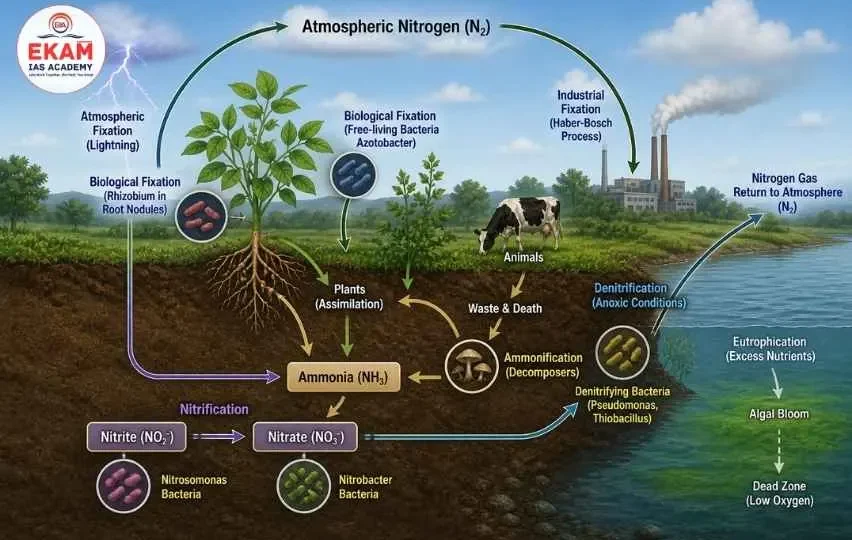
The nitrogen cycle process is the continuous circulation of nitrogen through the Earth’s atmosphere, land, and marine ecosystems. It involves the transformation of atmospheric nitrogen into organic compounds and back into nitrogen gas through various biological and physical processes.
Key Processes Involved in the Nitrogen Cycle
Understanding the sequence of nitrogen fixation, nitrification, and denitrification is critical for scoring well in environment ecology notes UPSC assessments:
1. Nitrogen Fixation
This is the process of converting atmospheric nitrogen ($N_2$) into ammonia ($NH_3$), which plants can absorb.
- Biological Fixation: Done by symbiotic bacteria like Rhizobium (found in root nodules of legumes) and free-living bacteria like Azotobacter.
- Atmospheric Fixation: Lightning provides enough energy to break $N_2$ bonds, allowing nitrogen to combine with oxygen to form nitrogen oxides.
- Industrial Fixation: The Haber-Bosch process creates chemical fertilizers.
2. Nitrification
Ammonia is converted into more stable forms that plants prefer.
- Ammonia is first converted to Nitrite (NO2) by Nitrosomonas bacteria.
- Nitrite is then converted to Nitrate (NO3) by Nitrobacter bacteria.
3. Assimilation
Plants absorb nitrates through their roots and incorporate them into plant proteins. Animals then obtain nitrogen by consuming these plants.
4. Ammonification
When plants and animals die, or excrete waste, decomposers (bacteria and fungi) convert organic nitrogen back into ammonia.
5. Denitrification
To complete the cycle, nitrates in the soil are converted back into gaseous nitrogen (N2). This is carried out by denitrifying bacteria like Pseudomonas and Thiobacillus in anaerobic conditions (like waterlogged soils).
Importance of the Nitrogen Cycle
- Soil Fertility: The soil fertility nitrogen cycle relationship is fundamental; without it, soil would rapidly lose the nutrients required for crop production.
- Ecosystem Productivity: Nitrogen is often the limiting nutrient in many ecosystems, meaning its availability determines the growth rate of plants.
- Biological Synthesis: It provides the building blocks for the genetic code and cellular structure of every living organism.
Human Impacts on the Nitrogen Cycle
Anthropogenic activities have doubled the rate of nitrogen fixation globally, leading to severe ecological imbalances:
- Eutrophication: Excessive use of chemical fertilizers leads to nutrient runoff into water bodies, causing algal blooms and “dead zones”.
- Air Pollution: Burning fossil fuels releases nitrogen oxides (NO), which contribute to acid rain and photochemical smog.
- Greenhouse Effect: Nitrous oxide (N2O) is a potent greenhouse gas, far more effective at trapping heat than CO2.
Conclusion
The nitrogen cycle is a “perfect” yet delicate balance of nature. For sustainable development, India must balance the need for nitrogen-based fertilizers with the need to protect our water and air from nitrogen-based pollutants. Mastery of this cycle is not just about passing an exam; it is about understanding the chemical heartbeat of our planet.
UPSC Prelims: PYQs & Practice Questions
Previous Year Questions (Prelims)
Q: Which of the following adds/add nitrogen to the soil? (UPSC CSE Prelims 2013)
1. Excretion of urea by animals
2. Burning of coal by man
3. Death of vegetation
Select the correct answer using the codes given below:
(a) 1 only
(b) 2 and 3 only
(c) 1 and 3 only
(d) 1, 2 and 3
Answer: (c) 1 and 3 only
Explanation:
Excretion of urea and death of vegetation add organic nitrogen to the soil. Decomposers convert this into ammonia through ammonification. Burning coal releases nitrogen oxides into the atmosphere but does not directly enrich soil fertility.
Q: Consider the following gases released into the atmosphere due to the burning of crop residue: (UPSC CSE Prelims 2019)
1. Carbon monoxide
2. Methane
3. Ozone
4. Sulphur dioxide
Which of the above are correct?
(a) 1 and 2 only
(b) 2, 3 and 4 only
(c) 1 and 4 only
(d) 1, 2, 3 and 4
Answer: (d) 1, 2, 3 and 4
Explanation:
Burning crop residue releases gases such as carbon monoxide (CO), methane (CH₄), ozone (secondary formation), and sulphur dioxide (SO₂). This process disrupts the natural nitrogen cycle by transferring nutrients from soil/biomass to the atmosphere.
Practice Questions
Q: Which of the following bacteria is responsible for denitrification, converting nitrates back into nitrogen gas (N₂)?
(a) Rhizobium
(b) Nitrosomonas
(c) Pseudomonas
(d) Nitrobacter
Answer: (c) Pseudomonas
Explanation:
Pseudomonas (and Thiobacillus) are denitrifying bacteria that operate under anaerobic conditions to convert nitrates into nitrogen gas. Rhizobium performs nitrogen fixation, while Nitrosomonas and Nitrobacter are involved in nitrification.
Q: In the context of the nitrogen cycle (fixation → nitrification → denitrification), what does "assimilation" refer to?
(a) Conversion of ammonia to nitrates
(b) Conversion of nitrogen gas to ammonia
(c) Incorporation of nitrogen compounds into organic molecules like proteins by plants
(d) Release of nitrogen gas from organic waste
Answer: (c) Incorporation of nitrogen compounds into organic molecules
Explanation:
Assimilation is the stage where plants absorb inorganic nitrogen (like nitrates) and convert it into organic molecules such as proteins and nucleic acids, forming the basis of the food chain.
UPSC Mains – Previous Year & Practice Questions
Mains Previous Year Questions
Question: Each year a large amount of plant material is produced by photosynthesis. Explain the mechanism of their decomposition. (Mains 2022)
(Relates to ammonification in the nitrogen cycle)
Question: What is an ecosystem? Describe the various services provided by an ecosystem. (Mains 2017)
(Nutrient cycling is a key ecosystem service)
Question: What do you understand by 'Environmental Ethics'? (Mains 2013)
(Includes human disruption of natural cycles like nitrogen due to fertilizers)
Question: Coastal regions of India are vulnerable to various climate change impacts. Discuss. (Mains 2019)
(Relates to nitrogen-driven eutrophication in coastal ecosystems)
Question: The Sustainable Development Goals (SDGs) are a set of 17 goals aimed at global development. Discuss. (Mains 2016)
(SDG 2 and SDG 14 involve nitrogen management and ecosystem sustainability)
Mains Practice Questions
[10 Marks | 150 Words]
Question: Explain the biological and physical processes involved in the nitrogen cycle. Why is nitrogen often the 'limiting nutrient' in terrestrial ecosystems?
[15 Marks | 250 Words]
Question: Discuss the ecological impact of excessive nitrogenous fertilizer use in Indian agriculture. How does it contribute to the phenomenon of 'Dead Zones' in oceans?
[15 Marks | 250 Words]
Question: Analyze the role of Nitrous Oxide (N₂O) as a greenhouse gas. How does it compare with Carbon Dioxide (CO₂) in terms of global warming potential?



Nitrogen Cycle-FAQs
What is Nitrogen Fixation?
It is the process of converting atmospheric N2 (which is inert) into ammonia (NH3), making it available for plants. It can be done by bacteria, lightning, or industrial processes.
What is the 'Haber-Bosch Process'?
It is an industrial method of nitrogen fixation used to produce chemical fertilizers. It has significantly increased global food production but also disrupted the natural nitrogen cycle.
Why is denitrification important?
It balances the cycle by returning nitrogen to the atmosphere. Without it, the world’s supply of atmospheric nitrogen would eventually be depleted.
How does the nitrogen cycle affect water quality?
High levels of nitrates from fertilizers can leach into groundwater (causing Blue Baby Syndrome) or runoff into lakes, causing eutrophication.
Are all nitrogen-fixing bacteria symbiotic?
No. While Rhizobium is symbiotic (living in legume roots), others like Azotobacter and Clostridium are free-living in the soil.