Table of Contents
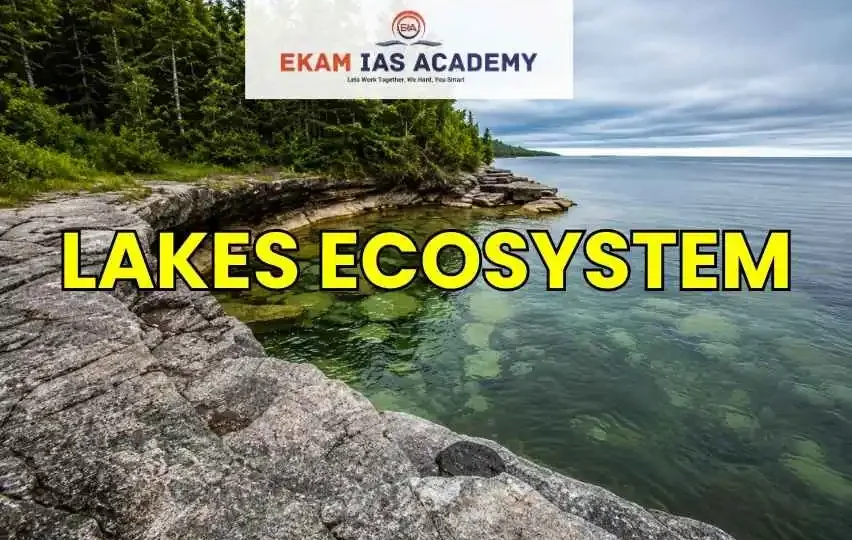
ToggleLakes are significant features of the Earth’s landscape, holding the majority of the planet’s liquid surface freshwater. In the lakes ecosystem UPSC framework, they are analyzed not just as standing pools of water, but as complex, self-sustaining ecosystems that regulate hydrological cycles and buffer regions against climate extremities.
Definition of Lakes
A lake is a large, inland body of relatively still water that is localized in a basin or a connected series of basins. It is distinct from rivers because its water is lentic (standing or slow-moving) and it is completely isolated from the ocean, except through river channels.
Characteristics of Lakes
- Thermal Stratification: Deep lakes experience distinct temperature layers—the warm epilimnion at the surface, the transitional thermocline, and the cold hypolimnion at the bottom.
- Zonation: Lakes are divided into horizontal and vertical zones based on light penetration:
- Littoral Zone: Shallow, near-shore area with rooted plants.
- Limnetic Zone: Open offshore water where photosynthesis occurs.
- Profundal Zone: Deep water beneath the limnetic zone where light does not reach.
- Trophic Status: Lakes progress over time from nutrient-poor (oligotrophic) to nutrient-rich (eutrophic) states.
Types of Lakes
Lakes are categorized based on their formation and water chemistry:
Tectonic Lakes: Formed due to the fracturing and faulting of the Earth’s crust (e.g., Baikal, Tanganyika).
Glacial Lakes: Created by the scouring action of glaciers (e.g., the Great Lakes of North America).
Oxbow Lakes: Formed when a meandering river cuts off a loop (common in the Indo-Gangetic plains).
Volcanic (Crater) Lakes: Formed in volcanic craters or calderas (e.g., Lonar Lake in Maharashtra).
Saline vs. Freshwater Lakes: Classified by dissolved salt content.
Ecological, Environmental, and Economic Importance
Ecological Importance
- Biodiversity Hotspots: Lakes host diverse communities of phytoplankton, zooplankton, aquatic insects, amphibians, and fish.
- Avian Corridors: They serve as critical wintering grounds for thousands of migratory birds traveling along global flyways.
Environmental Importance
- Climate Regulation: Lakes act as regional microclimate buffers, moderating local temperatures through high specific heat capacity.
- Carbon Sequestration: Lake sediments act as significant global carbon sinks, burial-trapping large volumes of organic carbon.
- Flood Mitigation: They serve as natural retention basins, absorbing excess runoff during heavy rains and preventing downstream flooding.
Economic Importance
- Water and Food Security: Lakes provide potable water and support major inland fisheries, ensuring food security for millions.
- Agriculture and Energy: They supply water for irrigation and feed hydroelectric power plants.
- Tourism and Recreation: Lakes are focal points for eco-tourism, boating, and cultural activities, generating local employment.
Major Lakes in India
India possesses an incredible diversity of lakes, from high-altitude regions to coastal plains:
- Freshwater Lakes in India: Wular Lake (Jammu & Kashmir) is one of the largest freshwater lakes in Asia, formed by tectonic activity. Loktak Lake (Manipur) is famous for its floating islands called phumdis.
- Saline and Brackish Lakes: Chilika Lake (Odisha) is Asia’s largest brackish water lagoon, while Sambhar Lake (Rajasthan) is India’s largest inland salt lake.
Threats to Lakes
- Eutrophication: Runoff containing agricultural fertilizers and urban sewage triggers massive algal blooms, depleting dissolved oxygen.
- Encroachment: Unplanned urbanization leads to the reclamation of lake beds for real estate (e.g., the degradation of lakes in Bengaluru and Hyderabad).
- Industrial Siltation: Deforestation and heavy construction lead to massive sediment deposits, reducing the water-holding capacity of lakes.
- Invasive Species: Plants like the Water Hyacinth clog the surface, choking native biodiversity.
Government Initiatives & Conservation Measures
- National Plan for Conservation of Aquatic Eco-systems (NPCA): A centrally sponsored scheme for the holistic conservation of lakes and wetlands.
- Ramsar Convention: India has designated numerous lakes (e.g., Ashtamudi, Deepor Beel) as Wetlands of International Importance.
- Amrit Sarovar Mission: Launched to rejuvenate at least 75 water bodies in every district of India.
Conservation Measures Include:
- Enforcing strict zero-discharge policies for untreated urban sewage.
- Promoting bioremediation and ecological dredging of lake beds.
- Fostering community-led conservation groups like Lake Mitras.
Conclusion
For the importance of lakes UPSC syllabus, these water bodies are best understood as environmental barometers. Protecting both freshwater lakes in India and saline wetlands is vital for securing national water reserves and building climate resilience. Balancing local community livelihoods with robust administrative enforcement remains the sustainable path forward.
UPSC Prelims: PYQs & Practice Questions
Previous Year Questions (Prelims)
Q: Which one of the following lakes of West Africa has become dry and turned into a desert? (UPSC CSE Prelims 2022)
(a) Lake Victoria
(b) Lake Faguibine
(c) Lake Oguta
(d) Lake Volta
Answer: (b) Lake Faguibine
Explanation:
Lake Faguibine in Mali (West Africa) experienced a severe ecological crisis due to prolonged droughts and poor water management, eventually drying up almost completely. This highlights the role of lakes as climate indicators, an important concept in environment and ecology preparation for UPSC.
Q: Consider the following statements: (UPSC CSE Prelims 2018)
1. The Barail Range forms the watershed between the Brahmaputra and Barak rivers.
2. Loktak Lake is located in the state of Mizoram.
Select the correct answer:
(a) 1 only
(b) 2 only
(c) Both 1 and 2
(d) Neither 1 nor 2
Answer: (a) 1 only
Explanation:
Statement 1 is correct because the Barail Range acts as a watershed between the Brahmaputra and Barak river systems. Statement 2 is incorrect because Loktak Lake, famous for its floating phumdis, is located in Manipur, not Mizoram. It is one of India’s most significant freshwater lakes.
Practice Questions
Q: With reference to the ecological zonation of a lake, consider the following statements:
1. The Littoral zone is the shallow, near-shore area where light penetrates completely to the bottom, supporting rooted vegetation.
2. The Profundal zone is the deep, open-water region where light is sufficient for active photosynthesis.
Which of the statements given above is/are correct?
(a) 1 only
(b) 2 only
(c) Both 1 and 2
(d) Neither 1 nor 2
Answer: (a) 1 only
Explanation:
Statement 1 is correct because the Littoral zone is the shallow, sunlight-rich region near the shore that supports rooted aquatic vegetation. Statement 2 is incorrect because the Profundal zone lies below the light-penetrating layer, making it too dark for significant photosynthesis. Active photosynthesis mainly occurs in the Limnetic zone.
Q: The phenomenon of "Thermal Stratification" in deep lakes usually results in which of the following?
(a) Uniform temperature from the surface to the bottom throughout the year.
(b) Distinct temperature layers, separating the warm surface water from the cold bottom water.
(c) A rapid drop in water salinity levels during winters.
(d) An increase in the water-holding capacity of the lake bed.
Answer: (b) Distinct temperature layers
Explanation:
Thermal Stratification divides deep lakes into distinct layers based on temperature and water density. These include the warm upper Epilimnion, the transitional Thermocline, and the cold deep-water Hypolimnion. This stratification significantly influences oxygen distribution and aquatic productivity.
UPSC Mains – Previous Year & Practice Questions
Mains Previous Year Questions
Question: Discuss the causes and consequences of urban flooding in India, with specific reference to major cities. (Mains 2020)
(Directly linked to the destruction and encroachment of urban lake ecosystems)
Question: What is a wetland? Explain the Ramsar concept of “wise use” in the context of wetland conservation in India. (Mains 2018)
(Lakes are extensively classified under the wetland framework)
Question: Enumerate the indirect services provided by an ecosystem. How do wetlands/lakes act as “Earth’s Kidneys”? (Mains 2014)
Question: The ideal solution for depletion of groundwater is rainwater harvesting. Discuss how lake restoration can aid this process. (Mains 2016)
Question: Identify the main causes of the loss of biodiversity in India. (Mains 2023)
(Highlights the pollution and drying up of inland freshwater ecosystems)
Mains Practice Questions
[10 Marks | 150 Words]
Question: “Urban lakes in India have turned from natural flood-buffers into vectors of disasters.” Discuss this statement in light of recent urban flooding events.
[15 Marks | 250 Words]
Question: Explain how the process of Eutrophication completely alters the biological and chemical parameters of a lake ecosystem.
[15 Marks | 250 Words]
Question: Evaluate the performance of the National Plan for Conservation of Aquatic Eco-systems (NPCA) in rejuvenating degraded freshwater lakes in India.



Lakes Ecosystem-FAQs
What is 'Eutrophication' and why is it dangerous for lakes?
Eutrophication is the nutrient enrichment of a lake, usually caused by agricultural runoff or sewage. It triggers massive algal blooms that block sunlight. When the algae die, their decomposition strips the water of dissolved oxygen, leading to the collapse of fish populations.
What are 'Phumdis' and where are they found?
Phumdis are heterogeneous masses of vegetation, soil, and organic matter in various stages of decomposition that float on the surface of Loktak Lake in Manipur. They host the endangered Sangai (brow-antlered deer).
How do lakes regulate the regional climate?
Water has a high specific heat capacity, meaning it absorbs and releases heat slower than land. Large lakes moderate the local temperature of the surrounding area, creating a milder microclimate.
What is the difference between an 'Oligotrophic' and a 'Eutrophic' lake?
An Oligotrophic lake is deep, nutrient-poor, clear, and has high dissolved oxygen levels. A Eutrophic lake is shallow, nutrient-rich, murky, and suffers from low dissolved oxygen levels.
What is the 'Amrit Sarovar Mission'?
Launched by the Government of India, the mission aims to develop and rejuvenate at least 75 water bodies (lakes/ponds) in every district of the country to combat water scarcity and improve local groundwater recharge.